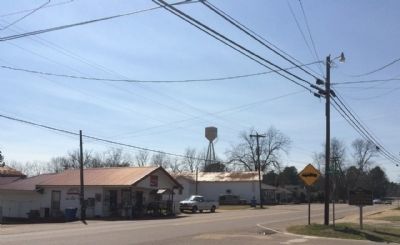
On Lee Street (State Road 10) at North Watts Avenue, on the right when traveling west on Lee Street.
Rutledge was the first county seat of Crenshaw County and held that position from March 1867 to May 1893. Originally called Barber’s Cross Roads, it was briefly named Crenshaw; but June 10, 1867, it was changed to Rutledge in honor of Captain . . . — — Map (db m72053) HM
On Forest Avenue at West 9th Street, on the right when traveling south on Forest Avenue.
In 1904, Alabama industrialist Frazier Michel
Douglass, Sr. hired a carpenter from Alexander
City, Alabama to build the Douglass House. The
house is a two-story Queen Anne Victorian and
might be the only home of this architectural type
in . . . — — Map (db m163677) HM
On West 3rd Street (Alabama Route 15) near Glenwood Avenue, on the right when traveling east.
Crenshaw County was established from five existing counties in 1866. The first courthouse and county seat were originally in Rutledge. The county seat moved to its present location after the 1893 election. The first courthouse at this location . . . — — Map (db m183474) HM
On Vortec Drive west of Woodford Avenue, on the right when traveling west.
Crenshaw County Training School (CCTS) was a predominantly Black school
built in 1931 near Brookwood Street in Luverne. The last class to
graduate from that location was in 1949 when the present building was
constructed on Hall Avenue. The new . . . — — Map (db m283915) HM
On Rutledge Street at St. Johns Street, on the right when traveling west on Rutledge Street.
In 1887, St. John Baptist Church was established under a brush arbor in
east Luverne. The congregation relocated to its present location when
George Foreman, a white resident, donated property to the church in 1893.
Years later, in 1937, a . . . — — Map (db m283917) HM
On Glenwood Avenue at East 4th Street, on the right when traveling north on Glenwood Avenue.
In the late 1800s, Benjamin R. Bricken,
Crenshaw County's first attorney-at-law, built
the Bricken Building, a landmark in the field
of law in this county. Between 1893 and 1933,
the Bricken Law Firm occupied the building
Then, Ben H. Lightfoot . . . — — Map (db m163730) HM
Thin black lines indicate changes in relevance. Between each pair of lines entries are ordered geographically but all have the same relevance.
* Inflectional forms of words are their plurals, singulars, and possessives as well as gramatical tenses and similar variations.