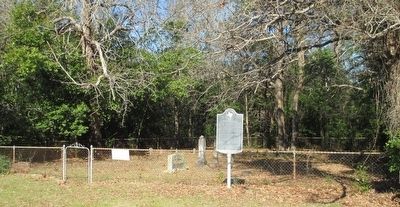
On Pine Springs Road (County Route 334) 0.2 miles south of Fielder Road (County Route 330), on the right when traveling south.
Members of the Peter Shamburger family came to this area of Texas from Mississippi in 1847. Peter and his family lived near Starrville. His son, Mathew, married Julia Ann Shockley in 1849 and settled in the Fruit community (later renamed Pine . . . — — Map (db m92264) HM
Here at Doaksville, June 23, 1865, Brigadier General Stand Watie, Cherokee Indian, was the last Confederate General to surrender. — — Map (db m151958) HM
On U.S. 271 near Loop State Highway 323, on the right when traveling north.
The issues of African Americans in the military became a keystone of controversy involving the politics of prisoner
of war exchange. This issue did not start in the east, but in the theater of the Mississippi river, and Camp Ford
became a . . . — — Map (db m60186) HM
On U.S. 271 at Loop State Highway 323, on the right when traveling north on U.S. 271.
On this site during the Civil War was located Camp Ford the largest prisoner of war compound for Union troops west of Mississippi river named in honor of Col. John S. "Rip" Ford who originally established a training camp here in 1862. It was . . . — — Map (db m26916) HM
On U.S. 271 near Loop State Highway 323, on the right when traveling north.
During the winter of 1863-64 the camp housed only about 170 prisoners, mostly officers. Life was generally
pleasant and the men were well treated. Prison crafts and endeavors flourished. Fairly substantial log cabins were
erected. Streets . . . — — Map (db m60203) HM
On U.S. 271 near Loop State Highway 323, on the right when traveling north.
In March 1862, the movement of the Confederate army in Northern Arkansas to the Mississippi River left the northern frontier of the Trans-Mississippi virtually defenseless. Immediate efforts in Texas were made to raise new regiments for service . . . — — Map (db m60180) HM
On U.S. 271 near Loop State Highway 323, on the right when traveling north.
Camp Ford had the distinction of having the most naval prisoners of any camp, North or South. There was no coordination between the branches, with each responsible for arranging the exchange of their men. By the fall of 1864, the naval prisoners, . . . — — Map (db m60184) HM
On U.S. 271 near Loop State Highway 323, on the right when traveling north.
The initial guards at the camp were local militia commanded by a regular officer, Captain S.M. Warner. With the
arrival of the Fordoche prisoners in October 1863, their numbers were inadequate, and an independent Cavalry
company, the . . . — — Map (db m60197) HM
The initial prisoners to arrive at Camp Ford were kept in the open with no stockade. Panic resulted with the arrival with over 600 prisoners October 23, 1863. The Camp Commander, Col. R.T.P. Allen, with only 40 guards, discovered a plot among the . . . — — Map (db m59725) HM
On North Bois d'Arc Avenue north of West Wilson Street, on the left when traveling north.
(front)
School named for Texas Confederate
Colonel Bryan Marsh
1833-1901
Alabama native, came to Tyler, 1854. 1861 was captain Co. C, 17th Texas Cavalry. In 1863 Confederate campaigns to prevent split of South along . . . — — Map (db m91362) HM
On North Broadway Avenue at West Erwin Street, on the right when traveling south on North Broadway Avenue.
(east face)
Smith County
C.S.A.
Major center of Confederate activity during Civil War. Many distinguished men and military units served south. The largest ordnance plant west of the Mississippi River manufactured "Tyler . . . — — Map (db m91380) HM
On Mississippi Route 13 0.1 miles east of County Road 141, on the left when traveling north.
(front)
Founded in 1972 as the Taylorsville Bluegrass Jamboree when ray Jones and other area pickers looked for a place to play together for their growing audience, this grass roots event soon became a spur and focal point for bluegrass . . . — — Map (db m178938) HM
This Monument Was erected by the liberality of the Citizens of the County of Sumner to the memory of her Patriotic Sons: who sacrificed their lives in the defense of the Flag of their country in the war with Mexico. In 1846. 1847 & 1848. . . . — — Map (db m85162) WM
Thin black lines indicate changes in relevance. Between each pair of lines entries are ordered geographically but all have the same relevance.
* Inflectional forms of words are their plurals, singulars, and possessives as well as gramatical tenses and similar variations.