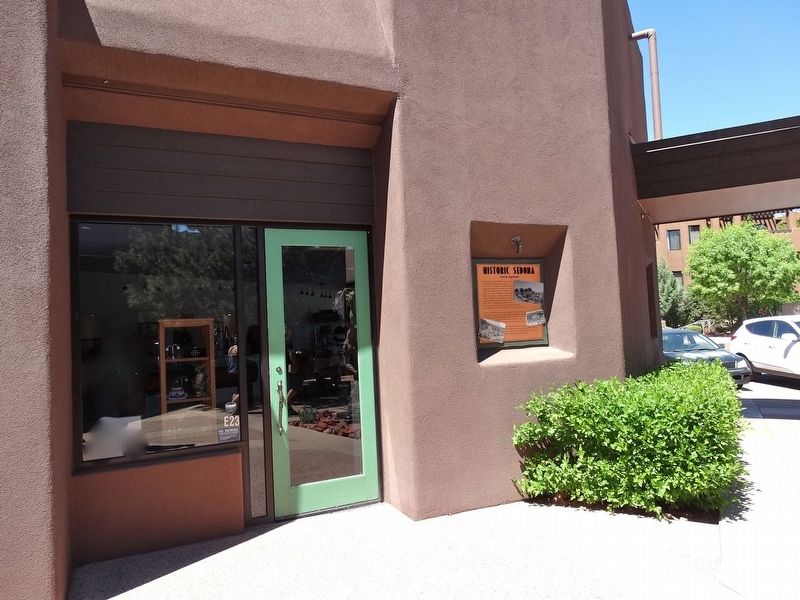
In early times. Uptown Sedona was a patchwork of orchards, homestead and pastures. In the late 1930s, the Jordan’s built a stone building along the highway from which to sell their fruit to the increasing traveler traffic coming down the newly . . . — — Map (db m133575) HM
By the time MGM came to Sedona to film “Stay Away Joe” in 1967, audiences had fallen in love with the Elvis Presley movie formula. This contemporary western comedy spotlighted Elvis and other such distinguished co-stars as Burgess . . . — — Map (db m133568) HM
The Pentecostal Church of Sedona met in 1932 to discuss affiliating with the Assemblies of God – it was June 1933 before the congregation was informed that they had been officially recognized by the General Council. In 1930 Pastor James . . . — — Map (db m133574) HM
The first Anglo settler in Sedona was John James Thompson in 1876. He had the advantage of finding an abandoned Yavapai garden, still bearing crops, hence the name "Indian Gardens" in Oak Creek Canyon. Three years later, the family of Abraham James . . . — — Map (db m133011) HM
It is said that the area now known as West Sedona was originally known as Copple Flat, named for B.F. Copple who was an early settler in Oak Creek Canyon. He arrived in 1875 but did not stay long. After he left the area, the flat became known for . . . — — Map (db m133005) HM
The original ‘heart’ of Sedona was the location of our first hotel, first post office, first school, first store, first church services, first patented homestead, and first institutional employer – the US Forest Service.
Near the town’s . . . — — Map (db m133517) HM
In California, conflicts between sheepherders and cattlemen were common. In a dispute, Jessie Jefferson Howard accidently killed a sheepherder. After turning himself in he was sent to San Quentin. Jessie was able to escape and came to Oak Creek . . . — — Map (db m133515) HM
His first time as producer John Wayne was to also star in the film “Angel and the Badman”. He had been to Sedona to film his 1944 movie “Tall in the Saddle”. The owner of the local film outfitter and catering company invited him back to Sedona to . . . — — Map (db m133680) HM
Little Horse Park, now called the Chapel area, was originally a mixture of private and US Forest Service property. Lee Piper homestead there and Otto Hallermund held the Forest Service-issued grazing permit for the area – part of the Sedona . . . — — Map (db m133690) HM
The first film shot in the Sedona area was Call of the Canyon, based on Zane Grey’s novel of the same name. This 1923 silent film was shot on location in Oak Creek Canyon near the site of Mayhew’s Lodge, and exposed the scenic wonders of the red . . . — — Map (db m133562) HM
Sedona’s earliest permanent settlers planted fruit trees as they arrived along Oak Creek. Apples and peaches seemed to grow well along with apricots and plums. Grapevines didn’t take as long to mature as fruit trees so the Schuerman’s planted grapes . . . — — Map (db m133679) HM
The Army's presence in Camp Verde contributed to settlement and roads in the Verde Valley area. A road came from Jerome to a stagecoach stop several miles south of town. West of the stop, a road crossed the creek and came into our area, not yet a . . . — — Map (db m133025) HM
In its' early days as a small, scattered and isolated settlement, Sedona had few emergency services.
In 1948 the Sedona School burned to the ground. This motivated the new Chamber of Commerce to start a "Firefight Fund". Sedona blacksmith and . . . — — Map (db m133032) HM
The Sedona Heritage Museum opened in 1998. It focuses on the history of the pioneer settlers of the greater Oak Creek area and those related historic themes that contributed to the settlement and development of Sedona.
The Museum is housed in the . . . — — Map (db m133693) HM
The Sedona Historical Society is a non-profit organization whose mission is to research, preserve and teach the history of the greater Sedona area. The Society plays an active and important role in local historic preservation and in displaying and . . . — — Map (db m133688) HM
By 1900, about 15 homesteading families called this area home. T.C. Schnebly was an enterprising young man who owned 80 acres, where his home also served as the area’s first hotel and general store. He saw a need for regular mail service, so . . . — — Map (db m133570) HM
The theme of arts and culture is a prominent one in Sedona for the period following World War II. Today, no city of its size in America has a finer arts pedigree than does Sedona. Home to both the Cowboy Artists of America and the Sedona Arts . . . — — Map (db m133573) HM
The Sedona area’s earliest schools were built and run by residents without government support. The first school was a one-room building at the Schuerman property on Red Rock Loop Road in 1892. Olive Welch was the teacher and there were seven . . . — — Map (db m133565) HM
This 43 acre parcel was originally homestead by Bill Fredericks, a local known for his "good whiskey." In 1924 he sold land to Earl Van Deren. Earl moved the north cabin from Sterling Canyon sometime between 1924 and 1929. Then in 1930 Van Deren . . . — — Map (db m132975) HM
Richard Wilson was an old bear hunter who lived at Indian Gardens. In 1885 he was killed by a large grizzly bear in what is now known as Wilson Canyon. — — Map (db m99272) HM
From 1857 to 1860 Lt. Edward F. Beale and a crew of 100 men built the first federal highway in the southwest. The 1857 Beale Expedition used 22 camels and dromedaries for pack animals. This road went from Fort Smith, Arkansas to Los Angeles, . . . — — Map (db m32206) HM
Juan Delgadillo built the now famous Snow Cap in Seligman, Arizona in 1953 out of scrap lumber. Home of the "Cheeseburger with cheese" and "Dead Chicken".
Get your Kicks on Route 66 in Arizona, learn more at www.historicaz66.com . . . — — Map (db m201770) HM
123 entries matched your criteria. Entries 101 through 123 are listed above. ⊲ Previous 100