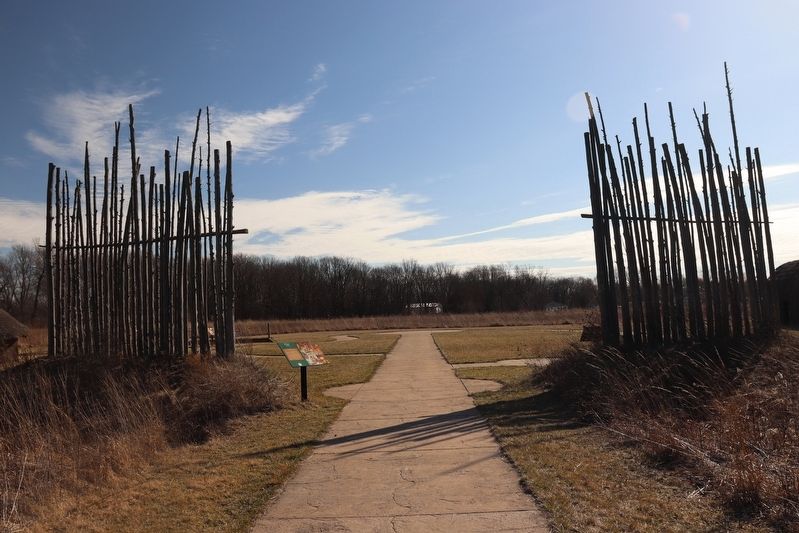
People from many interesting cultures made the area of Strawtown Koteewi Park their home. As you explore this exhibit you will see recreated structures from the Late Woodland time period. Although these structures are not exact replicas of the ones . . . — — Map (db m216792)
Welcome to the mock archaeological excavation.
Archaeology is one way we learn about the past life ways
of the people who once lived here. Archaeology is the
scientific study of man's material culture. Archaeologists
study artifacts and other . . . — — Map (db m163107) HM
We have uncovered multiple dwelling structures,
stockade walls, hearths, storage pits, middens
(trash pits), and thousands of artifacts. Many of the
material cultural items have long since decomposed,
but fragments remain.
Notice the . . . — — Map (db m163108) HM
We have recreated a large full-scale archaeological
excavation out of concrete. You can see the
stratigraphy in the levels of the soil by noticing the
different colors of the concrete. See if you can identify
these archaeological . . . — — Map (db m163109) HM
This stockade wall and ditch are representative of what was found at Strawtown Koteewi Park. The Oliver Village is often referred to as the Strawtown Enclosure because the village was "enclosed" by a stockade wall and ditch. The ditch was well . . . — — Map (db m216795)
Community buildings, as the name implies, belonged to the community and served a different purpose and were larger than a single family home. Community buildings could have served as the meeting place for discussing issues within the tribe. These . . . — — Map (db m216807)
Although much of the day-to-day living was done outside of the home, the family home played an important role in the lives of Strawtown's early Native American communities. The family resided in the home and many of their food items and personal . . . — — Map (db m216812)