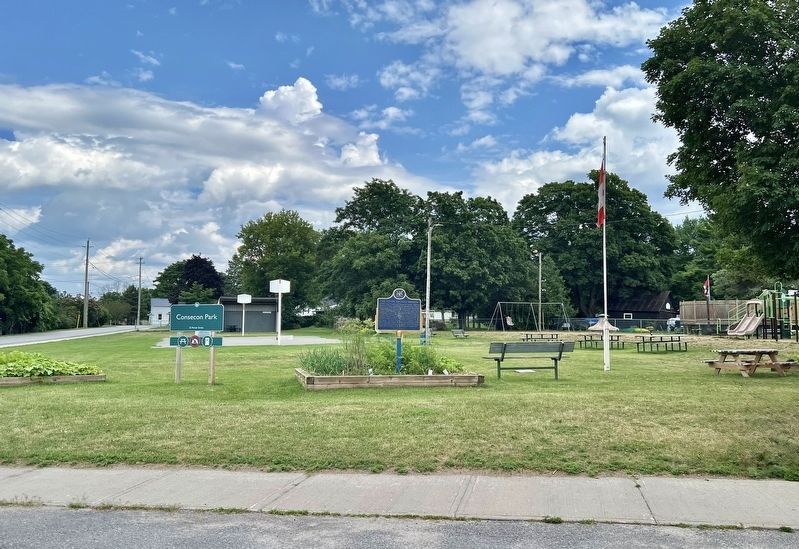
In 1668 Claude Trouvé and Francois de Fénelon, Sulpician priests from France, established this mission to serve Iroquois Indians on the north shore of Lake Ontario. Kenté, the Cayuga Village which had requested the missionaries, became the mission's . . . — — Map (db m307731) HM
The Cressy United Church dates to 1877, and is built of brick with a distinctive gothic character.
The highlight is the bracketed entrance tower and steeple, placed on a 45 degree angle to the nave. The arcaded windows are gothic in design, with . . . — — Map (db m308133) HM
Following the American Revolution, Marysburgh Township was established for the settlement of Loyalists and discharged soldiers of regular regiments. Surveyed in 1784 by the Honourable John Collins, Deputy Surveyor-General, the township was named in . . . — — Map (db m308161) HM
Rose House is one of the oldest remaining residences in North Marysburgh Township, originally known as "Fifth Town"- the fifth town to be settled west of Kingston.
The first Marysburgh settlers were United Empire Loyalists and Hessian . . . — — Map (db m308162) HM
This church, formerly known as the "Old Chapel, was built on land donated by Stephen Conger, a Loyalist from New Jersey, who had settled with his family in Hallowell Township in 1787. Commenced in 1809, it was the first Methodist church in Prince . . . — — Map (db m308019) HM
The Church of St. Mary Magdalene
Built C. 1825
Macauley House
Built C. 1830
The old Church of St. Mary Magdalene and its rectory were built by the Reverend William Macaulay on land he received as a crown grant.
When the . . . — — Map (db m308166) HM
In 1803 William Macauley, son of a United Empire Loyalist, received a crown grant of some 400 acres of land in this vicinity. Born in Kingston, Macauley was educated under the Rev. John Strachan and at Oxford University. Ordained in 1818, he used . . . — — Map (db m308169) HM
The Picton Armoury has a rich Canadian history. It is one of eleven drill halls built in rural Ontario between 1876 and 1918 as part of a campaign to expand the volunteer reservists who had been trained to defend our Country.
The Armoury was . . . — — Map (db m308018) HM
Built before 1839, this home, a fine example of Loyalist Neo-Classic architecture, was the main building of the West Lake Boarding School between 1841 and 1865. The first seminary in Canada of the Society of Friends this institution was opened as a . . . — — Map (db m307796) HM
Formerly Holy Trinity, it is now a library. A small stone country church, it is given architectural emphasis by its massive stone tower. Decoration is gothic, and of particular note is the octagonal
"Crown of Thorns" in place of the traditional . . . — — Map (db m307794) HM
From 1843-1967 this century old bell
echoed over the village of Consecon from the belfry atop the limestone school
Union School Section (U.S.S.) 17 & 19
Hillier and Ameliasburgh
which was situated on the hillier side
of the community . . . — — Map (db m307793) HM
Cast in Croydon, England by Gillett and Johnston in 1936
Commissioned by poet Wallace Havelock Robb (1888-1976)
Installed at his home Abbey Dawn near Kingston
Donated to Glenora United Church by his family in 1979
Moved to Cressy Glenora . . . — — Map (db m308131) HM
In June, 1846, the first bank in
Picton
was opened by the
Bank of Montreal.
This plaque commemorates that event and was
installed by the bank to observe its 150th anniversary,
in the centennial year of Canadian confederation.
This building . . . — — Map (db m307957) HM
John A. Macdonald (1815-1891), who became Canada's first prime minister at Confederation, began the study of law in 1830 under George Mackenzie, a prominent Kingston lawyer. Three years later he came to Hallowell (now Picton) to manage the law . . . — — Map (db m307970) HM
Born near Cobourg of Methodist parents, Letitia Youmans, née Creighton, was educated at local schools and at Burlington Ladies Academy. In 1849 she moved to Picton and taught briefly at a girls school. Deeply religious and believing that a . . . — — Map (db m307802) HM
The hotel occupies the most prominent spot in town, and was the site of very many early meetings and events in Picton's history. Built of brick in straight-forward American Loyalist house style, it is three stories high, with a shallow two storey . . . — — Map (db m307961) HM
In 1824, the first Methodist "Canada Conference," which resulted in the separation of the Canadian and U.S. churches, was held in a recently completed frame chapel that originally stood on this site. Built by a congregation that had been established . . . — — Map (db m307806) HM
County Registry Office Built 1871
Shire Hall Built 1874
Prior to the construction of the Shire Hall in 1874 the Prince Edward County Council met in the Court House on Union Street and the administration offices were in rented space . . . — — Map (db m307966) HM
On 2nd September 1939
The Hastings and Prince Edward Regiment
was mobilized for service overseas in the Second World War leaving from the Picton Armoury near this location.
The Regiment arrived in the United Kingdom on New Years Day 1940 as . . . — — Map (db m307973) HM WM
Originally designed in 1606, this flag was officially adopted in 1707 by England and Scotland as their royal standard at the time of the union of the thrones and parliaments of both countries. It consists of the blue background and white diagonal . . . — — Map (db m308128) HM
Born and brought up on this property, purchased by his grandfather Levi Roblin in 1821, Rodman Roblin moved to Fort Garry (Winnipeg) in 1877. Elected as an Independent member to the Manitoba legislature in 1888, he was defeated in 1892. Roblin was . . . — — Map (db m308020) HM