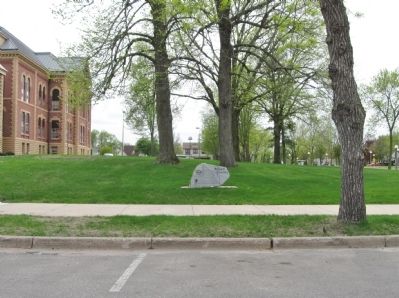
Brown County, an historic gateway on the Minnesota River, opened the fertile prairie lands of the Great Plains to the northern hardwoods of a continental divide. The U.S. Territorial Legislature organized the county in 1856 from lands ceded by . . . — — Map (db m66749) HM
The Sioux Indians called this lake "minne hanska," meaning "long water." The basin of the lake was formed 11,000 to 15,000 years ago by the Wisconsin glacier; the original hard clay bottom is now about 50 feet below the present surface of the . . . — — Map (db m66454) HM
Sleepy Eyes, or Drooping Eyelids, was born about 1780 in a Sisseton Sioux Indian village at Swan Lake in Nicollet County. The Bureau of Indian Affairs commissioned him a chief in 1824. His fame was achieved not as a warrior or hunter but as a . . . — — Map (db m67658) HM
In the 1850s there was a land boom in southern Minnesota. Jonathan Brown, 37 years old, filed on land along the Cottonwood River in what is now Burnstown Township. (S 1/2 of SW 1/4, Sec. 15; N 1/2 of NW 1/4 of Sec. 22)
Jonathan picked a good . . . — — Map (db m67820) HM
Colonel Wilhelm Pfaender (1826-1905), born in Heilbronn, Wurttemberg, Germany, came to America as a result of the 1848 Revolution. In Germany he helped found the Turner Societies in his birth-city of
Heilbronn and in Ulm. In Cincinnati, Ohio, he . . . — — Map (db m73673) HM
The Brown County Bank is among the oldest commercial properties within the district. As the local economy recovered from the devastating effects of the Dakota Conflict, the city found itself without a bank following the demise of the First . . . — — Map (db m66879) HM
In 1852, Joseph R. Brown founded the town of Henderson after a 32-year career as a soldier at frontier outposts, fur trader, experimental farmer, justice of the peace, speculator, lumberman, lobbyist and legislator, transportation agent and . . . — — Map (db m72373) HM
The second battle of New Ulm took place on August 23, 1862. About 650 Dakota Indians surrounded the town, while over 2,000 people were crowded behind a barricade. The attack began around nine in the morning and the Dakota Indians quickly encircled . . . — — Map (db m66402) HM
In 1851, leaders of the Dakota Nation signed the Treaty of Traverse des Sioux with the United States Government. This treaty opened new lands in Minnesota Territory for settlement. Two years later, German immigrants in Chicago, led by Frederick . . . — — Map (db m65452) HM
In the summer of 1851 the Dakota Indians, a group of Native Americans who lived in Southern Minnesota, sold their land, 35 million acres, to the United States for $3,000,000. The Dakota agreed to move to a reservation which included land ten miles . . . — — Map (db m67983) HM
Valentine Sommereisen was the first resident Catholic priest in three large areas of the American West: southwestern Minnesota, the Dakota Territory, and western Kansas. Born 28 May 1829 in Rouffach, Alsace, a German–speaking part of eastern . . . — — Map (db m74222) HM
In the summer of 1862, after years of broken treaty promises and late payments that fueled growing tensions and conflict, some Dakota began an attempt to forcibly reclaim their homeland. After attacking the Redwood (Lower Sioux) Agency . . . — — Map (db m67915) HM WM
The first news of the Sioux Uprising was brought to New Ulm at noon on August 18, 1862, by survivors of a Civil War recruiting party that had been ambushed in Milford Township. Barricades were hastily erected in a three-block area on Minnesota . . . — — Map (db m65402) HM
By the end of the fighting in New Ulm, the U.S.—Dakota War of 1862 had taken a heavy toll on the town. More than 50 settlers had been killed and 36 wounded, along with an unknown number of Dakota. In addition, at least 190 of the . . . — — Map (db m74136) HM
A Grand and Luxurious Home
This was the first house built of quarried granite in the Minnesota River valley during the 1860s. Most structures then were cabins or small wooden frame houses. Brick and stone structures had been built at . . . — — Map (db m226523) HM
This monument is erected by the State of Minnesota to commemorate the battles and incidents of the Sioux Indian War of 1862, which particularly relate to the town of New Ulm.
1890.
Honored be the memory of the citizens of Blue Earth, . . . — — Map (db m66990) HM WM
Frank Erd and his wife, Louise, came to New Ulm from Cincinnati. Frank, whose father was an architect, erected a substantial store, one of the few brick buildings in the city. The Brown County supervisors kept their offices in Erd's building, . . . — — Map (db m66897) HM
In 1899, the Iowa and Minnesota Land & Townsite Company circulated a petition to locate a railroad station in Lake Hanska Township. The petition was signed by 77 people and on October 9, 1899 the village of Hanska was platted in section 24 by Harry . . . — — Map (db m66468) HM
Following the outbreak of hostilities between the Dakota and white settlers on August 18, 1862, hundreds of people fled from nearby farms to New Ulm for safety. Quickly, Brown County Sherriff Charles Roos and Jacob Nix, a citizen with German . . . — — Map (db m73140) HM
To pay homage to the sturdy pioneers who founded the territory of Minnesota a century ago. And to express veneration for the pioneers of Brown County and members of their families who lost their lives during the Sioux War of 1862 — 1863. . . . — — Map (db m73642) HM WM
Searles, a small community in Section 21 of Cottonwood Township, was platted on October 10, 1899, by Harry and Anna Jenkins. It was a railroad station point named by officials of the Minneapolis and St. Louis Railroad.
The original plat . . . — — Map (db m67914) HM
Hagemeister Park was the home of the Packers from 1919, their inaugural season as a semipro team, through 1922, their second year in the NFL.
Before East High School and City Stadium were built, Hagemeister Park included the tract of land from . . . — — Map (db m120571) HM
Ole Synsteby was born in Lesja, Gulbrandsdalen, Norway. In the summer of 1873, the Synsteby family migrated to the Lake Hanska area. In 1879 Ole purchased the land which is now designated as Lake Hanska County Park.
The story of . . . — — Map (db m79934) HM
Christian Adam(s) was born circa 1812 in Prussia. He sailed from LeHavre, France aboard the ship Pactolus which arrived in New York City October 12, 1846. The passenger manifest listed his occupation as farmer.
Petronella Keller Adam(s) was . . . — — Map (db m73759) HM
During the Minnesota Sioux Uprising of 1862, eighteen men left New Ulm early on the morning of August 19, and travelled westward about 20 miles along the Big Cottonwood River to the area of Leavenworth. Searching for relatives and friends, they . . . — — Map (db m65486) HM WM
Thin black lines indicate changes in relevance. Between each pair of lines entries are ordered geographically but all have the same relevance.
* Inflectional forms of words are their plurals, singulars, and possessives as well as gramatical tenses and similar variations.