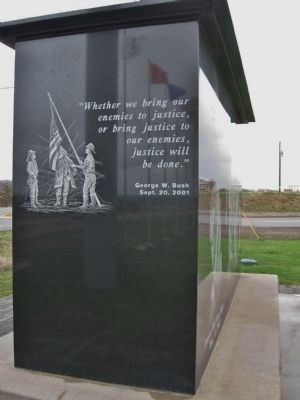
America Will Never Forget
Sept. 11, 2001 · Cadott, WI
Citizen Soldier
"Whether we bring our enemies to justice, or bring justice to our enemies, justice will be done."
George W. Bush
Sept. 20, 2001
. . . — — Map (db m43068) HM
Lansing A. Wilcox, last surviving Wisconsin veteran of the Civil War, was born in Kenosha March 3, 1846. In February 1864 he enlisted from Chippewa County in F Company, Fourth Wisconsin Cavalry, returning to the Cadott community in 1866. A farmer, . . . — — Map (db m30758) HM
The soldier bird who was captured in Chippewa County by Chief Sky and taken to Eau Claire by Daniel McCann of Eagle Point. With Company "C" of the Eighth Wisconsin Regiment, he participated in twenty-five battles of the Civil War and was afterwards . . . — — Map (db m38223) HM
Before there were numbered highways in the United States there were names attached to roads to help motorists navigate from town to town or from county to county. In 1912 no one thought in terms of an inter-state highway. However, a small band of . . . — — Map (db m42158) HM
Before there were numbered highways in the United States there were names attached to roads to help motorists navigate from town to town or from county to county. In 1912 no one thought in terms of an inter-state highway. However, a small band of . . . — — Map (db m42144) HM
This waiting shelter at the northern most point of service is the only physical structure remaining of what was once the 12½ mile long Eau Claire/Chippewa Falls interurban electric streetcar line.
In 1897, Boston financier Arthur Appleyard . . . — — Map (db m39822) HM
Millions of years ago the Midwest area of North America was covered by a great inland sea that laid down virgin white Cambrian sandstone. As the sea filled in, most of this sandstone became buried thousands of feet below the surface. The rim . . . — — Map (db m42326) HM
Built in 1871 by Alexander Wiley Sr. and Nels Elikson, the rooming house over the years was home for hundreds of immigrants, lumber jacks, mill workers, farm hands and log drivers (known as river pigs). In 1887 Wiley Sr. became the sole owner and . . . — — Map (db m42697) HM
The Bear Den Road Bridge was an example of a Pratt bridge construction, which was a design used in Wisconsin from 1895-1910. The Milwaukee Bridge and Iron Company fabricated the bridge, and it was moved to this site in 1940. The original site and . . . — — Map (db m43065) HM
The Irvine Park Drive Bridge was an example of a Pratt bridge construction, which was a design used in Wisconsin from 1895-1910. The Milwaukee Bridge and Iron Company fabricated the bridge in 1907. The structure originally crossed Duncan Creek on . . . — — Map (db m38734) HM
In 1880, Captain Ellery Clark of DePere, Wisconsin moved his hub and spoke factory to Cadott. Clark had been a steam boat operator moving logs on the Fox River. He was drawn to the Cadott area because of the high quality and abundant supply of white . . . — — Map (db m48931) HM
Hiram S. Allen was born in Chelsea, Vermont and came to the Chippewa Valley of Wisconsin in 1834. Here he began a long and flourishing career and an active business life. He built the first grist-mill, the first flour-mill, and the first hotel . . . — — Map (db m42343) HM
Chippewa Fall's oldest industry. In 1867, Jacob Leinenkugel, the son of a Bavarian brewmaster, came to Northern Wisconsin searching for a promising location to build a brewery. He settled on this spot purchasing the land from lumberman Hiram S. . . . — — Map (db m42360) HM
If this were summer 1856, you would be standing in Chippewa County. June 11 that year, the Chippewa County Board gave up this block for a Courthouse Square. So, when Governor Bashford signed the act carving Eau Claire County from Chippewa County on . . . — — Map (db m43485) HM
In September of 1873 James Monroe Bingham, a local attorney, State Assemblyman, and future lieutenant governor of the State of Wisconsin, purchased this land which had just been plotted as Block 14 of the Western Addition to the City of Chippewa . . . — — Map (db m42667) HM
This building was built in 1917 in memory of Edward Rutledge.
Mr. Rutledge was born in northern Ireland on March 6, 1834. As a child he moved with his parents to South Mountain, Ontario, Canada where they farmed. At age 16 Edward and his two . . . — — Map (db m39426) HM
In 1904 on this 25 acre site between the Chippewa River and the Soo Line Railroad tracks, sugar processing became a new industry in the Chippewa Valley. The Chippewa Sugar Company was incorporated and a huge six-story sugar beet factory was . . . — — Map (db m42693) HM
As early as 1846, Methodists were meeting in Chippewa Falls, with Thomas Randall preaching to his neighbors in a boarding house owned by the Chippewa Lumber and Boom Company. On March 10, 1860, Reverend Thomas Harwood, the first assigned . . . — — Map (db m42615) HM
In the early 1850's, settlers from Rhine, Bavaria, Bohemia, and Luxembourg came to this part of Wisconsin now known as Tilden Township. They vowed to build a church in honor of the "Blessed Virgin Mother of God" giving thanks for their safe voyage . . . — — Map (db m55397) HM
Logo text:
"Pokégnek Bodéwadmik" (Pokagon Band of Potawatomi)
New Buffalo was founded during an era of Indian removal from the region. Historically, the Potawatomi lands included millions of acres in Southern . . . — — Map (db m202624) HM
Thin black lines indicate changes in relevance. Between each pair of lines entries are ordered geographically but all have the same relevance.
* Inflectional forms of words are their plurals, singulars, and possessives as well as gramatical tenses and similar variations.