Tennessee native John McQueen Taylor came to Texas with his family in 1829 as a settler in the Empresario Grant of Lorenzo de Zavala. Taylor fought in the Anahuac disturbances of 1834 and later, as a soldier in the Texas army, he participated in . . . — — Map (db m23483) HM
Born in 1815 in Vermilion Parish, Louisiana, Peyton Bland became a vital figure in Orange County. He migrated to Texas as a young man and at Orange in 1835 enrolled to serve in the Texas Revolution. Bland participated in the Grass Fight and the . . . — — Map (db m304221) HM
A veteran of the War of 1812, Georgia native George Alexander Pattillo (1796-1871) migrated to this area in the early 1830s. He served on the local Committee of Correspondence created by the Convention of 1832 and on the General Council of the . . . — — Map (db m116654) HM
The Orange, Texas USA Rotary Club was admitted to Rotary International on 1 June 1919. Its first President was H.J.L. Stark. Mr. Stark, together with other influential members of the City of Orange, believed that the community would benefit from . . . — — Map (db m116336) HM
Sabine County, one of the original 23 Texas counties, is on the eastern border of Texas. It is bound by and named for the Sabine River, which separates the state from Louisiana. Originally, the Ais tribe of the Caddo Indians lived in the area. By . . . — — Map (db m107165) HM
A native of Louisiana, Elisha Allen moved with his parents in 1827 to what is now Orange County. When the Texas Revolution began, Allen joined the army and fought at the Siege of Bexar, Dec. 5-6, 1835. He explored the Texas frontier with a survey . . . — — Map (db m3208) HM
The first known settlers in what is now the City of Orange were John and Elizabeth Harmon, who arrived in 1828 with their three children. Known first as Green's Bluff, the small farming community that developed along a bend in the Sabine River was . . . — — Map (db m129621) HM
Louisiana native Jacob H. Garner, son of Bradley and Sarah Harmon Garner, settled in Jefferson, a village on Cow Bayou in present-day Orange County, Texas, in 1825. In 1835 he took part in the Grass Fight and Siege of Bexar while serving one of two . . . — — Map (db m273319) HM
Patriarch of the Orange County Stark family, John T. Stark was born in Pebble [sic - Preble] County, Ohio, in 1821 and moved to East Texas in 1840. He settled in Newton County in the 1850s where he read law and ran a mercantile store. In 1861 . . . — — Map (db m141306) HM
During World War II, over 50,000 German prisoners of war were interned in over 70 Texas P. O. W. camps. Base camps were established at military bases throughout the state. The base camps operated a number of branch camps in their respective areas. . . . — — Map (db m172281) HM
Born in Franklin County, Tennessee, Claiborne West moved as a young man to Louisiana. He married Anna Garner in 1824 and they had nine children. His family immigrated to this area in 1825 and received a land grant in the Cow Bayou settlement. . . . — — Map (db m190730) HM
1 • Mount Vernon Red Maple Planted in honor of the Founders of the City of Sanford, Florida on February 10, 1992. This red maple has been grown from seeds collected at Mount Vernon, President George Washington's beloved home on the . . . — — Map (db m214875) HM
The cabooses were built by the International Railway Car Company for the Norfolk & Western Railroad. Each weighs 54,000 pounds and went into service in 1969 (Red), 1970 (Green), and 1976 (Yellow). The three different heralds painted on the sides . . . — — Map (db m110803) HM
A native of North Carolina, Hugh Ochiltree migrated to Texas in 1840. Settling first in Nacogdoches, he studied law in the office of his cousin William Beck Ochiltree, who became a prominent Justice and Texas statesman. In 1843 he moved to San . . . — — Map (db m116641) HM
Shortly after the voters of Orange County and Texas approved secession in 1861, three military companies were raised in the county for Confederate service-- The Orange Light Guard, The Orange Greys, and Hannah's Company. Additional forces, . . . — — Map (db m116191) HM
The Winfree community originated in 1831 as a ranch of the early Texas settler Abraham Winfree. By 1914, the area had grown in population and the scattered rural churches were not adequate for the farming families of the area. After purchasing the . . . — — Map (db m150337) HM
The history of Orange County is actually the story of utilization and development of the natural resources of this part of southeast Texas. For more than a century and a half, lumber, agriculture, shipbuilding, oil, and finally chemically related . . . — — Map (db m116339) HM
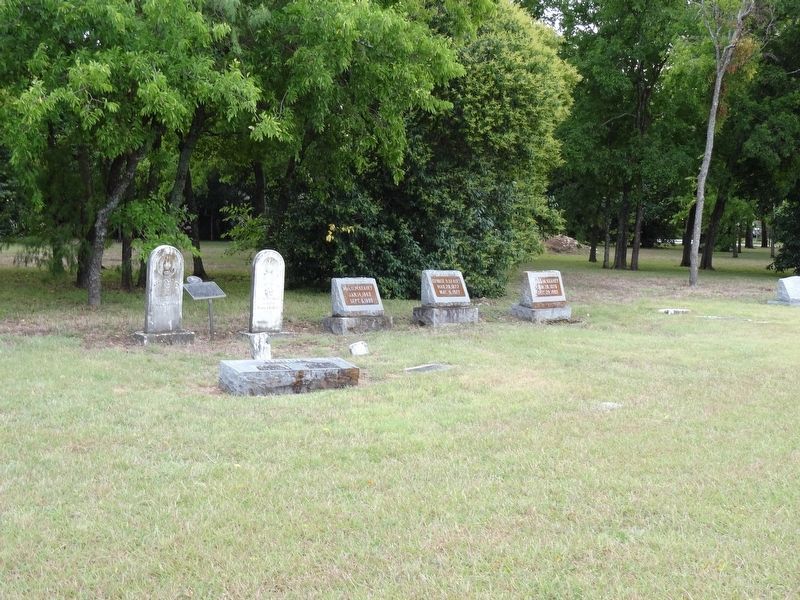
This cemetery lies within the Mexican Land Grant acquired by Thomas J. Chambers in 1834. Chambers died in 1865 and in 1867 his widow, Abbey, sold 3,000 acres containing this site to H.N. Duble at an estate sale held in Galveston. A portion of the . . . — — Map (db m183752) HM
Two in a long line of physicians in their family, William and David Caldwell Hewson were significant figures in Orange County. William was born in Philadelphia in 1801. in 1821, he married Mary Ann Bankson and they moved their family several times . . . — — Map (db m116876) HM
Old First Orange Baptist Church was organized on September 20, 1857, and is the earliest known religious establishment in Orange County. Charter members were Mr. and Mrs. Hollingsworth, Mr. and Mrs. Harvey Finch, Mr. and Mrs. Fietus Finch, Josh . . . — — Map (db m172276) HM
West End Park, a baseball field with wooden grandstands, was an institution in Orange for nearly 80 years. The park was originally constructed to draw a professional baseball team to the city for spring training. Orange was the center of Orange . . . — — Map (db m292112) HM
During the first 18 months of the Civil War, President Abraham Lincoln chose not to act upon recommendations of Frederick Douglass, and others, to enlist Black men in the Union Army in the fight against the Confederacy. After the much-needed Union . . . — — Map (db m314862) HM
At 11:20 a.m. on March 31, 1972, a 306th Bombardment Wing B-52D Stratofortress bomber stationed at nearby McCoy Air Force Base (now Orlando International Airport) crashed on this site. The plane, which was not carrying any weapons, had left McCoy . . . — — Map (db m223557) HM
Lynching of July Perry
November 3, 1920
On Election Day, November 3, 1920, black residents in the Ocoee area who owned land and businesses were eager to vote. Despite a terrorizing Ku Klux Klan march through the streets of . . . — — Map (db m137336) HM
Aaron Jernigan moved to what is now Orlando in 1843 after the passage of the Armed Occupation Act of 1842 that opened vast areas of Florida for settlement. According to the law, one could move onto land at least two miles from an established . . . — — Map (db m217596) HM
"No, boys, hold your fire until they come right up. Then pour a volley into them, and if they don't stop run your bayonets into their bellies." Brig. Gen. Henry L. Benning, C.S.A. Benning's Brigade, Hood's Division The fate of Devil's Den (located . . . — — Map (db m13321) HM
Thin black lines indicate changes in relevance. Between each pair of lines entries are ordered geographically but all have the same relevance.
* Inflectional forms of words are their plurals, singulars, and possessives as well as gramatical tenses and similar variations.