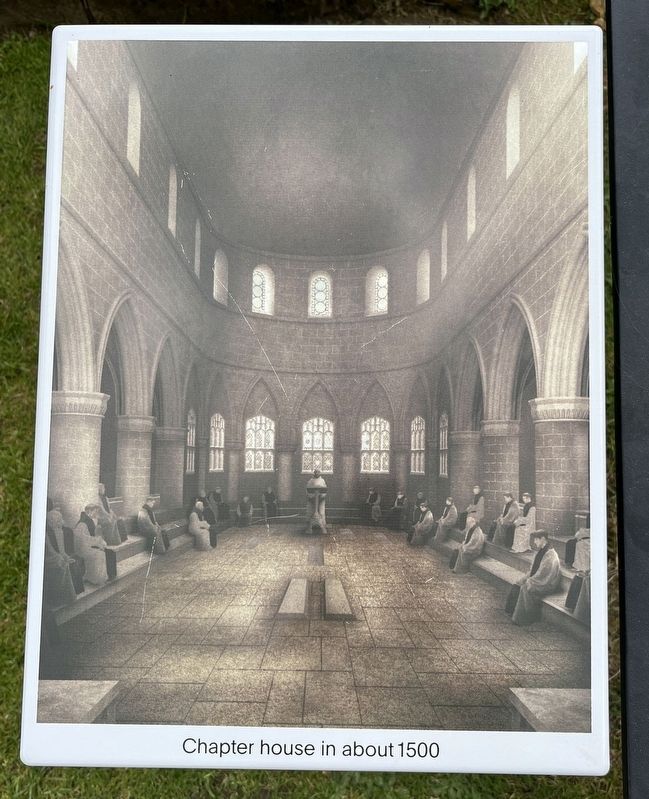
The chapter house was where the monks gathered for their daily meeting. They began by listening to a reading of a chapter from the Rule of St Benedict. The monks also confessed their faults, discussed business and received distinguished visitors . . . — — Map (db m278846) HM
Abbot Aelred described the cloister at Rievaulx as a paradise. It was at the heart of the monastery, linking its most important buildings.
Access to the cloister was restricted and monks were expected to be silent when here. It was therefore an . . . — — Map (db m278570) HM
The church served two separate communities. The Latin-literate choir monks, who sang eight daily services, used the eastern part. The largely illiterate lay brothers, who had much simpler services and served God with their labour, used the western . . . — — Map (db m278568) HM
Most drainage through the abbey was channelled to the Great Drain, directly in front of you. Water was held back by a sluice gate that, when released, flushed all waste into the River Rye downstream. It is a tribute to the technological knowhow of . . . — — Map (db m278564) HM
This was the holiest part of the abbey. The monks gathered here eight times a day for their services. The footings of their choir stalls can be seen close to where you are standing.
Mass was celebrated daily at the high altar, which has been . . . — — Map (db m277593) HM
Sick and elderly monks were cared for in the infirmary, which was built in the late 1150s when Aelred was abbot. Aelred suffered from serious illness in the later years of his life. This meant that he could no longer sleep in the monks' dormitory, . . . — — Map (db m278847) HM
'High hills surround the valley, encircling it like a crown. These are clothed by trees of various sorts and maintain in pleasant retreats the privacy of the vale!' (Walter Daniel, 1167)
This 12th-century description of Rievaulx could have been . . . — — Map (db m278567) HM
It was here that the monks gathered to eat. They ate in silence while listening to a reading delivered from the pulpit, the large recess in the wall to your right.
The community sat around the edges of the room at tables supported by stone . . . — — Map (db m315242) HM
Water was collected from the roofs and stored in tanks or cisterns, ensuring a supply of water even during the driest periods. Lightly-used water was recycled for washing, laundry and industry. Aelred, abbot of Rievaulx in the 12th century, . . . — — Map (db m278845) HM
Abbot William and 12 monks of the reforming and austere Cistercian Order founded Rievaulx Abbey in 1132. The Cistercians wanted to return to the basic principles of monasticism, following a daily routine of church services, reading and manual work. . . . — — Map (db m277592) HM
Water was an essential part of daily worship for the monks. Holy water, which was blessed by leaders of the community, was used for ritual cleansing of the body, soul, and vessels used in worship. Special basins held holy water in the church. Water . . . — — Map (db m278569) HM