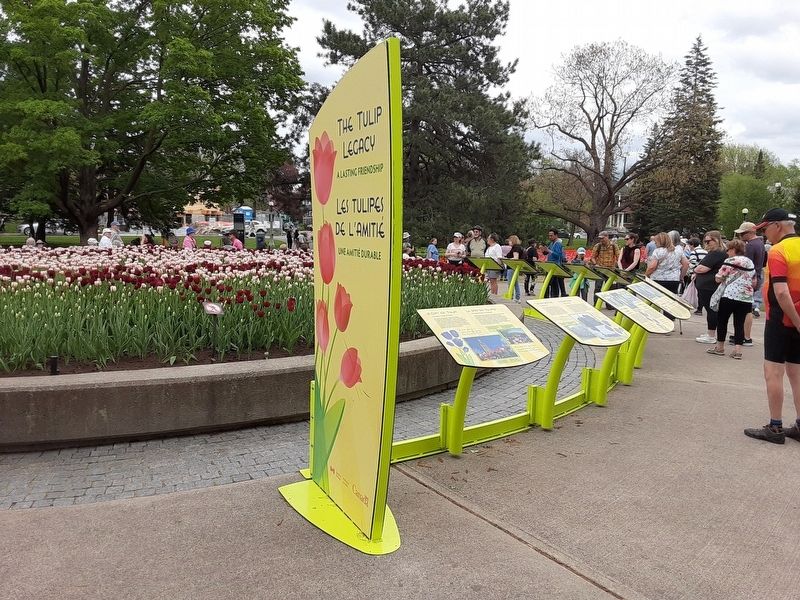
Canadian Tulip Festival, Ottawa Historical Markers
Twelve markers placed at Dow's Lake by the Canadian government to honor the history of the Canadian Tulip Festival, which began as a generous post-World War II gift by Queen Juliana and the People of the Netherlands for providing refuge for the royal family, celebrating the 1943 birth of Princess Margriet in Ottawa Civic Hospital, and the 1945 Liberation of the nation in which Canadian military forces had a major role. Since then, the annual gift of tulips bulbs has ensured that spring in Ottawa is a time not to be missed. This series includes other markers across Canada that celebrate the gift of Dutch tulips in honoring Canada's role in World War II Europe.
Canada was a refuge for Princess Juliana during the
Second World War. She arrived in June 1940 with her
two children, Princesses Beatrix and Irene. The family
rented a house in Rockcliffe Park, attended by a small
household staff. Juliana's . . . — — Map (db m274130) HM
By the "Hunger Winter" of 1944-1945, food rations
were so slim that people were eating tulip bulbs and
potato peelings. With the threat of 3.5 million people
dying of starvation, Canadian forces negotiated a truce
to deliver food relief in . . . — — Map (db m274221) HM
Look around you. You can see that many of the beds are
planted in large blocks of colour. In the 1950s, when the
car was king, the NCC pioneered a new style of massed
plantings best viewed from the comfort of a passing
automobile. Today, many . . . — — Map (db m274279) HM
The tulip has become the symbol of friendship
between the Netherlands and Canada. It celebrates
Canada's dual role as liberator of the country and safe
haven for Princess Juliana during the Second World War.
In thanks, Princess Juliana gave . . . — — Map (db m274122) HM
Every year, the National Capital Commission (NCC)
plants thousands of bulbs in tulip beds throughout
Canada's Capital Region. Different varieties are selected -
for colour, shape, height, texture and symbolic significance
-and planted in the . . . — — Map (db m274271) HM
Princess Margriet has returned to Ottawa numerous
times. On her first trip, she visited the Ottawa Civic
Hospital, where she talked to nurses who attended
her birth. The Princess has also unveiled plaques and
monuments, and been a guest of . . . — — Map (db m274224) HM
Princess Juliana travelled extensively as a representative
of the Netherlands, encouraging support for the war.
In Canada, she hosted foreign dignitaries at her home,
and visited the Royal Netherlands Army, stationed in
Stratford, Ontario. . . . — — Map (db m274136) HM
The Armenian-born photographer had a
great love for both Canada and tulips, and
sought to re-create scenes that reflected
their beauty. On Parliament Hill in 1946,
Malak photographed the first blooms sent
by Princess Juliana. In 1951, he . . . — — Map (db m274225) HM
Princess Margriet was born on January 19, 1943, at the
Ottawa Civic Hospital. Her name means "daisy," a flower
that symbolized hope and resistance in the Netherlands
during the war. In order for the baby to be born with full
Dutch . . . — — Map (db m274143) HM
Canadians did their part at home, as well as abroad
during the Second World War. The Queen Wilhelmina
Fund collected donations for the Dutch by advertising
through posters and pamphlets. Small pieces of
jewellery, such as pins made from Dutch . . . — — Map (db m274140) HM
Princess Margriet's baptism, on June 29, 1943, was a joyful
occasion. That morning, Princess Juliana had picked a large
spray of marguerite daisies, which decorated the high pulpit
in the church. The congregation included important . . . — — Map (db m274211) HM
After Nazi Germany invaded the Netherlands on
May 10, 1940, the Dutch faced a brutal occupation.
Young men, Jews and other vulnerable people went into
hiding for months and even years. Those caught by the
Nazis were imprisoned and deported to . . . — — Map (db m274126) HM
Liberating the Netherlands Canadian forces were tasked with liberating the Netherlands from Nazi occupation. For the first time in history, two Canadian army corps were fighting together and with more than 450,000 men the First Canadians became . . . — — Map (db m274973) HM