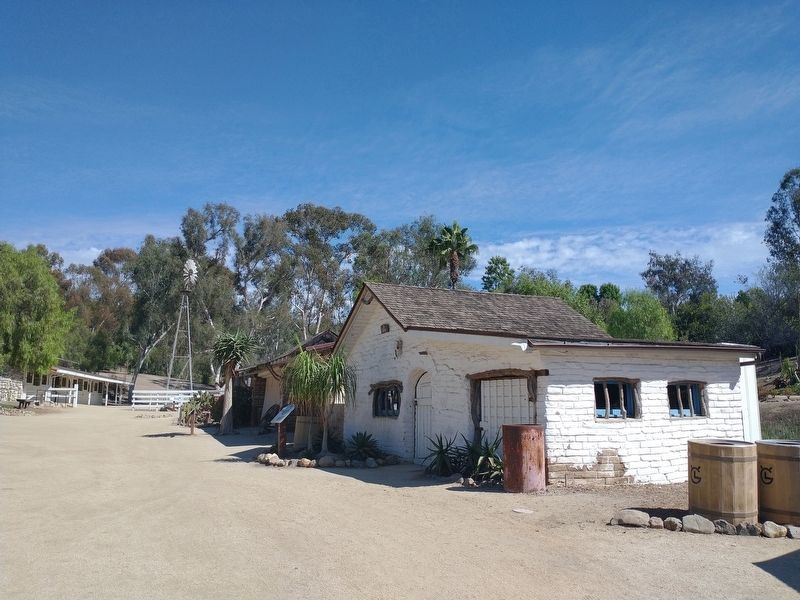
Leo Carrillo Ranch Historic Park Historical Markers
In 1976, the city of Carlsbad initially acquired 10.5 acres of the ranch and added an additional 16.4 acres to create the 27 acre Leo Carrillo Ranch Historic Park.
Leo Carrillo, a famous actor during the golden era of Hollywood, purchased land in 1937 in Carlsbad, CA and built a ranch that was inspired by the historic ranchos of the early Californio era. He named his ranch “Rancho de los Quiotes” or “Ranch of the Spanish Daggers” after the spiky yucca plants native to the area.
La Cantina
Leo’s Rancho de Los Quiotes was more than an imagined movie set. It was a 1,750-acre working ranch with cattle and horses. The Carrillos raised turkeys, chickens, peafowl, food crops and fruit orchards. Who did all this work? The . . . — — Map (db m312242) HM
Deedie’s House
Leo dedicated a building in 1940 for his wife, Deedie, to enjoy as an artist retreat. They called it the Indian House, or Deedie’s House. See how this structure is in the Pueblo style? The Mendozas, New Mexico-based adobe . . . — — Map (db m312260) HM
The Foundry
This was a noisy place when the blacksmith was at work. Across the fields you could hear the banging and shaping of hot iron into customized door hinges, gates, horse shoes, cattle brands and light fixtures. The hissing sound of . . . — — Map (db m312236) HM
The Carriage House
Here in the Carriage House, not just any ranch vehicle was stored. This building sheltered Leo’s custom Town & Country convertible, carefully painted to represent his golden palomino, Conquistador. “It had a horn . . . — — Map (db m312244) HM
Checking In
Welcome to the Caretaker’s House. The ranch managers, who lived here with their families, greeted guests at the entrance to Rancho de Los Quiotes. They supervised ranch operations, cared for the property and ensured a . . . — — Map (db m312263) HM
Inspired by memories of peafowl wandering his uncle’s ranch, Leo Carrillo brought three pairs of peafowl to his ranch in 1937. Their descendants frequent the park today. Peafowl include the male peacock, the female peahen and baby peachicks. These . . . — — Map (db m312232) HM
Between 1937 and 1940, these adobe and wood buildings were built by actor Leo Carrillo as a retreat, working ranch, and tribute to old California culture and architecture. The Leo Carrillo Ranch, with its Flying "LC" brand, originally covered 2,538 . . . — — Map (db m51105) HM
Spanish Ancestry
Leo Carillo was a Los Angeles-born stage and screen actor. As a seventh-generation Californio, he was an ambassador of early California culture across the generations. Leo’s stewardship for Rancho de Los Quiotes, and . . . — — Map (db m312240) HM
In 1868 Matthew Kelly homesteaded 174.5 acres in this valley creating the Los Kiotas Ranch. In 1882 he built a second two story adobe home on this site. Nearly 60 years later, the four original walls of that house were preserved and incorporated . . . — — Map (db m312241) HM
Adobe Oasis
The estate is blessed with fertile earth, flowing water and plenty of sunshine. Here, Leo Carrillo could re-create a working ranch like the ones he knew as a child. “The adobe is my birthstone”, Leo wrote in reflection of his . . . — — Map (db m312239) HM
Leo’s Peeps
Crowing banty roosters welcomed the rising sun. There were many beaks and mouths to feed each morning. Life on the ranch was also about raising food. Leo’s daughter, Tony, loved to help her dad care for and feed the turkeys and . . . — — Map (db m312259) HM
Why the Ranch Name?
Up on the hillsides, a spiky native yucca plant grows. When the yucca blooms it sends a beautiful plume of petals high in the sky. Its slender, sharp leaves give the plant its sword-like shape and name: this is the Spanish . . . — — Map (db m312233) HM
Imagine hearing Leo driving his work truck in, and opening the big, creaking doors to toss down bales of hay for the neighing horses. The tri-level stable and its fenced corral are built naturally into the sloping hillside. The lower level included . . . — — Map (db m312238) HM
Meet the Luiseno
Imagine life here 10,000 years ago. The Luiseno people thrived on this land, living off the rich resources. They also traded with near and distant neighbors for special materials. When newcomers from Europe arrived by ship . . . — — Map (db m312267) HM
Country Road
The Carrillos and their guest entered Ranch of the Spanish Daggers form a back road in Carlsbad, known today as Palomar Airport Road. They motored over a wooden bridge and as they crested the hills, views of the ranch unfolded. . . . — — Map (db m312272) HM
Matthew Kelly Homestead
Leo Carrillo bought an abandoned two-story, wood paneled adobe in 1937. It had been the home of Isle of Man immigrant Matthew Kelly, who arrive here in 1868 to join his brother Robert. Robert was the majordomo, or . . . — — Map (db m312262) HM
Drip. Drop. Drink!
You are in the Batiquitos watershed, where water moves downstream to the ocean. This creek used to run regularly, until modern development altered its flow. In summer you can see water trickle from residential irrigation . . . — — Map (db m312268) HM
Water Above and Below
When Leo was shown the abandoned adobe house and land in 1937, he imagined the possibilities for a ranch of his dreams. He desired views to the ocean, but water was what he needed. A spring on the property delivered . . . — — Map (db m312246) HM