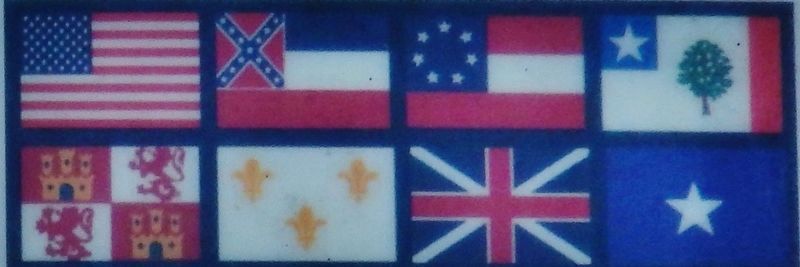
Jackson County has seen many governments. The first European settlement in the Mississippi gulf coast area was at present-day Ocean Springs in 1699. The French found the area already occupied by several American Indian tribes, with the primary . . . — — Map (db m117281) HM
On August 12, 1822, the year after the United States received possession of the Floridas, an Act of the Territorial Legislative Council divided West Florida into two counties -- Jackson and Escambia. At that time, Jackson County included all . . . — — Map (db m74194) HM
Near this site stood “Sylvania”, the plantation home of John Milton, Florida's Civil War governor, who settled in Jackson County in 1845. Milton's holdings consisted of over 2600 acres, a manor house, a school and family chapel, barns, . . . — — Map (db m74197) HM
In 1922, Robert T. Gilmore (1879-1948), born in Monticello, founded Gilmore Academy, one of Jackson County's first African-American high schools. Trustees of Marianna's African-American community purchased this three-acre site in 1907 and raised . . . — — Map (db m74191) HM
This two-story residence is one of Marianna's first great antebellum mansions, built by Francis R. Ely around 1840. The house was acquired in 1889 by Francis B. Carter, who later became Justice of the Supreme Court of Florida. In 1900 the house was . . . — — Map (db m67540) HM
Creek Town of the Spanish Era
Ekanachatte ("Red Ground") was an important Creek Indian town that stood here at Neal's Landing Park during the latter half of the 18th century and the first two decades of the 19th.
This site was known as . . . — — Map (db m201244) HM
Loftin’s Ferry, on Pitts Avenue, which later became Parker, was an important part of the major land route called the “Military Road” that ran from Apalachicola through St. Joseph to Marianna and beyond. This road, constructed from 1836 . . . — — Map (db m42114) HM
The Arthur G. Dozier School for Boys, also known as the Florida State Reform School, the Florida School for Boys, and the Florida Industrial School for Boys, was a reform school operated by the State of Florida, in Marianna, FL from January 1, 1900 . . . — — Map (db m280486) HM
Maple Hall served as the home of the African American journalist T. Thomas Fortune from 1901 to 1908. Born into slavery in 1856 and freed by the Emancipation Proclamation of 1863, Fortune rose to prominence during his more than twenty-year . . . — — Map (db m257902) HM
The house was built in the 1830's by John A. Syfrett. It is likely the oldest residence in Jackson County. It faces Fort Road, believed to have been routed by Andrew Jackson. In 1861, it became the home of Colonel John M.F. Erwin and his wife, . . . — — Map (db m67531) HM
The Abstract Office is the oldest business building in Marianna. Believed to have been built as his office in the 1840's by Dr. W.S. Wilson who died in 1868. Marianna's telephone exchange was established in 1801 and this building housed the Central . . . — — Map (db m74195) HM
Presbyterians first worshipped in Marianna, Florida in 1835. The First Presbyterian Church in Marianna was established by nine women and one man, Bryan Erwin, the first ruling elder. It is recorded that Mr. Erwin came to Jackson County from Scotland . . . — — Map (db m73942) HM
Front (East Side)
In memory of the
Confederate
Soldiers
of
Jackson County Florida
North Side
We care not whence they came,
Dear in their lifeless clay!
Whether unknown, or known to fame,
Their cause and country . . . — — Map (db m74209) WM
Thin black lines indicate changes in relevance. Between each pair of lines entries are ordered geographically but all have the same relevance.
* Inflectional forms of words are their plurals, singulars, and possessives as well as gramatical tenses and similar variations.