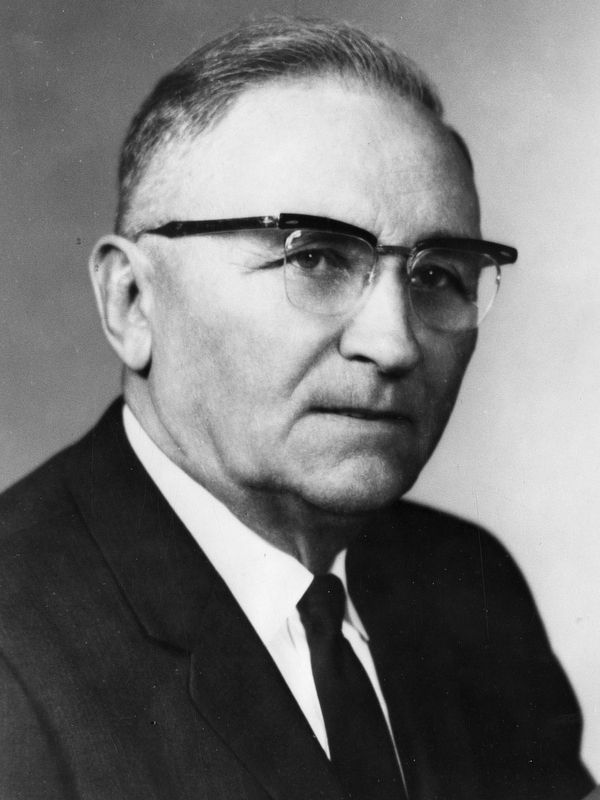
Born in 1894, Frank Zybach grew up in Loup Township, Platte County, Nebraska. He began inventing at age 13. In 1948, he developed a prototype of a self-propelled sprinkler irrigation machine. In 1952, the “Zybach Self-Propelled Sprinkling . . . — — Map (db m181698) HM
Due to the generosity of Mrs. Albert Gehner, Mr. Theodore Friedhof, and many other benefactors, this site has become a focal point of agricultural activity in Platte County.
The donation of this land, formerly known as the Browner Farm, and a . . . — — Map (db m122883) HM
In October 1934 Camp Platte was established near here by the Civilian Conservation Corps (CCC). The CCC was one of President Franklin D. Roosevelt’s New Deal programs designed to promote economic recovery during the Great Depression. Its goal was . . . — — Map (db m206955) HM
The Columbus Powerhouse is one of Nebraska’s largest hydroelectric generating plants and the pulse of the Loup River Public Power District hydroelectric system. The system was financed in 1933 by a $7.3 million New Deal Public Works Administration . . . — — Map (db m182100) HM
During the 1950s and 1960s Paul Zimmerer, working in his auto and farm equipment repair shop in Lindsay, Nebraska, invented a series of irrigation products that changed the landscape of Nebraska agriculture. One was the tractor-towed “Towline” that . . . — — Map (db m181350) HM
The site of the Nebraska House, a former hotel completed in 1857 and located in Brownville, Nebraska, was associated with an escape of three runaway slaves (freedom seekers) from Missouri who engaged in a bloody shootout with slave catchers. . . . — — Map (db m251893) HM
The New York Foundling Hospital received a request from Andrew and Anna Fangman in 1923. They were unable to have children of their own. They wished to adopt a baby boy with brown hair. A sweet, 9-month-old little boy arrived by train in the . . . — — Map (db m219209) HM
Near this site was located the historic town of Quindaro, founded in 1856 as a port-of-entry for free-soil immigrants into Kansas. The principal founder was Abelard Guthrie, who named the town for his Wyandotte Indian wife, Nancy Quindaro Brown. . . . — — Map (db m69458) HM
This 13-ton anchor is from the USS Platte (AO-186), the second U.S. Navy warship named after the Platte Rivers flowing through Iowa, Nebraska and Missouri, including Platte City. The first USS Platte (AO-24) served in three wars from 1939 to 1970 . . . — — Map (db m254872) HM WM
Edward Martin Nielsen
Edward Nielsen bought the Columbus Chevrolet franchise in 1926. Soon after, the dealership moved to the 13th Street site where it remained for the next 70 years. Nielsen Chevrolet-Buick was in business one day short of . . . — — Map (db m58748) HM
[Front]
Platte is one of 6 counties formed from the U.S. Government's 1836 Platte Purchase in which Iowa, Sac, Fox, and small bands of other Indian tribes gave up over 2 million acres of land for $7,500 and other benefits. The Purchase was . . . — — Map (db m66465) HM
Thin black lines indicate changes in relevance. Between each pair of lines entries are ordered geographically but all have the same relevance.
* Inflectional forms of words are their plurals, singulars, and possessives as well as gramatical tenses and similar variations.