
Hopewell, Virginia — The American South (Mid-Atlantic)
Welcome to the Hopewell Riverwalk
Photographed by Bernard Fisher, January 16, 2026
1. Welcome to the Hopewell Riverwalk Marker (panel 1)
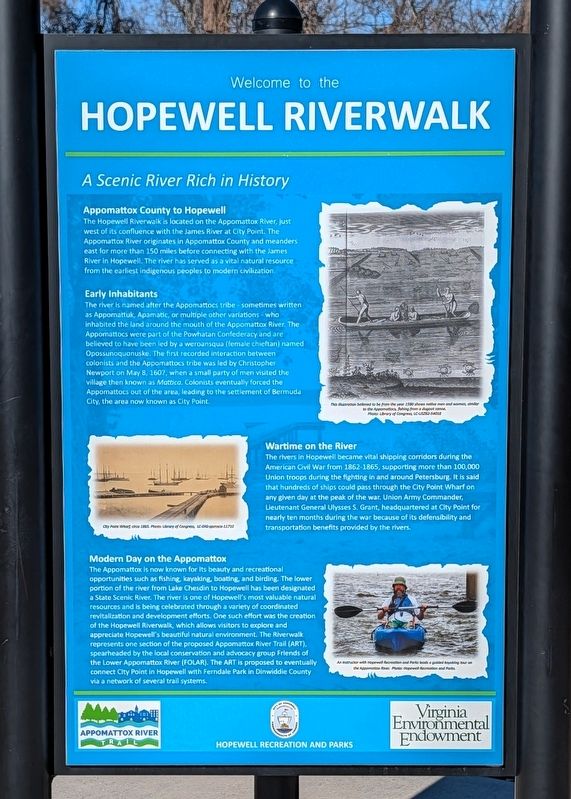
A Scenic River Rich in History
Appomattox County to Hopewell
The Hopewell Riverwalk is located on the Appomattox River, just west of its confluence with the James River at City Point. The Appomattox River originates in Appomattox County and meanders east for more than 150 miles before connecting with the James River in Hopewell. The river has served as a vital natural resource from the earliest indigenous peoples to modern civilization.
Early Inhabitants
The river is named after the Appomattocs tribe - sometimes written as Appomattuk, Apamatic, or multiple other variations - who inhabited the land around the mouth of the Appomattox River. The Appomattocs were part of the Powhatan Confederacy and are believed to have been led by a weroansqua (female chieftan) named Opossunoquonuske. The first recorded interaction between colonists and the Appomattocs tribe was led by Christopher Newport on May 8, 1607, when a small party of men visited the village then known as Mattica. Colonists eventually forced the Appomattocs out of the area, leading to the settlement of Bermuda City, the area now known as City Point.
Wartime on the River
The
this page online
Modern Day on the Appomattox
The Appomattox is now known for its beauty and recreational opportunities such as fishing, kayaking, boating, and birding. The lower portion of the river from Lake Chesdin to Hopewell has been designated a State Scenic River. The river is one of Hopewell's most valuable natural resources and is being celebrated through a variety of coordinated revitalization and development efforts. One such effort was the creation of the Hopewell Riverwalk, which allows visitors to explore and appreciate Hopewell's beautiful natural environment. The Riverwalk represents one section of the proposed Appomattox River Trail
Photographed by Bernard Fisher, January 16, 2026
2. Welcome to the Hopewell Riverwalk Marker (panel 2)
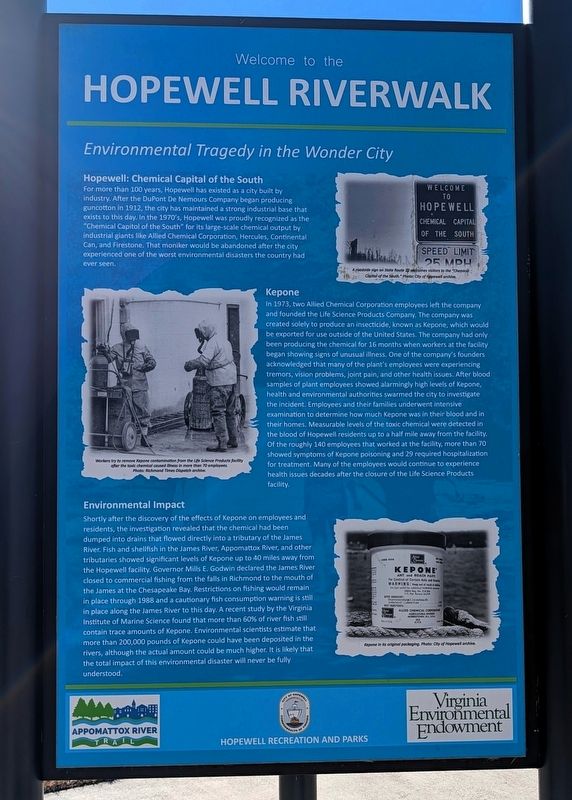
Environmental Tragedy in the Wonder City
Hopewell: Chemical Capital of the South
For more than 100 years, Hopewell has existed as a city built by industry. After the DuPont De Nemours Company began producing guncotton in 1912, the city has maintained a strong industrial base that exists to this day. In the 1970's, Hopewell was proudly recognized as the "Chemical Capitol of the South" for its large-scale chemical output by industrial giants like Allied Chemical Corporation, Hercules, Continental Can, and Firestone. That moniker would be abandoned after the city experienced one of the worst environmental disasters the country had ever seen.
Kepone In 1973, two Allied Chemical Corporation employees left the company and founded the Life Science Products Company. The company was created solely to produce an insecticide, known as Kepone, which would be exported for use outside
Photographed by Bernard Fisher, January 16, 2026
3. Welcome to the Hopewell Riverwalk Marker (panel 3)
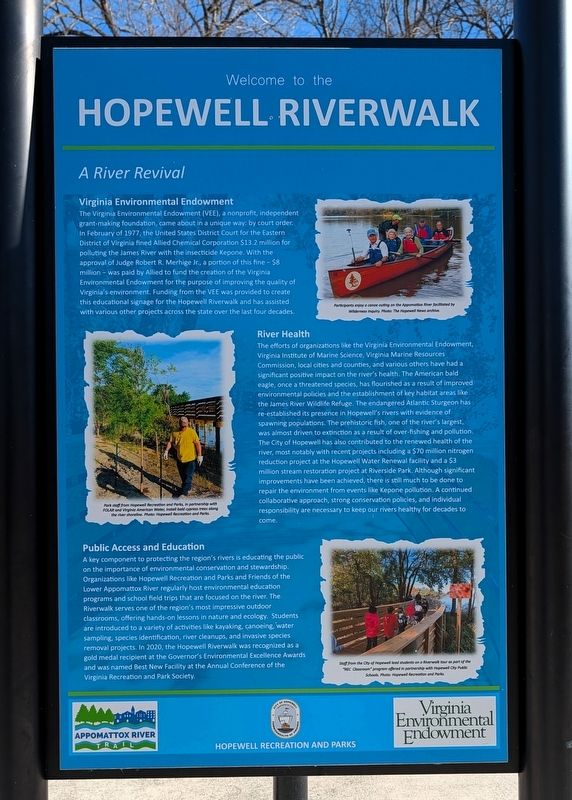
Environmental Impact
Shortly after the discovery of the effects of Kepone on employees and residents, the investigation revealed
Photographed by Bernard Fisher, January 16, 2026
4. Welcome to the Hopewell Riverwalk Marker
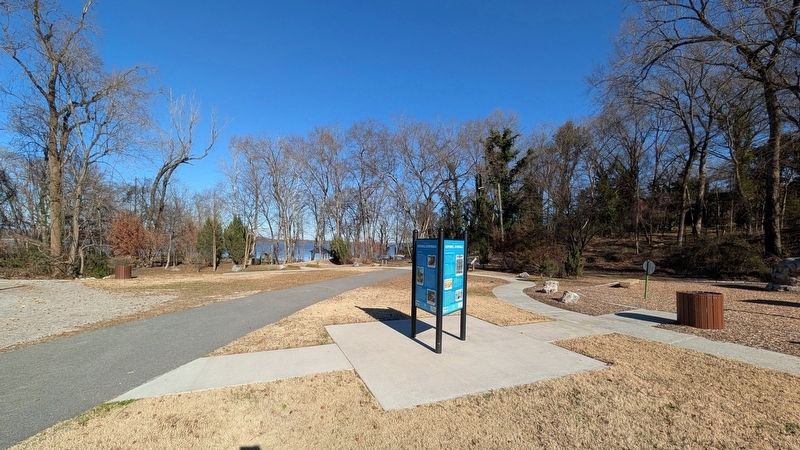
A River Revival
Virginia Environmental Endowment
The Virginia Environmental Endowment (VEE), a nonprofit, independent grant-making foundation, came about in a unique way: by court order. In February of 1977, the United States District Court for the Eastern District of Virginia fined Allied Chemical Corporation $13.2 million for polluting the James River with the insecticide Kepone. With the approval of Judge Robert R. Merhige Jr., a portion of this fine - $8 million - was paid by Allied to fund the creation of the Virginia Environmental Endowment for the purpose of improving the quality of Virginia's environment. Funding from the VEE was provided to create this educational signage for the Hopewell Riverwalk and has assisted with various other projects across the state over the last four decades.
River Health
The efforts of organizations like the Virginia Environmental Endowment, Virginia Institute of Marine Science, Virginia Marine Resources Commission, local cities and counties, and various others have had a significant positive impact on the river's health. The American bald eagle, once a threatened species, has flourished as a result of improved environmental policies and the establishment of key habitat areas like the James River Wildlife Refuge. The endangered Atlantic Sturgeon has re-established its presence in Hopewell's rivers with evidence of spawning populations. The prehistoric fish, one of the river's largest, was almost driven to extinction as a result of over-fishing and pollution. The City of Hopewell has also contributed to the renewed health of the river, most notably with recent projects including a $70 million nitrogen reduction project at the Hopewell Water Renewal facility and a $3 million stream restoration project at Riverside Park. Although significant improvements have been achieved, there is still much to be done to repair the environment from events like Kepone pollution. A continued collaborative approach, strong conservation policies, and individual responsibility are necessary to keep our rivers healthy for decades to come.
Public Access and Education
A key component to protecting the region's rivers is educating the public on the importance of environmental conservation and stewardship. Organizations like Hopewell Recreation and Parks and Friends of the Lower Appomattox River regularly host environmental education programs and school field trips that are focused on the river. The Riverwalk serves one of the region's most impressive outdoor classrooms, offering hands-on lessons in nature and ecology. Students are introduced to a variety of activities like kayaking, canoeing, water sampling, species identification, river cleanups, and invasive species removal projects. In 2020, the Hopewell Riverwalk was recognized as a gold medal recipient at the Governor's Environmental Excellence Awards and was named Best New Facility at the Annual Conference of the Virginia Recreation and Park Society.
Erected by Appomattox River Trail, Hopewell Recreation and Parks, Virginia Environmental Endowment.
Topics. This historical marker is listed in these topic lists: Colonial Era • Disasters • Environment • Indigenous Peoples and Communities • Industry & Commerce • Parks & Recreational Areas • War, US Civil • Waterways & Vessels. A significant historical date for this entry is May 8, 1607.
Location. 37° 18.445′ N, 77° 17.228′ W. Marker is in Hopewell, Virginia. It can be reached from Appomattox Street north of Library Street, on the left when traveling north. Touch for map. Marker is at or near this postal address: 205 Appomattox St, Hopewell VA 23860, United States of America. Touch for directions.

Regionally, this marker is in Central Virginia. It is also in the American South, specifically in the Upper South, and on the Eastern Seaboard. Globally, it is in the North Atlantic Region, North America, the Western Hemisphere, the Western World, and the Anglosphere. Historically, it finds itself in what was once the territory of the Mississippian Culture, one of the original Thirteen Colonies, one of the Confederate States of America, and the Antebellum South.
Other nearby markers. At least 8 other markers are within walking distance of this marker: Appomattox River (within shouting distance of this marker); Depot Field Hospital (approx. 0.2 miles away); Confederate Memorial (approx. 0.2 miles away); John Randolph (approx. 0.2 miles away); Dr. M. L. King, Jr. (approx. ¼ mile away); Peter Francisco (approx. ¼ mile away); "Captain Francis Eppes Making Friends with the Appomattox Indians" (approx. 0.3 miles away); Carter G. Woodson School / Hopewell Colored School (approx. 0.4 miles away). Touch for a list and map of all markers in Hopewell.
Credits. This page was last revised on January 17, 2026. It was originally submitted on January 17, 2026, by Bernard Fisher of Richmond, Virginia. This page has been viewed 60 times since then. Photos: 1, 2, 3, 4. submitted on January 17, 2026, by Bernard Fisher of Richmond, Virginia.
