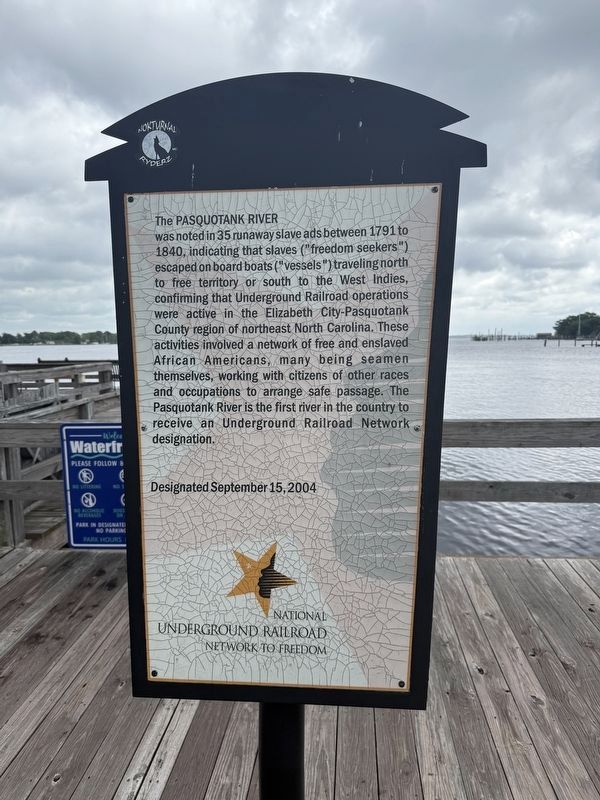
The Pasquotank River was noted in 35 runaway slave ads between 1791 to 1840, indicating that slaves (“freedom seekers”) escaped on board boats (“vessels”) traveling north to free territory or south to the West Indies, confirming that . . . — — Map (db m56811) HM
After the Battle of Elizabeth City and the destruction of the Confederate Mosquito Fleet in February 1862, the Confederates scuttled ships to block the North Carolina cut. The Federals had the same idea to stall Confederate traffic and sent five . . . — — Map (db m56979) HM
During the Civil War, neither the North nor the South was totally united over the key issues. Just as some Northerners supported slavery and secession, some Southerners were abolitionist and Unionists. These issues could split families, . . . — — Map (db m56770) HM
(side 1)
This monument honors
Patriots who assembled
at this site in the Cause of
American Freedom in 1775
American Patriots
at the Battle
Second Virginia Regiment
Commanded by
Colonel William Woodford,
of . . . — — Map (db m211239) HM
As we mark the occasion of the 100th anniversary of the women's right to vote, we honor our foremothers — the brave women suffragists around the United States who protested and picketed for their constitutional right to vote. The ratification of . . . — — Map (db m276339) HM
Federal judge whose writs of habeas corpus, 1870, prevented arbitrary arrest of N.C. citizens during Reconstruction. Home was ¼ mile east. — — Map (db m2772) HM