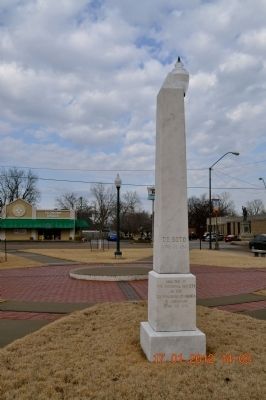
Phillips County lies in what is known as the Mississippi alluvial plain, also called The Delta. The earliest known inhabitants were native Indians, noted for building large earthen mounds for ceremonial purposes and to bury their chiefs.
By the . . . — — Map (db m51929) HM
In the first months of 1861 many Phillips County men joined militia companies supporting the Confederate cause. In February 1861, they marched on Little Rock to take the Federal arsenal. Most joined the Confederate army that spring.
A . . . — — Map (db m51979) HM
Quick to Volunteer
Between 1861 and 1865, several hundred men— one-third of
the able-bodied men in Phillips County — joined the
Confederate army. Most enlisted in the opening weeks of the
Civil War. The volunteers joined . . . — — Map (db m109136) HM
Fairground Transformed Fourteen-year-old Imogene Eakin watched with excitement as workmen labored at the fairground opposite her Cleburne Avenue home. They built guard towers, erected barbed-wire fence, and converted the exhibit hall into . . . — — Map (db m262800) HM
Seven men from Phillips County, all of them immigrants to Arkansas, became high ranking Confederate officers. They served with honor in the Army of the Tennessee and in the Trans-Mississippi, participating in many decisive battles and campaigns. . . . — — Map (db m51981) HM
The Lake View Community began in 1938 as a government resettlement project. It was one of three New Deal farm communities established for Arkansas' black farmers during the Great Depression.
Homesteaders were selected from 11 Arkansas . . . — — Map (db m299929) HM
In the 1850s Helena businessmen dreamed of a railroad connecting the city with Little Rock. They drew up plans, but powerbrokers diverted money from the Helena project to a line connecting Memphis and Little Rock. Arkansas's First Railroad . . . — — Map (db m262841) HM
Conditions in Civil War Helena were horrible. Overcrowding, poor sanitation, contaminated drinking water, and mosquitoes led to typhoid, dysentery, malaria and other diseases. Tents, churches, barns, abandoned houses and business buildings housed . . . — — Map (db m51978) HM
Frank Moore, a WWI veteran buried at Little Rock National Cemetery in 1932, moved to Phillips County, Arkansas, after being honorably discharged in December of 1918 from service as a private in the 162nd Depot Brigade, There he worked on a farm and . . . — — Map (db m210364) HM
The State of Arkansas is Dissolved
In 1867, the state of Arkansas ceased to exist. It was dissolved, as were all states still in rebellion when the Confederate government surrendered in 1865. Readmission to the Union required that the states . . . — — Map (db m51927) HM
This stone marks the base established Nov. 10, 1815
from which the lands of the Louisiana Purchase were surveyed by the United States Engineers. The first survey from this point was made to satisfy the claims of the soldiers of the War of 1812 . . . — — Map (db m6037) HM
Side 1
Born in Friar’s Point as Harold Lloyd Jenkins, son of a ferryboat captain, Conway Twitty (1933-1993) first achieved stardom as a bluesy rockabilly singer. Beginning in the 1970s, he became one of country’s bestselling balladeers ever, with . . . — — Map (db m170382) HM
Robert Nighthawk (1909-1967) was one of the foremost blues guitarists of his era. Although he rarely stayed long in one town, he called Friars Point home at various times from the 1920s to the 1960s. In a 1940 recording, he sang of “going back to . . . — — Map (db m160406) HM
The Confederate Memorial
In 1889, the Phillip County Memorial Association began raising funds to erect a grand memorial to honor all the Confederate dead.
The Association sent an appeal throughout the South and donations poured in. Not . . . — — Map (db m107834) HM
The election of Abraham Lincoln in 1860 broke the nation apart. In May 1861, Arkansas became the ninth state to join the new Confederate States of America.
The Union Army Occupies Helena
By the spring of 1861, most of the men in Helena . . . — — Map (db m229329) HM
The Mississippi River defines Helena
The Mississippi River has for centuries been the backbone of life in Helena; fertilizing its soil, supporting its farms and businesses, connecting people and cultures. Despite this rich history, there . . . — — Map (db m231812) HM
Jacob Trieber served as United States District Judge for the Eastern
District of Arkansas from 1901 to 1927. He was the first Jewish judge
ever to serve on the federal bench. Trieber was born in Prussia in
1853, immigrated with his parents to St. . . . — — Map (db m107824) HM
Patrick Cleburne found a home, friends and a profession in Helena.
When the Civil War began, he supported his adopted state, writing
to his brother, Richard, "I am with Arkansas in weal and woe."
— — Map (db m109144) HM
African Americans Exercise Their Rights
In the decades following the Civil War, former slaves in
Arkansas saw African Americans elected to local, state and
national offices. Henderson B. Robinson was elected . . . — — Map (db m107892) HM
While the vast majority of Helena's white population favored secession, there were also men and women loyal to the Union in Phillips County.
White Unionists Rally in Helena
Not only fugitive slaves, but white . . . — — Map (db m107991) HM
This sculpture, erected in 1927, is one of the best-known outdoor sculptures in the nation. Named Spirit of the American Doughboy, it depicts a World War I soldier attacking across the "no man's land" between the trenches. Created in 1920 . . . — — Map (db m107933) HM
With an astounding 55 number one hits to
his credit, Conway Twitty was a legendary
performer. Bụt while he is remembered
best as a country superstar, he started
his career and scored his first big hit as a
rockabilly singer. . . . — — Map (db m170389) HM
Guard, Garrison and Fatigue Duty
The United States Colored Troops (USCT) in Helena were part
of the Union garrison holding the city. Their duties were much
the same as those of white troops. Like all Union . . . — — Map (db m108015) HM
Thin black lines indicate changes in relevance. Between each pair of lines entries are ordered geographically but all have the same relevance.
* Inflectional forms of words are their plurals, singulars, and possessives as well as gramatical tenses and similar variations.