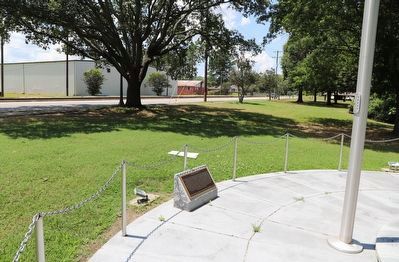
With a reputation as a "soldier's soldier" and as both warrior and peacemaker, Henry Hugh Shelton served as Chairman of the Joint Chiefs of Staff from 1997 to 2001. Born in Tarboro in 1942 and reared in the Speed Community of Edgecombe County, . . . — — Map (db m226919) HM WM
Near East 1st Street just east of Evans Street, on the left when traveling east.
Research conducted by the Department of Anthropology at East Carolina University has revealed that Native Americans inhabited locations along the Tar River from about 11,500 to 3000 years ago. Archaeologists have located over 20 sites along the . . . — — Map (db m276398) HM
On Woodhead Street at Harold Street, on the left when traveling north on Woodhead Street.
Obedience Smith was a pioneer of three American frontiers: Kentucky, Mississippi, and Texas. Newly widowed, she arrived in the Mexican state of Coahuila y Texas from Jackson, Mississippi just weeks before the Texas Declaration of Independence on . . . — — Map (db m269167) HM
On Mutual Boulevard (U.S. 258) west of South Main Street (Business U.S. 64), on the right.
During the Civil War, thousands of slaves escaped to U.S. Army lines, and more than thirty African Americans from Edgecombe County enlisted in the 35th, 36th, and 37th U.S. Colored Troops, 14th U.S. Colored Heavy Artillery, and U.S. Navy. After . . . — — Map (db m74138) HM
On East St. James Street at St. David Street, on the right when traveling east on East St. James Street.
Civil War soldiers and veterans are buried in Calvary Episcopal Churchyard and Old Town Cemetery. Among the fifty Confederates interred in the churchyard are Gen. William Dorsey Pender and Lt. Col. John L. Bridges. In May 1863, Pender led a . . . — — Map (db m45432) HM
On North Main Street (North Carolina Route 33) at St. Andrew Street, on the right when traveling north on North Main Street.
Built and operated by Dr. Milton Douglas Quigless, Sr., an African-American physician and surgeon, this hospital offered complete services, an operating room, and a medicine dispensary for outpatients. When desegregation became a national law, . . . — — Map (db m290868) HM
On West Water Street at Monroe Street, on the right when traveling west on West Water Street.
In its edition of August 27, 1851, the Plymouth Villager made a backhanded confirmation of the presence of abolitionists in Washington County, North Carolina. "A coat of tar and feathers is in waiting for the gentleman who will come about . . . — — Map (db m276306) HM
On South Main Street 0.1 miles south of Craven Street, on the right when traveling north.
Agricultural reformer, a founder of the State Fair, published and edited the "Farmer's Journal", 1852-53, in Bath. This was his home. — — Map (db m67567) HM
On Alternate U.S. 64 near Kingsboro Road (State Highway 1225), on the left when traveling east.
Confederate general. His brigade fought in last infantry action at Appomattox. Later Congressman; Secretary U.S. Senate. Home here. — — Map (db m44997) HM
On East Grand Avenue (State Highway 43) near Holly Street, on the left when traveling south.
A founder in 1908 of Alpha Kappa Alpha,
nation’s oldest sorority for African Americans;
history teacher. Her grave is ¼ mile east. — — Map (db m48677) HM
On West St. James Street near Main Street (U.S. 64), on the right when traveling east.
Confederate major general; graduate of U.S. Military Academy, 1854. Mortally wounded at Gettysburg, age 29. Grave is 4 blocks east. — — Map (db m44899) HM