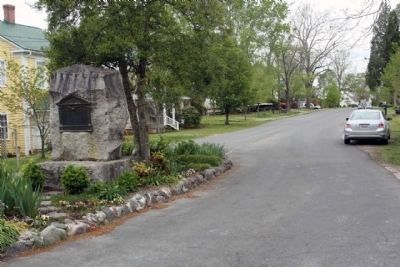
Bath, originally the Indian town of Pampticough, was settled by white men about 1690 and incorporated in 1705. It is the oldest town in North Carolina. Its first commissioners were John Lawson, Joel Martin, and Simon Alderson. Here was founded in . . . — — Map (db m64799) HM
Bath, the oldest incorporated town in North Carolina, was established in 1705. By the 1708 the town consisted of twelve houses and a population of fifty people. Among the early inhabitants were John Lawson, Surveyor General of the colony and . . . — — Map (db m67575) HM
[ Main Text: ]
This railroad station was built by Norfolk & Southern Railway in 1903 at a cost of $4,824. Its primary purpose was to serve the needs of lumber businesses, most notably the Interstate Cooperage. In the same year as the . . . — — Map (db m299661) HM
The Original Washington
The history of Washington began around 1585 when English explorers first visited the area that would become Washington. The easily navigable waters and excess of natural resources made the area a very successful port . . . — — Map (db m226611) HM
Bath, oldest town in North Carolina, was established in 1705. The first settlers were French Huguenots from Virginia. Among the early English inhabitants were John Lawson, author of the first history of Carolina (1709) and Christopher Gale, Chief . . . — — Map (db m67574) HM
After the Civil War, women’s associations throughout the South sought to gather the Confederate dead from battlefield burial sites and reinter the remains in proper cemeteries, while Confederate monuments were erected in courthouse squares and . . . — — Map (db m76917) HM
POW Camps Across the United States
There were POW camps across the United States, setup by the federal government. By May of 1945, the United States held 378,000 German prisoners of war, across 155 base camps and 511 branch camps. They were . . . — — Map (db m186841) HM
As we mark the occasion of the 100th anniversary of the women's right to vote, we honor our foremothers — the brave women suffragists around the United States who protested and picketed for their constitutional right to vote. The ratification of . . . — — Map (db m276339) HM
Colonial home of Colonel Robert Palmer, Surveyor-General of North Carolina 1753-1771 and Collector of Customs for the Port of Bath. Built c. 1744, probably by Michael Coutanche, it is one of the oldest surviving dwelling-houses in the State. . . . — — Map (db m66701) HM
Agricultural reformer, a founder of the State Fair, published and edited the "Farmer's Journal", 1852-53, in Bath. This was his home. — — Map (db m67567) HM
In memory of the first person, a young girl whose name is unknown. Buried here about 1760. The story goes that she was visiting the Lesly family and died as a result of injuries sustained while they were making lye soap. John Lesly and his . . . — — Map (db m18756) HM
[Front]:
This cemetery, sometimes called Upper Long Cane Cemetery, dates from 1760. It includes the graves of some of the most prominent families of this area from the Colonial era to the present. The first marked grave is the field . . . — — Map (db m50740) HM
Built before 1762 by Jacob Blount, member of Assembly, 1754-1762, 1764-1771, and of Provincial Congress, 1775 - 1776. Stood 90 Yds. N.W. — — Map (db m65465) HM
Governor, 1889-91, state Adjutant General, 1863, Confederate officer, superior court judge, state legislator. His home was here. — — Map (db m65862) HM
Native of Washington, Zurich graduate, head of a Boston hospital, 1st woman member N.C. Medical Society, 1872. Her girlhood home was here. — — Map (db m66169) HM
Thin black lines indicate changes in relevance. Between each pair of lines entries are ordered geographically but all have the same relevance.
* Inflectional forms of words are their plurals, singulars, and possessives as well as gramatical tenses and similar variations.