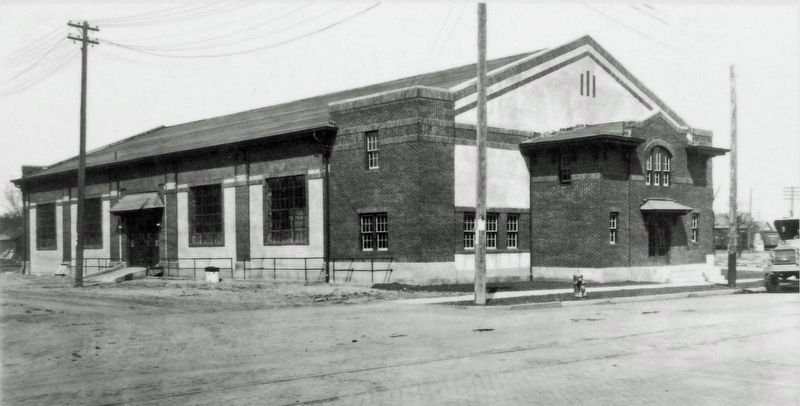
For over 100 years, local men and women have served their country and community through service in the Minnesota National Guard. Members have been called to federal service in combat and support roles during World War 2, the Korean Conflict, in the . . . — — Map (db m266797) HM
Breckenridge
Headwaters of the Red River of the North
Breckenridge, founded in 1857, has a current population of 3559 (2000 census). A progressive city, located at the juncture of three rivers, it is the gateway to the . . . — — Map (db m261716) HM
Old Georgetown A Tranportation Crossroads
In 1857 the Hudson's Bay Company received United States government permission to
ship furs and trade goods across the United States. They contracted with the Burbank
brother's Minnesota Stage . . . — — Map (db m205727) HM
In the late winter of 1871, 22-year-old John Bergquist was one of very few settlers living in this area. Far from his native Sweden, he chose this spot for his new home. Like many immigrants, John was drawn to the Minnesota Frontier by the . . . — — Map (db m266999) HM
The Red River of the North is designated by the State of Minnesota as an official canoe and boating route. The Red River meanders northward 550 miles from its source in Breckenridge, Minnesota to Lake Winnipeg in Canada. The designated portion . . . — — Map (db m261709) HM
M.B. Johnson Park is located on the Red River in north Moorhead, Minnesota. In 1971, the City of Moorhead and Clay County purchased 107.9 acres from the Martin Johnson family estate for $107,000 to provide a regional park. M.B. Johnson Park has a . . . — — Map (db m266993) HM
Moorhead-Fargo grew up around this home. But the building didn't always look this way. It has undergone many changes as new owners added their touches. Some of the residents built additions to the house. By 1915, modern construction completely . . . — — Map (db m267000) HM
Many visitors and residents of the area are amazed to find that steamboats on the Red River provided an important local transportation link 150 years ago. "The river must have been wider or deeper or straighter then," many people have suggested. . . . — — Map (db m266798) HM
The Red River of the North starts In Breckenridge, Minnesota, where the Otter Tail and Bois de Sioux rivers flow together then winds a sinuous 548.7 miles to Lake Winnipeg, a straight-line distance of 286 miles. The Red River watershed is about . . . — — Map (db m266799) HM
We are willing to pay the price as far as the good need arises.
—Cpl. Maurice Masterson, 151st Field Artillery, 42nd "Rainbow" Division, writing to his father, September 19, 1918
Maurice Masterson at Fort Riley, August 10, . . . — — Map (db m230607) HM
At one time the Red River was home to over a dozen steamboats including the Anson Northup (later renamed the Pioneer), the International, the Selkirk, the Dakota, the Alpha, the Cheyenne, the . . . — — Map (db m239995) HM
German homesteaders John and Dora Maier left Odessa, Russia and entered Eureka, South Dakota in the late 1880s. They first farmed near fellow Germans from Russia before moving to Moorhead, Minnesota. The Maier's built a house on their new homestead . . . — — Map (db m278723) HM
Born in Maine in 1842, Solomon G. Comstock worked on the family farm until he came of age and then followed the pioneers west. After reading law in Bangor, he studied at the University of Michigan, then went to Omaha and Minneapolis. Finally, in . . . — — Map (db m207124) HM
Land claims in Fargo, North Dakota were filed soon after it was determined the
railroad would cross at that point. Homesteader A. H. (Harry) Moore entered the Red River Valley area in 1869 and filed one of the earliest claims. Moore built an oak . . . — — Map (db m278744) HM
I will bear true faith and allegiance to the United States of America.
—from the volunteer enlistment form of Felix Battles, August 8, 1864
Felix Battles was 20 years old when he enlisted. He was born into slavery near Memphis, . . . — — Map (db m231429) HM
Thin black lines indicate changes in relevance. Between each pair of lines entries are ordered geographically but all have the same relevance.
* Inflectional forms of words are their plurals, singulars, and possessives as well as gramatical tenses and similar variations.