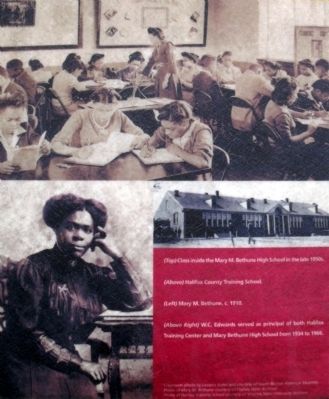
In 1872 the Banister Baptist Association built a private African-American training school in Halifax County. Originally the campus consisted of four wooden buildings and a dormitory. The school year was six months, and the grades went only as . . . — — Map (db m30988) HM
Mecklenburg County. Area 669 Square Miles. Formed in 1764 from Lunenburg, and named for Princess Charlotte, of Mecklenburg-Strelitz, Queen of George III. Bacon, the Rebel, defeated the Indians near the present town of . . . — — Map (db m30932) HM
William M. Tuck was born near High Hill, Halifax County, Virginia. After service in the U.S. Marine Corps in World War I, he attended the College of William and Mary and earned a law degree from Washington and Lee University. Governor Tuck served . . . — — Map (db m30937) HM
Halifax County, east of Danville, was established in 1752. It has a strong agricultural tobacco heritage. Today, visitors will will discover more: scenic, vineyards and wineries, historic sites and parks, equestrian centers, fine dining arts and . . . — — Map (db m171886) HM
Joseph R. Holmes, formerly enslaved in Charlotte County, campaigned for civil rights and education after emancipation. He served as a delegate to the Virginia Republican Party conventions in 1867 and 1869 and was elected to represent Charlotte and . . . — — Map (db m262856) HM
Caleb Robinson was born in Jamaica in 1864 and educated at Virginia Union University in Richmond, Virginia. In 1893 he formed the McKinley Institute on land he purchased in the Meadville section of Halifax County. He imported northern teachers . . . — — Map (db m30991) HM
Russell Grove Presbyterian Church and the Russell Grove School were established as a result of the efforts of Mrs. Samantha Jane Neil, a Presbyterian missionary and teacher of African-American children after the Civil War. At first the school . . . — — Map (db m28927) HM
Southside Virginia Community College has two campuses: the Christanna Campus in Alberta, which opened in 1970, and the John H. Daniel campus in Keysville, which opened in 1971. The college is part of the statewide system of community colleges . . . — — Map (db m30868) HM
In 1714, at Governor Alexander Spotswood’s urging, the Virginia General Assembly funded the Virginia Indian Company, charged with building a fort on the banks of the Meherrin River in what would become Brunswick County. The fort would provide . . . — — Map (db m20197) HM
Saint Paul’s College began as a small parochial school founded by a newly ordained Episcopal deacon, the Rev. James Solomon Russell. Born into slavery, Russell attended seminary school in Petersburg. Within a year of graduation he had managed . . . — — Map (db m30870) HM
Union Grove School is representative of the many one-room schools for African-American students in Buckingham County and throughout the area. The African-American members of the community built Union Grove around 1925, and like most schools, . . . — — Map (db m21148) HM
North of this sign is the birthplace of Dr. Carter G. Woodson. Dr. Woodson was born December 19, 1875, to former slaves, James Henry and Eliza Ann Riddle Woodson. Young carter left Buckingham to work in West Virginia when he was 17 years old. . . . — — Map (db m31608) HM
Beginning in 1937, Ambassador and Mrs. David K. E. Bruce anonymously gave money to 11 sites in Southside Virginia to build libraries. The Bruce libraries, as they were called, became the first public libraries to allow access to African . . . — — Map (db m31019) HM
Southside Virginia Community College has two campuses: the Christanna Campus in Alberta, which opened in 1970, and the John H. Daniel campus in Keysville, which opened in 1971. The college is part of the statewide system of community colleges . . . — — Map (db m31025) HM
After the Civil War, in the Red Oak area of Charlotte County, many freed slaves were welcomed to worship at Antioch Baptist Church, a traditionally white church. The Antioch congregation helped raise money to build Salem Baptist Church in . . . — — Map (db m30999) HM
Virginia State University was chartered by the Virginia legislature in 1882 as the Virginia Normal and Collegiate Institute. Delegate Alfred W. Harris, an African-American attorney in Petersburg, championed the charter and supported it . . . — — Map (db m26005) HM
Parents in the Cartersville area of Cumberland County met in 1909 to discuss the need for a centralized high school to replace the one-room schools serving white children in the area at that time. The county Superintendent of Schools led the . . . — — Map (db m31609) HM
Julius Rosenwald, a former president of Sears, Roebuck & Co., continued the efforts made by numerous philanthropists to bring education to African Americans in the South. During the early 1900s, funding for schools was scarce; the South had half . . . — — Map (db m21159) HM
Jackson Davis, an educational reformer and amateur photographer, was born in Cumberland County, VA, to William Anderson and Sally Wyatt (Guy) Davis on September 25, 1882. He attended the public schools of Richmond, VA, and received his B.A. . . . — — Map (db m21150) HM
Prior to the Civil War, Dinwiddie County was home to several private academies for those who could afford to pay for their education. While it was mostly affluent males who were educated, Pegram’s Academy, Female Academy, Girard Heartwell . . . — — Map (db m26834) HM
In 1938 the Virginia Assembly chartered a residential care facility for mentally retarded African-American males between 8 and 21 years of age. The Petersburg State Colony for the Negro Insane, as it was named, was located on the present site . . . — — Map (db m23455) HM
In 1911 a group of Dinwiddie County’s African-American residents established the Rocky Branch School in Sutherland. The school was a typical two-room schoolhouse. It had been moved from original location across from Ocran Methodist Church on . . . — — Map (db m26833) HM
Many churches in the second half of the 19th century and early part of the 20th century helped fill African Americans’ need for schooling. Frequently the church would raise funds to build the school, with county governments occasionally . . . — — Map (db m30961) HM
Determined to provide elementary education for young African Americans, the Rev. Parham B. Ragland started a school in his backyard some time around 1875. Though the "Backyard School" was private, Rev. Ragland was able to garner financial . . . — — Map (db m30970) HM
In 1880 a German Lutheran minister, the Rev. W. R. Buehler, a well-educated man who had worked for five years as a missionary in Africa, moved with his family to Green Bay, Virginia. He had not been in Green Bay long when the black community, . . . — — Map (db m31035) HM
On May 13, 1947, several African-American leaders in Lunenburg County met at First Baptist Church in Victoria to discuss the need for a centrally located building large enough to accommodate countywide gatherings and educational activities . . . — — Map (db m31856) HM
Boydton Academic and Bible Institute was opened in 1879 in building that had been abandoned by Randolph-Macon College when it moved to Ashland in 1868. Dr. Charles Cullis, a humanitarian from Boston, purchased the property in 1878 and opened . . . — — Map (db m30917) HM
Thyne Institute was established by Rev. J.Y. Ashenhurst, United Presbyterian Church, and a group of local citizens to provide an opportunity for African Americans (known as “freedmen” in the late 1800s) to obtain an education. In 1876 73 . . . — — Map (db m31003) HM
The Blackstone Female Institute was conceived in 1891 by George Pierce Adams, a Blackstone merchant, and Joshua Soule Hunter, a Methodist minister. Originally designed as a school to prepare young female students to enter Randolph-Macon . . . — — Map (db m31045) HM
Mt. Nebo Church was founded shortly after the Civil War in 1867. A northerner named Mr. Rickets bought the place called Oak Hill and began preaching to a group of African Americans at this place in the woods. The audience increased as people . . . — — Map (db m20242) HM
When the Russell Grove School in Amelia County grew too big for its building, land was found in Nottoway County near Burkeville for a new school. Built in 1892 to educate African-American girls, the new school was named Ingleside Seminary. It . . . — — Map (db m31042) HM
Petersburg established a public school system in 1868, two years before the state’s mandate. Colored Elementary School #1 was conducted in the old church building of the African Baptist Church, which stood to your left. The building had been . . . — — Map (db m26011) HM
Disrupted by the convulsions of the First World War, efforts to replace the increasingly inadequate Peabody School on Fillmore Street stretched out from 1913 until 1920, when the new Peabody-Williams School opened on Jones Street. Charles . . . — — Map (db m26012) HM
Beulah African Methodist Episcopal (AME) Church was founded in 1868. Originally, it was known as The Colored Methodist Church of Farmville. The original wooden-framed building was destroyed, by fire in 1898. The cornerstone on the present . . . — — Map (db m31318) HM
Founded on March 5, 1839 as the Farmville Female Seminary Association, Longwood is one of the oldest colleges originally for women in the country. In 1842 the cornerstone was laid for the first true college building, which is today known as . . . — — Map (db m31316) HM
The First Baptist Church was organized in 1866 as an outgrowth of the predominantly white Farmville Baptist Church. In 1949, following the death of the Rev. C. H. Griffin, the Church voted unanimously to call his son, L. Francis Griffin, as . . . — — Map (db m31310) HM
Hampden-Sydney College, in continuous operation since November 10, 1775, was established “to form good men and good citizens.” One of the few remaining all-male colleges, it was named for John Hampden (1594-1643) and Algernon Sydney . . . — — Map (db m31324) HM
In 1954, after the Supreme Court ruled in Brown vs. the Board of Education of Topeka, that United States schools must integrate, Senator Harry S. Byrd and several Virginia governors followed the policy of “massive resistance.” Integration was . . . — — Map (db m31321) HM
On this site of the former R.R. Moton High School, the actions of some brave African-American students to achieve equal educational opportunities for blacks eventually led to the end of legal segregation in American public schools.
Moton . . . — — Map (db m31319) HM
Halifax Church is the oldest Presbyterian church in Halifax County. The Congregation was formed in June, 1830, from Cub Creek Church in Charlotte County. The organizational group included the Reverend Clement Read of Cub Creek and twenty-six local . . . — — Map (db m66027) HM
A short distance south is the grave of Nathaniel Terry, colonial soldier and statesman. Terry served as sheriff of Halifax County, 1752, and captain of Rangers, 1755. He was a member of the House of Burgesses, 1755-1765, 1771-1775, and also sat in . . . — — Map (db m66029) HM
Hickey’s Road, first laid off by court order in 1749, followed this general path. Named after John Hickey, a merchant who operated a store at its western limits and peddled his wares along its length, the road stretched more than 100 miles from . . . — — Map (db m66059) HM
Sneed Acres was established as a plantation in 1798 by James Sneed (1764-1853) and wife, Bethenia Harden Perkins Sneed (1770-1812). They came to this area from Halifax County, Virginia. Three original buildings remain on this site with a portion . . . — — Map (db m151476) HM
Activated in South Boston, Virginia, Company F, under the command of Captain William R. Callahan, was one of four infantry companies to land at H-Hour, 0630, in the 116th Infantry's first-wave assault on Omaha Beach. Its mission was to secure the . . . — — Map (db m241314) HM WM
The Town of Chatham has served as the seat of Pittsylvania County government since 1777. It is rich in history with architecturally significant pre-Revolution, Federal, Victorian and post-Victorian houses. Brochures for self-guided walking . . . — — Map (db m171909) HM
In 1767 the Virginia House of Burgesses divided Halifax County to create Pittsylvania County. They named it for William Pitt, First Earl of Chatham, who earned the gratitude of the colonists for his defense of America before Parliament in 1765. The . . . — — Map (db m251495) HM
Abundant water and fertile land in this area south of the Tennessee River attracted pioneer settlement in the early 1800s. The community established here by three Virginia-born brothers, Hopkins, John, and Theophilus Lacy, took on their name and . . . — — Map (db m27611) HM
You are looking toward a site of American Patriot General Nathanael Greene’s strategic “Retreat to the Dan” which occurred on February 14, 1781. This retreat foiled British General Cornwallis’s southern strategy and was a turning point in the . . . — — Map (db m30951) HM
Born enslaved on one of William Sydnor’s
plantations in Halifax County, Patrick Robert
“Parker” Sydnor became literate at a freedmen’s
school after the Civil War. A preacher and farmer
in his youth, he began crafting grave . . . — — Map (db m107460) HM
This school, built at a cost of more than $600,000 provided secondary education to Black students from 1950 until 1970, when Nottoway County fully desegregated its schools. Although planning for the new high school had begun by 1946, the county . . . — — Map (db m310236) HM
I rejoice that America has resisted.
William Pitt, 1st Earl of Chatham
July 14, 1766
William Pitt, 1st Earl of Chatham, delivers a stunning speech to the British Parliament denouncing the 1765 Stamp Act . . . — — Map (db m294738) HM
The Mead Community Center is the realization of a dream of Caleb Robinson, who imagined an African American gathering place to enhance and educate the community. Professor Robinson was born in Jamaica in 1864 and graduated from Virginia Union . . . — — Map (db m181113) HM
In April 1861, Louis Froelich, a Bavarian immigrant, began manufacturing uniform buttons in Wilmington for North Carolina soldiers. With Hungarian partner Col. Bela Estvan, Froelich operated his first arms factory for the Confederacy from November . . . — — Map (db m77289) HM
Eighteenth-century towns were important gatherinsg spaces for people from various backgrounds. Halifax, on the south bank of the Roanoke River and at the intersection of major roads, became a major trade center and port during this period. . . . — — Map (db m207804) HM
Nearby to the east once stood the community
of Peytonsburg a part of Halifax County when
the county was formed in 1752. Peytonsburg
was incorporated as a town in 1759 by the Virginia
General Assembly and became part of Pittsylvania
County in . . . — — Map (db m20774) HM
Thin black lines indicate changes in relevance. Between each pair of lines entries are ordered geographically but all have the same relevance.
* Inflectional forms of words are their plurals, singulars, and possessives as well as gramatical tenses and similar variations.