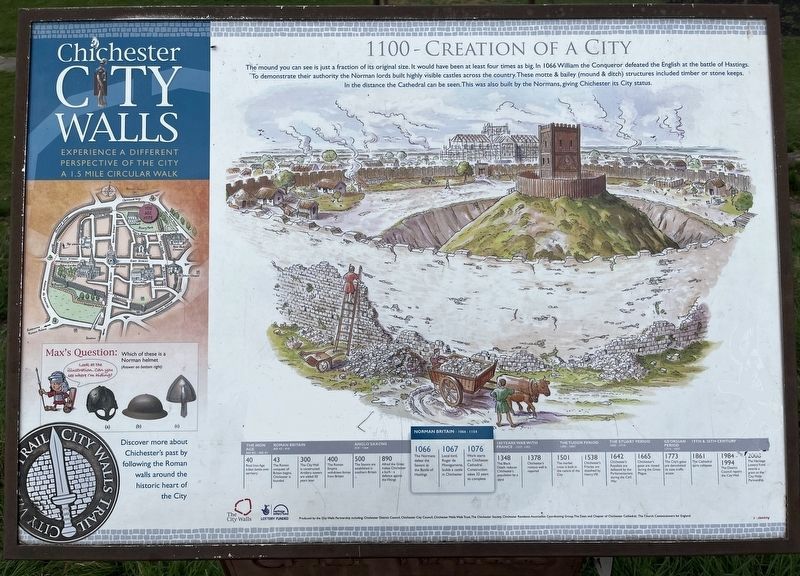
The mound you can see is just a fraction of its original size. It would have been at least four times as big. In 1066 William the Conqueror defeated the English at the battle of Hastings. To demonstrate their authority the Norman lords built highly . . . — — Map (db m279521) HM
On Saint Pancras, on the left when traveling north.
In 1642 tensions between Parliament and King Charles I sparked the English Civil War. This area was obliterated as William Waller's Parliamentarian forces exchanged cannon fire with the Royalists holding the City. A lightweight leather cannon was . . . — — Map (db m279517) HM
In the 19th Century the City Walls found a new role as a focus for leisure and recreation. Trees were planted along the banks and a fashionable promenade was created around the City. In 1850 Priory Park was created including the bowling green and . . . — — Map (db m279520) HM
When the Romans founded Noviomagus Reginorum they marked the town boundary with a ditch and bank. Around 200 years later the local authority decided to enclose the town with Walls as a symbol of civic status and protection. This could only be done . . . — — Map (db m279519) HM
George Murray was born in Chichester in 1759 and joined the Royal Navy aged 11.
He rose swiftly through the ranks and first served under Admiral Nelson in 1801 when the two men became close friends. Murray was Nelson's Captain of the Fleet but . . . — — Map (db m272471) HM
In grateful remembrance of the men of Chichester who gave their lives in the Great War 1914-1919, 1939-1945
(names not transcribed) — — Map (db m279546) WM
On North Street, on the left when traveling south.
The council house was erected in 1731 by public subscription at a cost of £1.189. It was designed by Roger Morris (1695-1749), the architectural associate of the 9th Earl of Pembroke, who, with the 3rd Earl of Burlington, was the leader of the . . . — — Map (db m279270) HM
Please take time to rest in our garden. This is a Chichester City Council project to commemorate the end of World War One.
The sculpture was carved in Sussex from a local fallen Oak tree.
It is not intended to depict a specific individual . . . — — Map (db m272523) HM
The impressive medieval building standing before you is the only surviving remains of a late 13th century Franciscan Friary that once dominated Priory Park.
1369-1383 - A Franciscan Friary is constructed in Priory Park. Believed to have been . . . — — Map (db m272526) HM
On Eastgate Square, on the left when traveling north.
This sculpture, by Vincent Gray, depicts John Keats contemplative on a bench, with his notebook, looking up towards the city centre and cathedral - almost certainly the inspiration for his epic poem, The Eve of St Agnes.
Keats and . . . — — Map (db m271531) HM
This statue of Lance Corporal Maurice Patten, Service number G/483 of the 7th Battalion, The Royal Sussex Regiment, 12th Division, was gifted to Chichester City Council by local sculptor Vincent Gray MRSS.
Maurice Patten, a resident of Eartham, . . . — — Map (db m272464) HM
On West Street west of Tower Street, on the right when traveling west.
Leslie Evershed-Martin CBE
1903-1994
lived here
Founder of the Chichester Festival Theatre in 1962
Mayor and Freeman of this City — — Map (db m279273) HM
Chichester War Memorial
The War Memorial was dedicated by the Dean of Chichester, and unveiled by Field Marshal Sir William Robertson in Eastgate Square on 20 July 1921. It was erected in remembrance of the three hundred and twenty three men . . . — — Map (db m272533) HM
Following the dissolution of the monasteries, Chichester's Franciscan friary was acquired from the King by the Mayor and citizens of the city. The friary church was retained to be used as a council house and law court but the rest of the site was . . . — — Map (db m272468) HM