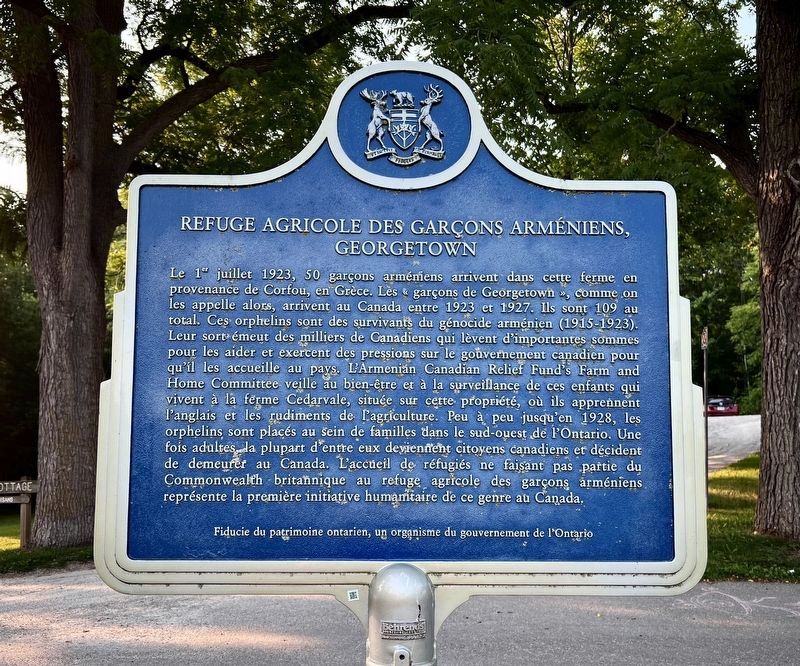
The Armenian Boys’ Farm Home, Georgetown
On July 1, 1923, a group of 50 Armenian boys arrived at this farm site from an orphanage in Corfu, Greece. The 'Georgetown Boys,' as they came to be known, arrived in Canada between 1923 and . . . — — Map (db m281556) HM
Joseph Tweedle ran a saw mill on this
site in the 1860's. The present building
was built circa 1872 by Richard Hurst
and purchased in 1882 by Samuel
Beaumont. The structure operated
as a knitting mill until 1982.
Designated 1990 LACAC — — Map (db m281459) HM
In 1923, Cedar Vale Farm was the
site of Canada's first
international humanitarian
resettlement effort, rescuing
orphans of the Armenian Genocide.
It later became a
United Church girls' school. — — Map (db m281552) HM
Early in the history of the settlement the
northwest corner of Mr Jacob Swackhamer's
farm became a public locality for the
community, and it is rather remarkable that
in 1827, eight years after his coming here,
it was used as a burying ground. . . . — — Map (db m280979) HM
This Gothic Revival structure was built in 1877
to replace an earlier frame chapel. Reverend
Joseph Unsworth a minister here for 26 years
was active in the Mechanic's Institute, the
precursor of the Public Library. The building was
given to the . . . — — Map (db m281179) HM
This building is a good example of
farmhouses built during the second
settlement phase of Ontario farmers, like
the Devereaux family who tilled this land
from 1831 to 1972. The 1860's west structure
is fronted by a High Victorian front . . . — — Map (db m281178) HM
Founding of Georgetown
After British officials acquired a block of land from the Mississaugas in 1818, the initial survey of Esquesing Township was undertaken in 1819. A township surveyor, Charles Kennedy, and several of his . . . — — Map (db m281194) HM
Built 1847 by Thomas Frazier,
a tailor. A fine example of an
early Victorian commercial
building once common in Canada
West. Timothy Eaton, founder
of the T. Eaton Co., was a
clerk here in 1853-54. — — Map (db m281239) HM
In 1923 and 1924, 90 Armenian orphan boys, brought from
Greece to this land by the Armenian Relief Association, made
their first Canadian home on this site at Cedarvale Farm.
"The Georgetown Boys, as they soon became known were
joined in 1926 . . . — — Map (db m281547) HM
The story of the Georgetown Boys is one that celebrates the generosity and humanitarian nature of Canadians. With an overwhelming number of Armenians left in dire conditions after the Armenian Genocide (1915-1923), relief efforts emerged around the . . . — — Map (db m281543) HM
The Georgetown Lawn Bowling Club was
established in 1907. A log cabin and stable
were relocated from Chinguacousy township
to this location to serve as a clubhouse in
1917. The clubhouse and green have remained
in continuous use since that time. — — Map (db m281462) HM
This community hall, built of
local brick in a simple
Colonial Cape Cod style,
has been central to the life
of the village since 1871. — — Map (db m281336) HM
You are standing on the foundation stones of The Hotel McGibbon, an iconic landmark in Georgetown. Over 150 years go, these stones were locally quarried and hauled to the site at Main and Mill to support the original wooden, two-storey building. . . . — — Map (db m281243) HM
Built 1858 by James Laidlaw who
owned the Frazier Shop next door.
The Wheeler family, prominent
Glen Williams merchants, owned
Laidlaw House for
almost 100 years. — — Map (db m281242) HM
The village of Limehouse, originally known as Fountain Green, was once a bustling industrial site with well over 100 men working 24 hours each day to "fire-up" the kilns and operate the mills. Situated along the Niagara Escarpment, early . . . — — Map (db m309359) HM
This village, originally called Fountain Green, was founded in 1840 and the name was changed to Limehouse in 1857. Many years ago the village was a bustling community with a sawmill, woolen mill, paint factory, limekilns, stores and hotels. Early . . . — — Map (db m309365) HM
Limestone Quarry History
In the mid 1800s, when the lime industry of Limehouse was just beginning, natural lime was mined from beds of limewater shale which occur naturally along the Niagara Escarpment. Chunks of limestone that had sheared . . . — — Map (db m309361) HM
In a step meant to meet the growing demand for affordable housing, for both defence-related industry workers and returning veterans, the Federal Government jumped into the world of residential development for the first time in the 1940s and Victory . . . — — Map (db m281467) HM
The first house on this land, built about 1854 by
Albert Bonesteel, was followed by this Gothic
Revival stone house built by Frederick Near in
1883. The farm features a barn circa 1890, a pond
once used as a quarry, and a former fishing camp. . . . — — Map (db m280950) HM
This Plaque is Dedicated to the Parishioners throughout the Years
By The Right Reverend D. Ralph Spence, Bishop of Niagara
June 22, 2003
The History of this Church is a Creation by the Parishioners to the Love of God, this Church, and this . . . — — Map (db m281343) HM
This late 19th century church and early 20th
century parish hall reflect an evolved
ecclesiastical landscape within the community
of Norval. The church and hall are associated
with founding families in the community as
well as Canadian author . . . — — Map (db m281554) HM
Charles Kennedy of Gainsborough Township,
surveyor for the northern part of Esquesing
Township was instrumental in introducing
Methodism to this area. Located on this site at
the south west corner of his land, the first
meeting house and . . . — — Map (db m281176) HM
In 1852, this Georgian style pump
factory was built of local bricks
by Isaac Williams and John Holt.
Water power was supplied from
behind the building for 20 years
until it was converted
to a residence. — — Map (db m281339) HM