New Hampshire, Pittsfield Historical Trail Historical Markers
First settled by John Cram in 1768, it was incorporated in 1782. Between 1870-90, many of the town's governmental buildings and business establishments were constructed. Most remain today and form the heart of Pittsfield's Historic Trail, a driving tour with 36 stops throughout the town.
Agents for the Cotton Mill lived in this house
during the 19th Century. Agent James A.
Treat's nephew, E.P. Sanderson, one of
Pittsfield's most generous benefactors, was
born here February 5, 1860. Sanderson
attended local schools and later . . . — — Map (db m260867) HM
Raised in Barnstead and educated in Pittsfield, this heroic
fighter pilot and leader of men fought in every theater of
war from World War II through Vietnam. He was the first
U.S. Army Air Force pilot to encounter the Luftwaffe
during World War . . . — — Map (db m260939) HM
Designed by architect William
Butterfield, this building and land was a
gift of Josiah and Georgianna Carpenter
to the Town of Pittsfield. The stack room
is fire proof and was originally lighted by
gas. The granite steps are from Concord
and . . . — — Map (db m260886) HM
The First Congregational Church was established in 1789 and built on the corner of Broadway and Main. The first church on this site was a wooden structure built in 1839. After the disastrous fire of February 14, 1876, this brick edifice was erected. . . . — — Map (db m260906) HM
In 1826 James Joy formed Pittsfield
Mfg., Inc. and built a five-story
wooden mill on this spot. It burned the
next year but immediately was
reconstructed of bricks made near
Webster's Mills and operated until
1948. In 1951 it was converted . . . — — Map (db m260855) HM
With the coming of the railroad in
1869, Charles T. Cram solicited 20
people to lend him $100 each at 6%
interest to help pay for 10 brick houses
he would build the following year. In
July 1870, he started producing bricks
in his newly . . . — — Map (db m260899) HM
In 1768, under contract with the colonial
proprietors of Chichester, John Cram
chose this spot on the “Great Suncook”
upon which to build a saw mill and grist
mill. He constructed a crude dam for
power to run the mills by felling trees
from . . . — — Map (db m260923) HM
In 1856 Dr. Tenney erected his
homestead on this property but a
disastrous fire in 1873 leveled
everything. He then built the finest
house in Pittsfield and the first to have
steam heat. Dr. Tenney was on the
Governor's Council from 1861-63, . . . — — Map (db m260870) HM
The Drake family was prominent in
Pittsfield for over 150 years. Major James
Drake was a member of the first Board of
Selectmen. This athletic field was
presented as a memorial to his son, Col.
James Drake, who held numerous town
offices and . . . — — Map (db m260935) HM
The first stove and tin shop in Pittsfield
was located here c. 1836. The building was
acquired by the infamous “Dr.” G.G.
Wilkins in 1866 and became known as Ft.
Wilkins. Here he sold firearms and animal
pelts, practiced tooth filling . . . — — Map (db m260905) HM
On one of these gravestones sat the
Black abolitionist Frederick Douglass
in a cold, drizzling rain after giving an
anti-slavery speech in the Old Meeting
House. Having been refused service at
a nearby hotel, he was hungry and
without shelter. . . . — — Map (db m260898) HM
The first church on this site was built
in 1838 after the demise of the original
church on Catamount Mountain. The
church was enlarged in 1852. In 1886
it was entirely redesigned by renowned
architect William Butterfield in the
present Queen . . . — — Map (db m260929) HM
The Grand Army of the Republic Building was erected after the conflagration of February, 1914. The hall on the second floor served the G.A.R., Sons of Veterans and Women's Relief Corps. In 1925, the American Legion purchased the building and used . . . — — Map (db m260937) HM
Designed by renowned architect
William Butterfield and constructed
by E.B. Hutchinson in association
with Pittsfield's esteemed contractor
Charles H. Lane, this building initially
served as a high school. It also
contained primary and . . . — — Map (db m260889) HM
“Uncle” John Berry occupied this house
until his death in 1880. One of the most
prominent residents of Pittsfield during
the 19th century, he was one of the
founders of the Academy and was the first
president of the Pittsfield Savings Bank.
He . . . — — Map (db m260885) HM
“Uncle” John Berry opened a store in
this building about 1818. It was said that
he kept “a little salt, a little fish, and lots
of rum.” This beverage, consumed on all
social occasions, was teamed from
Newburyport by his brother Thomas. . . . — — Map (db m260884) HM
On a dark evening in 1874, young
Mary Bodge plunged into the river
as she attempted to cross a little foot
bridge that had been removed
during the day while she was at
work. Her screams were heard for
some distance, but she drowned. As
a . . . — — Map (db m260931) HM
In 1838 the Calvinist Baptist
Church was moved to this site from
the Pittsfield Common. In 1854 a
new church was erected (its bell
rests on the lawn) but was razed in
1909 to make way for the Memorial
School. This building was a gift of
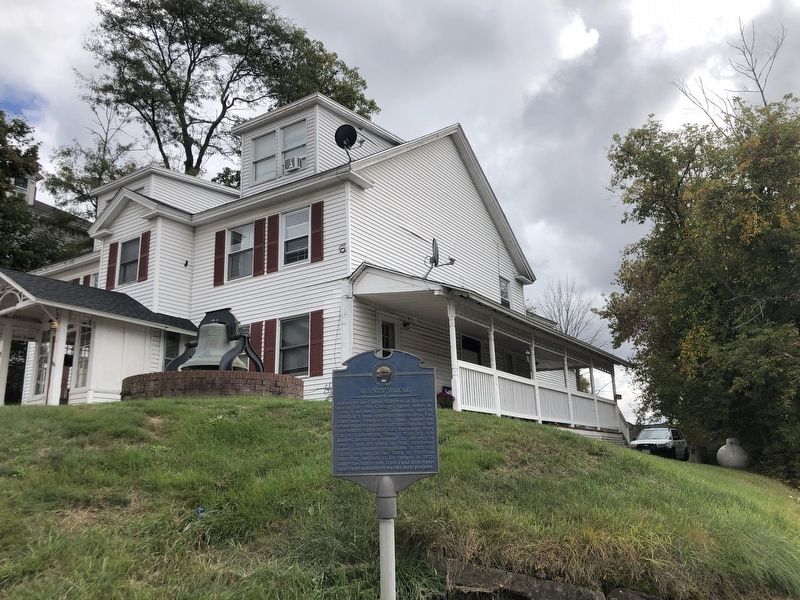
Gov. . . . — — Map (db m260887) HM
The first fire district for Pittsfield
was created by the legislature in
1870. Initially equipment was housed
in a building on Water Street. Engine
Hall was erected in 1878 with room
for the famous Babcock Fire
Extinguisher on the first floor . . . — — Map (db m260926) HM
Erected in 1789 on land given by John
Cram, this building was the first church in
Pittsfield. Between 1800-1818 Rev. Benjamin
Sargent preached to both Congregationalists
and Baptists from the same pulpit. The
building was turned over to the . . . — — Map (db m260895) HM
The town's founder, John Cram, gave
this land for a burial place, “in
consideration of one ear of corn.”
Nearly 30 Revolutionary War soldiers
are buried here, including Mr. Cram,
Rev. Benjamin Sargent, Bradbury
Green and “Jockey” Fogg. . . . — — Map (db m260925) HM
Jackson Freese, one of the most
popular “knights of the whip,”
operated the Pittsfield-Dover stage line
out of this building, which he
purchased in 1865. His outfit was
drawn by four and sometimes six
horses. While traversing the . . . — — Map (db m260888) HM
Built by Charles H. Lane in 1883, this
building was originally three stories
high. The first floor contained business
establishments including Henry
Osgood's furniture store. His famous
photographic studio was located on part
of the second . . . — — Map (db m260904) HM
This twice-moved building was once the
parsonage of the Baptist Church.
Constructed c1843 when the church moved
from Catamount Mountain to the Village, it
was originally located on Park Street.
Subsequently it served as the dwelling
house for . . . — — Map (db m260932) HM
In 1830 the prestigious Pittsfield Academy
was erected on land donated by James Joy.
It served over 2000 pupils before closing in
1890. Teachers included such notables as
James Frederick Joy and Judge Lewis
Clark. Famous attendees included . . . — — Map (db m260928) HM
The first bank in Pittsfield was
chartered in 1850. Its offices opened in
the old Pinkham Hotel on this site the
following year. In 1865 it became a
national bank. In 1884 it moved across
the park into the new Opera House
Block where Electa . . . — — Map (db m260903) HM
Founded in 1926, Pittsfield Weaving Co.
began operations in a building on this
site. The structure, erected c1901 and
used as a wheelwright-horse shoeing
shop, was moved here from Depot Street.
Surviving the Great Depression, the
fledgling . . . — — Map (db m260933) HM
One of Pittsfield's earliest schools
occupied a spot about 100' out in the river.
In 1826 voters at Town Meeting granted
mill owner James Joy permission to
construct a bigger dam, thus creating a
much larger mill pond. The school was
moved . . . — — Map (db m260930) HM
Known as the “Blueberry Express,”
the railroad was a vision of “Uncle”
John Berry and John Cate French.
The first train left Pittsfield December
12, 1869. Its 17 miles of track to
Concord resulted in unprecedented
growth for Pittsfield. . . . — — Map (db m260924) HM
In 1854 the old Calvinist Baptist
Church was reconstructed on this
site, raised and stores built
underneath. Known as the Central
Block, it housed Dr. Mack's famous
apothecary shop which contained the
public library. All were destroyed in
the . . . — — Map (db m260883) HM
On this site David Fogg built a small
home about 1804. Occupied and
enlarged by woolen mill owner John
Carroll in 1817, it later became the W.
Bryant Drake Hotel & Tavern. In
1865 the building and stable, which
contained a wagon full of shoes . . . — — Map (db m260897) HM
The Thorndike-Tuttle Block, which
housed Pittsfield Savings Bank and
post office was destroyed by fire in
1876 along with all of the town's school
records. The safe was saved and the
bank opened the next day in John
Berry's store. The bank, . . . — — Map (db m260907) HM
On this site stood town founder John
Cram's house. It was the first frame
house built with lumber coming off his
mill located at the foot of the hill. In
1782, the first Pittsfield Town Meeting
was held here in his inn, which was the
heart of . . . — — Map (db m260908) HM
This is the former site of the
“Yellow Block,” erected by Charles
H. O. Green in 1883. One of the
most beautiful tenements in
Pittsfield, it comfortably housed five
or six families. After years of
gradual decline it was purchased by
the town . . . — — Map (db m260900) HM