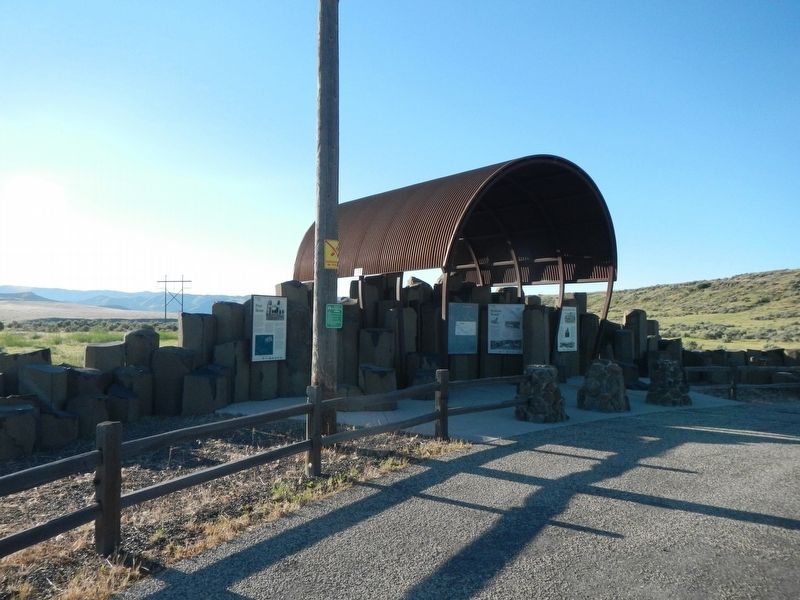
From the high ridge above the Boise River 5 miles southwest of here, westward-bound travelers got their first view of the Boise Valley. In 1811, Wilson Price Hunt and the Overland Astorians' party were the first white sojourners to enjoy the scene. . . . — — Map (db m119002) HM
In 1906, at the age of seventy-five, Ezra Meeker began a journey east from his home in Puyallup, Washington, to retrace the route of the Oregon Trail over which he originally traveled in 1852 with his wife and young son. He traveled the route with . . . — — Map (db m118993) HM
Concern for the safety of westward-bound emigrants became more immediate when news of the Utter party's disastrous confrontation with hostile Indians on September 9 and 10, 1860, reached western settlements. Colonel George Wright, commander of . . . — — Map (db m119004) HM
Westward-bound emigrants entered Idaho after crossing Thomas Fork Valley. They soon encountered the climb and descent of Big Hill, witnessed nature's curiosities at Soda Springs, and discovered willing traders at Fort Hall.
In 1843 wagons . . . — — Map (db m118992) HM
After the transcontinental railroad was completed on May 10, 1869, new stage and freight routes were established to connect southwester Idaho with newly established railheads.
Kelton, Utah, soon became the main shipping point for Boise, when John . . . — — Map (db m118996) HM
President Franklin Roosevelt’s tour of the American West in 1937 included a stop in Boise. The tour provided the president opportunities to promote New Deal public works and job stimulus programs and see first-hand how they benefitted American . . . — — Map (db m267016) HM
Thin black lines indicate changes in relevance. Between each pair of lines entries are ordered geographically but all have the same relevance.
* Inflectional forms of words are their plurals, singulars, and possessives as well as gramatical tenses and similar variations.