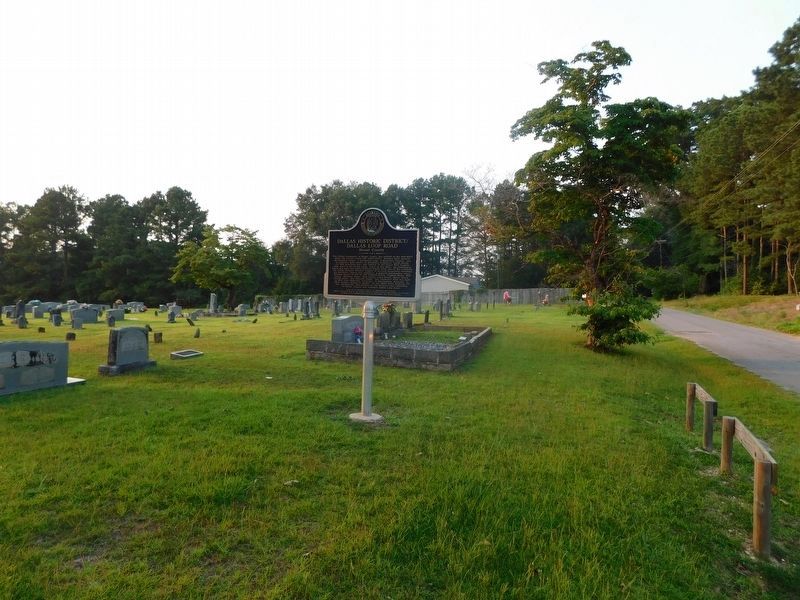
The Dallas Community in Blount County was settled in the mid-1800s
after the Second Creek War (1836-1837). Settlers built general
merchandise stores, a blacksmith shop, a Methodist Church, and
a cemetery later known as Bethlehem Cemetery. Local . . . — — Map (db m307414) HM
The first family to settle this area in 1832. Married Nancy Stewart Hanby, daughter of Gabriel Hanby, who was one of the original framers of the Alabama Constitution. They became parents of 11 children: 4 sons served in the Confederate Army. At one . . . — — Map (db m201371) HM
Four school sites have been located in this community known as Morton’s Center, Hew Hope, and Poplar Springs now Holly Springs. The first at Morton’s Center was taught in 1882 by George W. Burttram. The first school at New Hope was taught by . . . — — Map (db m145410) HM
Side 1
February 13, 1818 — Gin Port - west of Amory, MS on Tombigbee River
December 16, 1819 — Henry Grier House, near Columbus, MS - first designated courthouse
Late 1820-1822 — Military Ford Court - under . . . — — Map (db m96791) HM
Antioch (an'~te~ok') was an ancient Biblical city and a chief center of early Christianity. Today, many churches and cemeteries throughout the United States use the name. Once called Glover's Graveyard, the earliest recorded burial is 1794. Antioch . . . — — Map (db m128071) HM
While traveling south with his troops, General Andrew Jackson camped at the fork of the river in 1813. General Jackson carved his name in a locust tree naming this area Locust Fork. In 1817, the Hanby family came from Virginia and settled in this . . . — — Map (db m50125) HM
In 1864, traveling in an ox cart, Dr. Robert M. Moore left his family in Walton County, Georgia, and journeyed to Blount County, Alabama. Finding fertile land, he returned to Walton County and persuaded his wife to move to Blount County with him. In . . . — — Map (db m49251) HM
The Hinkle cabin was built in 1873 by John Weaver and Lucy Kenner Hinkle, who homesteaded the surrounding 154 acres. They married in 1859 in Blount County, Alabama, where seven children were born: William, Louisa Ann (“Eliza”), Mary Jane, Frances . . . — — Map (db m286892) HM
1820-1889 seat of Blount County, a county older than the State.
Named for Tennessee Governor W. G. Blount who sent Andrew Jackson to aid Alabama settlers in Creek Indian War, 1812-1814.
Indian Chief Bear Meat lived here at crossing of . . . — — Map (db m156445) HM
Member Constitutional Convention 1819
First Senator of Blount County
Brigadier General,
Alabama Militia
County road and court
systems organized
at his house 1820. — — Map (db m32484) HM
William M. Bailey (born 1859 in Cherokee Co.; died 1909 in Blount Co.) settled 40 acres on what became Co. Rd 36 to the west and New Home Church Rd to the east in 1893. He brought three small sons from Cherokee Co. after the death of his first wife . . . — — Map (db m42599) HM
Side 1
Old Indian trails leading to the Mulberry River were still fresh when a few dirt farmers began to settle just west of what is now Hanceville. From the beginning a steady stream of settlers, many of whom were German and Irish . . . — — Map (db m156413) HM
Thin black lines indicate changes in relevance. Between each pair of lines entries are ordered geographically but all have the same relevance.
* Inflectional forms of words are their plurals, singulars, and possessives as well as gramatical tenses and similar variations.