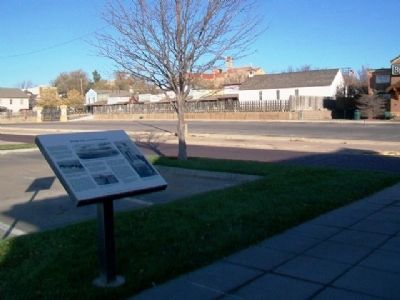
The Santa Fe Trail was a busy overland route for fifty years before Dodge City was founded. The heavy freight wagons rumbled along where you are now standing. In 1865, Fort Dodge was established to provide protection for wagon trains and to . . . — — Map (db m65270) HM
This 32-foot-high original fine art sculpture titled “Kansas Wheat Shock” was built in 1980 and for 40 years welcomed visitors to the High Plains Journal headquarters at 1500 E. Wyatt Earp Blvd. Since 1876, the High Plains Journal . . . — — Map (db m307997) HM
Million-Dollar Block Dodge City entered a new period of growth and prosperity after 1900, when many of the business buildings currently standing in the downtown area were built. Also constructed in the community were new hospitals, a post . . . — — Map (db m307984) HM
In the mid 1880s, economic factors contributed to a change in Dodge City's character. The cowtown era ended with the last Texas cattle drives in 1885. Two severe blizzards in that period destroyed the local range cattle industry. At the same . . . — — Map (db m65356) HM
The first structure built on the future site of Dodge City was a three-room sod house. Constructed by Henry L. Sitler, it was near the dusty ruts of the Santa Fe Trail, approximately 500 feet southwest of where you now stand. The "soddie" was . . . — — Map (db m65273) HM
South Wall: A look into the Dodge City Army Airfield After the outbreak of World War II and in early 1942, Dodge City Chamber of Commerce president and editor of the Dodge City Daily Globe, Jess C. Denious (Muncys father), lobbied the U.S. . . . — — Map (db m308200) HM
George Hinkle purchased this property from the Dodge City Town Company in 1878 for $44.50. He built this home on Gospel Hill in 1880, the first year of his term as Ford County Sheriff. Gospel Hill is a nickname for the area where all of the . . . — — Map (db m307999) HM
Thin black lines indicate changes in relevance. Between each pair of lines entries are ordered geographically but all have the same relevance.
* Inflectional forms of words are their plurals, singulars, and possessives as well as gramatical tenses and similar variations.