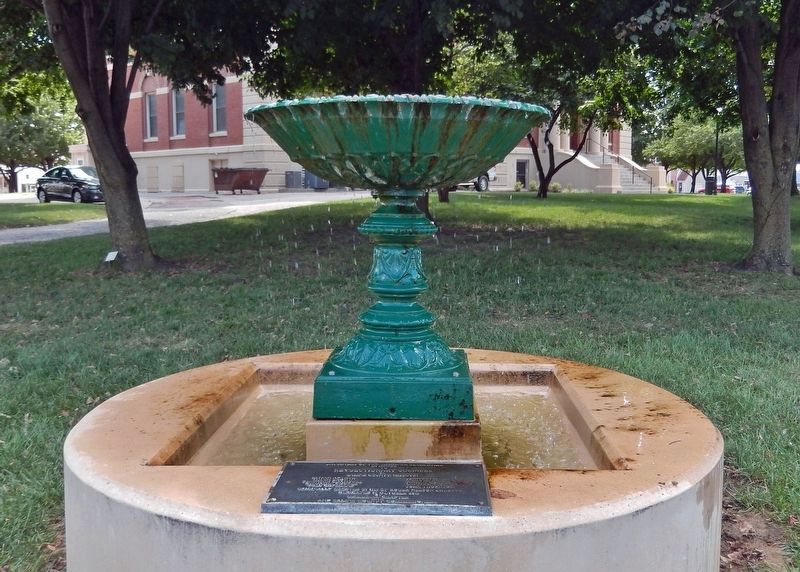
Daughters of the American Revolution in honor to Revolutionary Soldiers in Saline County, Missouri Elijah Arthur • Isham Brown • Benjamin Chambers • Benjamin Cooper • Joel Copeland • Jean Estelquay • David Jones • Joshua Roberts • . . . — — Map (db m216802) HM WM
The 1860 census shows 15,000 people living in Saline county, 5,000 of whom were enslaved African Americans. The collapse of the hemp market and emancipation in 1865 resulted in many African Americans leaving farms and plantations. Many "freedmen" . . . — — Map (db m247019) HM
William Becknell was born in Amherst County, Virginia. He married Jane Trussler in 1807 and in
1810 moved to St. Charles. In the War of 1812 he joined Daniel Morgan Boone's company of U.S. mounted rangers and later participated in Major Zachary . . . — — Map (db m252449) HM
William Becknell, known as the “Father of the Santa Fe Trail,” was an American frontier soldier, trader, farmer, rancher and politician. Becknell was born in Virginia in 1787 or 1788 to Micaiah and Pheby (Landrum) Becknell. He married . . . — — Map (db m160379) HM
In 1877, the Chicago & Alton Railroad decided to build a bridge across the Missouri River at Glasgow. It was to be the first large all-steel bridge in the world. Mr. A.F. Hay, of Burlington, Iowa, had developed a steel that met all specifications & . . . — — Map (db m216963) HM
At the Arrow Rock State Park entrance stands this pioneer town as a memorial to the Boon's Lick Country and the expanding frontier. In the 24-acre park are Arrow Rock Tavern, built by Joseph Huston, ca. 1834, for travelers on the Santa Fe Trail, . . . — — Map (db m246742) HM
"Prairie Park" was built between 1845 and 1849 by William Breathitt Sappington and his wife Mary Mildred Breathitt Sappington. It is one of the finest surviving examples of nineteenth century Greek Revival architecture in rural Missouri and was a . . . — — Map (db m247018) HM
Salt: The Precious Substance
If an area or territory possessed any prospect for settlement by Europeans or Americans, it had to have the quantity of food sufficient to last year-round - especially meat. Salt was the main means available to . . . — — Map (db m248999) HM
Developing a Town:
The Missouri River, a conduit of commerce and transportation, drove the development of Arrow Rock. So important was the river that Burton Lawless, one of the founders of the town that would become Arrow Rock, guaranteed . . . — — Map (db m246947) HM
1790
Indians Along the Missouri
The Missouri River served as a boundary between Indian tribes in historic times. The Osage dominated a vast area south of the river. To the north, the loway, and later Sauk and Fox, held power. . . . — — Map (db m247363) HM
1797 - James Mackay granted land including the salt spring by Spanish authorities in St. Louis.
1799 - Daniel Boone and his family arrive in Missouri and receive land grants in St. Charles County from the Spanish authorities.
. . . — — Map (db m248767) HM
Sappington Cemetery is the burial place for Dr. John and Jane Sappington, patriarch and matriarch of one of Missouri's most influential families before the American Civil War (1861-1865). The 111 burials in this cemetery are direct or extended . . . — — Map (db m246864) HM
Marquette and Joliet
The first reference to the Osage Indians was in 1673 when Louis Joliet and Father Jacques Marquette descended the Mississippi River from the Great Lakes and stopped at the mouth of the Missouri River. They collected . . . — — Map (db m61381) HM
(LEFT PANEL)
The Battle of Hartville
The Civil War Comes to Hartville
The battle of Hartville, Mo., on Jan. 11, 1863, was a chance meeting of two armies. On Jan. 8, Confederates led by Brig. Gen. John S. Marmaduke . . . — — Map (db m99345) HM
This is one of the oldest churches in Saline County. It was organized about 1825, with nine founding members. "Zoar", appropriately means "little" (Genesis 19:22). The first church building was erected in 1831, of logs, in the Hardeman . . . — — Map (db m246873) HM
This cemetery has served the African American community of Arrow Rock for more than 150 years. Most communities in Missouri had designated cemeteries for African American burials, continuing the practice of segregation. In oral history passed down . . . — — Map (db m247020) HM
Thin black lines indicate changes in relevance. Between each pair of lines entries are ordered geographically but all have the same relevance.
* Inflectional forms of words are their plurals, singulars, and possessives as well as gramatical tenses and similar variations.