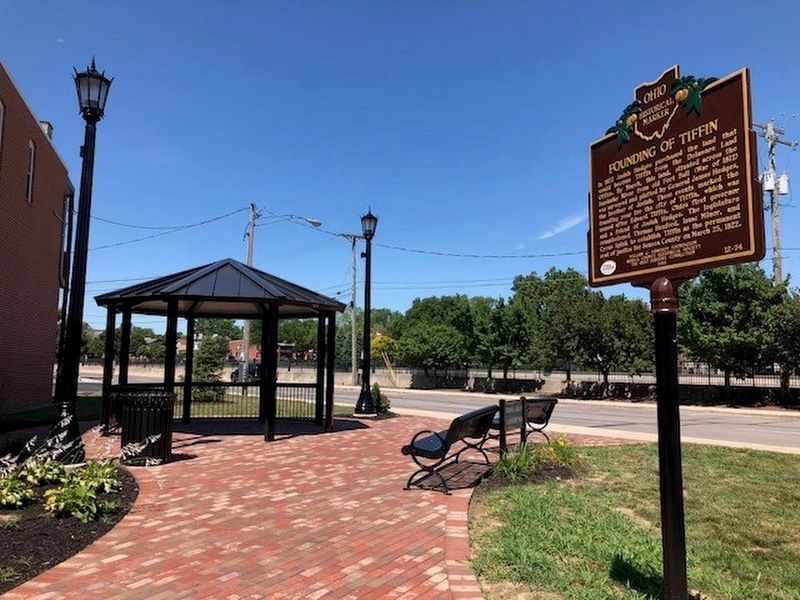
In 1822 Josiah Hedges purchased the land that would become Tiffin from the Delaware Land Office. By March, this land, situated across the Sandusky River from old Fort Ball (War of 1812) was surveyed and platted by General James Hedges, the brother . . . — — Map (db m119964) HM
Whereas Paul M. Gillmor is a lifelong resident and distinguished community leader in
the village of Old Fort.
Whereas Paul M Gillmor and his family have worked tirelessly to further the prosperity
of the Old Fort community by bringing the . . . — — Map (db m219752) HM
In July 1813 a detachment of soldiers under Lt. Col. James V. Ball built a supply fort here along the military road that ran along the west bank of the Sandusky River. Ball chose this site for its large spring of cold water, which he enclosed within . . . — — Map (db m17977) HM
This is the site of Camp Noble, named for
Congressman Warren P. Noble, who obtained the
officer’s commission for William H. Gibson as the
colonel of the 49th Ohio Volunteer Infantry.
Companies of 100 began to arrive here August 12,
1861 from . . . — — Map (db m141529) HM
The Seneca County Museum is the former home of local businessman Rezin W. Shawhan. Born in 1811, Shawhan arrived in Tiffin in 1832 and opened a store with his brother Lorenzo. The store’s success enabled Rezin to expand his interests into real . . . — — Map (db m224963) HM
St. Joseph Catholic Church has been located here since the parish's formation in 1845. Tiffin was established by Josiah Hedges in 1822, and shortly after, many German Catholic families began to settle in the area. They formed part of St. Mary's . . . — — Map (db m166162) HM
In 1873, Tiffin's Cronise sisters became the first women admitted to the Ohio Bar. At that time, Ohio laws did not provide for the admission of women attorneys. On April 4th 1873, Nettie Cronise applied to the district court. Despite vigorous . . . — — Map (db m100140) HM
A) In 1858, the Sandusky Dayton Cincinnati Railroad Company took control of the Mad River and Lake Erie Railroad line and built the Tiffin passenger depot in 1862, which served as one of the six railroad depots in the Tiffin area. As a result of the . . . — — Map (db m119969) HM
The Missionaries of the Precious Blood established in Italy in 1815, and the Sisters of the Precious Blood established in Switzerland in 1834, began their American ministry in 1844 in Peru, Ohio. In 1845 Swiss born Father Francis de Sales . . . — — Map (db m221330) HM
One of the last remaining original
log churches in Ohio. Built in 1848 in
Adams Township, Seneca County,
Ohio. Used until 1875. An Evangelical
Association Church.
The Builder, Adam Snyder, lived
about a mile from the construction
site. The . . . — — Map (db m204766) HM
In 1891, a small group of glass-making artisans from Seneca County, Ohio, founded the Seneca Glass Company. For almost 100 years, Seneca Glass Company’s highly skilled craftspeople manufactured glassware and exquisitely etched lead crystal by hand, . . . — — Map (db m74624) HM
Side A Runaway slaves used a web of routes through Crawford County, most going through the city of Bucyrus. Present-day State Route 98 to State Route 4, laid out in 1822 from Norton in northern Delaware County through Bucyrus to Sandusky in . . . — — Map (db m107079) HM
The Underground Railroad. The Underground Railroad was neither underground nor a railroad, but a system of loosely connected safe havens where those escaping the brutal conditions of slavery were sheltered, fed, clothed, nursed, concealed, . . . — — Map (db m221322) HM
General Gibson believed the two most
important things in life were piety and
patriotism. In his creed they were linked
in indissoluble union. His piety was broad
enough to include every creed, his patriotism
wide enough to cover . . . — — Map (db m195296) HM WM
Thin black lines indicate changes in relevance. Between each pair of lines entries are ordered geographically but all have the same relevance.
* Inflectional forms of words are their plurals, singulars, and possessives as well as gramatical tenses and similar variations.