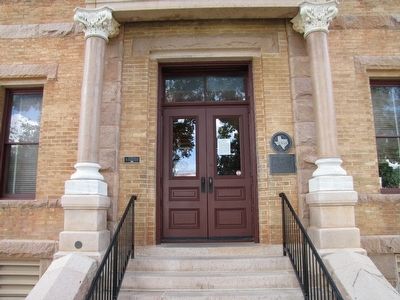
Designed by Austin architect A. O. Watson, this building is the fourth courthouse for Llano County. Work on the structure began in 1892 and was completed one year later. The contractors were J. A. and G. H. Wilson of Sulphur Springs. The courthouse . . . — — Map (db m89190) HM
Llano County's granite industry can be traced to 1888 when J. K. Finlay first polished a stone from his mill site and David Stewart opened a quarry south of Llano. Prominent sculptor Frank Teich leased a quarry from Stewart and established Teich . . . — — Map (db m89329) HM
This building was erected in 1895 by the Pauly Jail Building and Manufacturing Co. of St. Louis, Mo. The gray granite for the exterior was quarried in the county. The red roof of the Romanesque revival jail provided the building its nickname, and . . . — — Map (db m89322) HM
Throughout Llano County, large granite outcrops exist. The first granite quarry in Llano County opened in 1888 on the Llano River. When the railroad arrived in 1892, the demand for granite rapidly increased. Italian immigrant Vincenzo Fantozzi . . . — — Map (db m143040) HM
The name "Llano," first given by Spanish explorers in the 18th century to the river traversing the region, is a corruption of the French name given the Lipan Indians. First settlements were made by Germans about 1850. The county, created from . . . — — Map (db m307860) HM
The Oxford community was founded in 1880 when Confederate veteran A.J. Johnson came to Llano County and laid out the townsite. In 1881, a burial ground was established near this site for the use of the families of Oxford. Burials date from 1883, . . . — — Map (db m29843) HM
Between 1844 and 1846, thousands of German immigrants under the auspices of the Society for the Protection of German Immigrants in Texas, better known as Adelsverein, landed at Galveston and Indianola. Their ultimate destination was the 3,878,000 . . . — — Map (db m164039) HM
Gideon Cowan Thorp was born in Tennessee in 1844 and had settled in Texas with his family by 1850. The Thorps later moved to Llano County. Gideon served in the Confederate Army during the Civil War and returned to the area after the war, relocating . . . — — Map (db m244565) HM
Area residents founded the city of Llano as the county seat for newly-formed Llano County in 1856. By August 1862, with interment of one-year-old Tina Miller, this site served as a burial ground. Seventeen-year-old Emily Young Wright was interred . . . — — Map (db m238501) HM
Early Llano County leader, Robert Flack (Bob) Rowntree (1847-1893), built this majestic two story house in the Prairie Mountain community from 1875 to 1888. Scottish architect John K. Finlay, a pioneer in the Texas granite industry, designed the . . . — — Map (db m237469) HM
In 1931, the Central Texas Hydro-Electric Company planned to build a dam on the Colorado River on the county line of Burnet and Llano counties. However, in April 1932, the project went bankrupt and lay unfinished. State Senator Alvin Wirtz took the . . . — — Map (db m293209) HM
Born in Vermont, Charles Haynes came to Texas in 1836 with the "Buckeye Rangers" of Ohio to fight for independence. He settled at Lockhart, operated a blacksmith shop, was a member of the first county commissioners' court, a justice of the peace, . . . — — Map (db m216158) HM
These three attached structures are believed to have been built by John Goodman, a builder and stone mason who immigrated to Llano from Germany in 1878. They exhibit typical features of early 20th century commercial structures, including corbelled . . . — — Map (db m150357) HM
Located between Tow Valley and Old Bluffton, 15 mi. NE. Since 1935 under Lake Buchanan. During Civil War made salt for table, meat preserving, diet of cavalry horses, tanning hides. A day's boiling in 100 iron 250-gallon kettles produced 20 to 30 . . . — — Map (db m51150) HM
"Of all the things I have ever done, nothing has given me as much satisfaction as bringing power to the Hill Country of Texas." - Lyndon B. Johnson
In the 1930s, investor-owned utilities didn't consider it profitable to extend miles of . . . — — Map (db m236546) HM
Ludwig Schneider and Heinrich Vasterling came from Germany and settled on the north side of the Llano River in 1847. Here Ludwig built the first known log home in Llano county.
In 1872 the first U.S. Post Office was opened on the north side of . . . — — Map (db m164343) HM
In 1867 on Fisher Miller land grant, 3 settlements were begun by German emigration company under Commissioner General John O. Meusebach.
CASTELL: Settled by Fredericksburg pioneers of the German Emigration Company, was first and only permanent . . . — — Map (db m155725) HM
This hilltop cemetery has served the local community since 1867 when Martha Epperson Eaker and Hattie Phillips, daughters of pioneer settlers in the area, were buried here. Burials continued, and in 1877 the Epperson family donated land for the . . . — — Map (db m238679) HM
Built 1872 by the Rev. S. J. Lane, chaplain, Southwestern University; founder, First Methodist church, Georgetown. Bought 1903 by the Rev. George W. Riley (1853-1925), a grandson of Llano County Indians' 1859 victim, the Rev. Jonas Dancer.
G. . . . — — Map (db m3952) HM
Education for students in Castell may have begun as early as 1852, according to local oral tradition. Earliest written records indicate that the Llano County Commissioners Court designated the Castell School as District No. 6 in 1884, and land was . . . — — Map (db m237462) HM
German immigrants and pioneer settlers established the Prairie Mountain community once known as Starks in the mid 1800s. In 1906 the Putman School relocated to Hickory Creek site and was renamed Prairie Mountain School. Community members built a . . . — — Map (db m237471) HM
James Jackson Larremore brought his family to Llano County in 1853. Daughter Martha met and married James S. Huffman in 1856 and the couple resided along the Llano River, rearing their seven children. Following service in the Civil War, Huffman . . . — — Map (db m238728) HM
Ira Clarence Eaker was born April 13, 1896, in Field Creek, Llano County, Texas. In 1906, his parents, Young Yancy and Ladonia (Graham) Eaker, moved the family to the Eden area, where he and his brothers attended school. Eaker enlisted in the army . . . — — Map (db m115560) HM
Thin black lines indicate changes in relevance. Between each pair of lines entries are ordered geographically but all have the same relevance.
* Inflectional forms of words are their plurals, singulars, and possessives as well as gramatical tenses and similar variations.