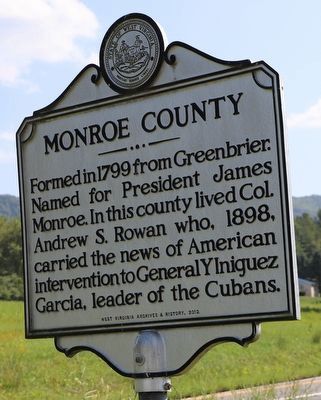
On Sweet Springs Valley Road (West Virginia Route 3) at Peters Mountain Road ( Route 311), on the right when traveling east on Sweet Springs Valley Road.
West Virginia. (Monroe County). "The Mountain State" - western part of the Commonwealth of Virginia until June 20, 1863. Settled by the Germans and Scotch-Irish. It became a line of defense between the English and French . . . — — Map (db m255187) HM
On U.S. 219 near 219/Mill st, on the right when traveling south.
West Virginia (Monroe County). "The Mountain State"- western part of the Commonwealth of Virginia until June 20, 1863. Settled by the Germans and Scotch-Irish. It became a line of defense between the English and French during . . . — — Map (db m118889) HM
On Seneca Trail (U.S. 219), on the right when traveling south.
Born here November 21, 1810, Monroe County, he served in both houses of the Virginia legislature before the civil war. Although he opposed secession, he voted for it in 1861 at the Richmond Convention. From 1863 to 1865, Caperton served in the . . . — — Map (db m128136) HM
The Sistersville Ferry is the longest continuously working mode of transportation in Monroe County, operating from 1815 to 2003. It crosses the Ohio River between Fly, Ohio, and Sistersville, West Virginia, which is the apex of the longest straight . . . — — Map (db m79270) HM
On Seneca Trail South (Route 219) east of Park Drive, on the right when traveling north.
This stone fountain is a remnant from when US Rt. 219 was one of the primary north-south roads in eastern West Virginia. Beginning at Rich Creek, VA, US 219 winds its way through the mountains before eventually reaching the northern terminus in . . . — — Map (db m305325) HM
Near South Monroe Street at Railroad Avenue (West Virginia Route 3).
Greenbrier County. Formed, 1778, from Botetourt and Montgomery. Named for the river which drains it. This county had many pioneer forts and saw many bloody Indian battles. Here are the world-famed White Sulphur and other mineral springs. . . . — — Map (db m76553) HM
On Main Street (U.S. 219) at Middle Street, on the right when traveling south on Main Street.
This is the Chapman House, built in 1803 and the home of one of Union’s most prominent families. Augustus A. Chapman and his son, George Beirne Chapman, both served the Confederacy in the Civil War.
Augustus Chapman, an attorney, was twice a . . . — — Map (db m59260) HM
On South Street east of Pump Street, on the right when traveling east.
The white building in front of you and the red brick house behind you are the former Union College, a Presbyterian school founded in 1820 as Union Academy and the earliest private school still standing in West Virginia. The white dormitory-dining . . . — — Map (db m59266) HM
Near Main Street (U.S. 219) north of Elmwood Lane, on the right when traveling north. Reported permanently removed.
The Confederate Monument, dedicated in 1901 to honor the local men who served the South, is up the walkway to your left. Thirteen Confederate companies were formed here in Monroe County.
From the top of the hill, behind the monument and the . . . — — Map (db m59269) HM
On Kanawha Trail (Virginia Route 311) south of Sweet Springs Lane, on the right when traveling south.
This monument marks the true boundary between Allegheny County, Virginia and Monroe County, West Virginia as determined by a joint commission representing the Commonwealth of Virginia and the State of West Virginia on December 2, 1958, and . . . — — Map (db m298544) HM
On Seneca Trail North (U.S. 219) north of Elmwood Lane, on the right when traveling south.
Standing here, you're surrounded by Civil War history.
To your left rests the monument dedicated in 1901 to honor local men who served the Confederate States of America. Thirteen Virginia companies were formed here in Monroe County.
To . . . — — Map (db m298526) HM
On North State Street (Ohio Route 3) at East Main Street, on the right when traveling north on North State Street.
From 1941 to 1967, Isaly's Dairy Store occupied this structure which
had an Art Deco influenced design. Isaly's was one of the first chain
businesses to come to Uptown.
The Isaly family, Swiss immigrants who settled in Monroe County,
Ohio, . . . — — Map (db m247891) HM
On Kanawha Trail (West Virginia Route 311) at Jefferson Lane, on the right when traveling south on Kanawha Trail.
Ann Royall. Ann Royall, America's first woman journalist, lived here. Widowed at 50, she became an author and prominent figure in national political life. In her newspaper, "Paul Pry," at Washington, she set the style for modern columnists. . . . — — Map (db m34489) HM
On Ballengee Street at 1st Avenue on Ballengee Street.
On February 27, 1871, Summers County was formed from parts of Fayette, Greenbrier, Mercer, and Monroe counties. Summers County was named for George W. Summers, a prominent jurist and legislator from Virginia then West Virginia. Summers County was . . . — — Map (db m243866) HM
On U.S. 219 0.2 miles south of Route WV 3, on the right when traveling south.
West Virginia’s first Corn Club was organized at Pickaway School on idea of county superintendent C.A. Keadle, with support from WVU Agricultural Dean T.C. Atkenson. WVU Extension Dept. provided 71 schoolchildren with tested seed in 1908 and 46 . . . — — Map (db m23998) HM
On Koontz Road (U.S. 219) at County Route 10/5, on the left when traveling south on Koontz Road. Reported missing.
Opened as a resort in 1820. Main building erected about 1823. Martin Van Buren, Clay, and Calhoun among prominent guests. General Jenkins and other Confederate leaders made headquarters here during several campaign. — — Map (db m253410) HM
On West Virginia Route 3/12 0.2 miles east of Huston Road, on the right when traveling east.
Great Bend Tunnel Construction
Construction of the Great Bend Tunnel aka the Big Bend Tunnel
began on 10 January 1870, tracks were laid 9 September -
12 September, 1872, and final completion of the tunnel was
in early 1873. The C&O . . . — — Map (db m165177) HM
Thin black lines indicate changes in relevance. Between each pair of lines entries are ordered geographically but all have the same relevance.
* Inflectional forms of words are their plurals, singulars, and possessives as well as gramatical tenses and similar variations.