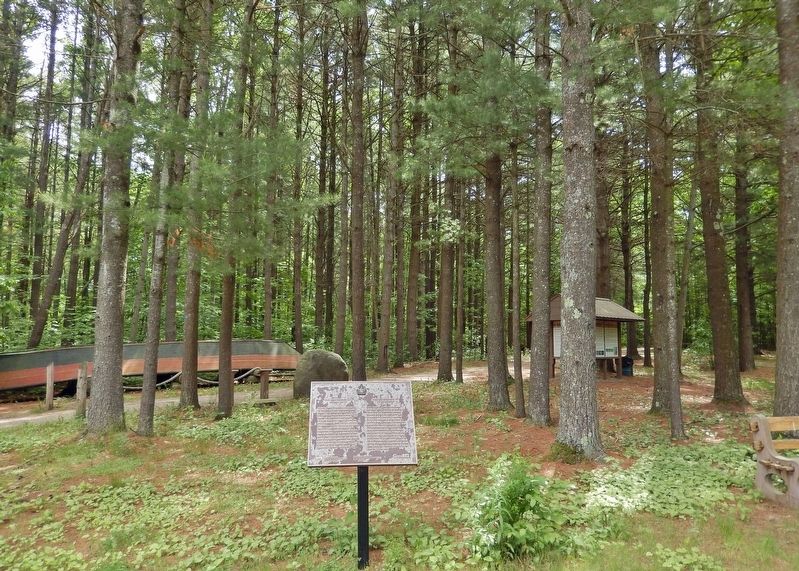
Near Grenfel Road 3.6 kilometers north of Sunnidale Road (County Road 40), on the left when traveling north.
[English] Linking Upper Canada to British posts on the Great Lakes, this supply chain played a vital role during the War of 1812. In 1813, after the Americans seized control of Lake Erie, the Nine Mile Portage and . . . — — Map (db m259864) HM
Near Grenfel Road 3.6 kilometers north of Sunnidale Road (County Road 40), on the left when traveling north.
During the War of 1812, the Nine Mile Portage from Kempenfel(d)t Bay to Willow Creek formed part of the vital route, via Yonge Street, Lake Simcoe, the Nottawasaga River and Georgian Bay, which linked Upper Canada with the British posts on the . . . — — Map (db m259850) HM
Near Grenfel Road 3.6 kilometers north of Sunnidale Road (County Road 40), on the left when traveling north.
Long-used as a trading route by indigenous people and then serving as a critical supply depot during the War of 1812, “Willow Depot” and the connecting Nine Mile Portage played a significant role in the development of our region and our nation. . . . — — Map (db m274589) HM
Near Grenfel Road 3.6 kilometers north of Sunnidale Road (County Road 40), on the left when traveling north.
People have been meeting at the site of Fort Willow for thousands of years. The first people in the area fished along the shorelines of Lake Nipissing 3,000 to 4,000 years ago. Evidence of their fishing camps has been found around the edge of what . . . — — Map (db m274633) HM
Near Grenfel Road 3.6 kilometers north of Sunnidale Road (County Road 40), on the left when traveling north.
In 1812, an urgent dispatch travelled by courier along the Nine Mile Portage and through Fort Willow to the British commander stationed at St. Joseph Island: The United States had declared war against Britain! The dispatch was sent via the . . . — — Map (db m274707) HM
Near Grenfel Road 3.6 kilometers north of Sunnidale Road (County Road 40), on the left when traveling north.
By the end of 1813, Fort Mackinac was critically low on provisions. A relief expedition via the Nottawasaga Route was organized under the command of Lt. Col. Robert McDouall of the Glengarry Light Infantry of Kingston. In January 1814, an advance . . . — — Map (db m274708) HM
Near Grenfel Road 3.6 kilometers north of Sunnidale Road (County Road 40), on the left when traveling north.
Following the War of 1812, the British recognized the strategic importance of the Great Lakes and set to work strengthening the defences of Upper Canada. Vast quantities of supplies passed this way to build and maintain new settlements including . . . — — Map (db m274709) HM
Near Grenfel Road 3.6 kilometers north of Sunnidale Road (County Road 40), on the left when traveling north.
Although the view is obscured by trees, Fort Willow is located on a ridge overlooking the Minesing Wetlands to the northwest. From the fort, the land drops nearly 40 metres to Willow Creek, a tributary of the Nottawasaga River that runs through the . . . — — Map (db m274808) HM
Near Grenfel Road 3.6 kilometers north of Sunnidale Road (County Road 40), on the left when traveling north.
Throughout the War of 1812, British forces relied on wooden batteaux to transport troops, supplies and provisions along inland waterways like Willow Creek and the Nottawasaga River. Coming from the French word for boat, batteaux were flat . . . — — Map (db m274469) HM
Near Grenfel Road 3.6 kilometers north of Sunnidale Road (County Road 40), on the left when traveling north.
In 1795, Captain Skinner founded the Royal Newfoundland Regiment in St. John's. By the summer of 1805 the regiment had grown to 683 men strong. During the War of 1812, detachments from the regiment were sent to Upper and Lower Canada where they . . . — — Map (db m274510) HM
Near Grenfel Road 3.6 kilometers north of Sunnidale Road (County Road 40), on the left when traveling north.
In early 1814, 200 men of the Regiment marched from Kingston, via York, along the Nine Mile Portage to this place. Here they built 29 batteaux which they took down the Nottawasaga River and across Georgian Bay to Michilimackinac with 30 tons of . . . — — Map (db m274394) HM
Near Grenfel Road 3.6 kilometers north of Sunnidale Road (County Road 40), on the left when traveling north.
As you wander through Fort Willow, you'll pass outlines of the historic buildings found on the site during archaeological digs. The first archaeological work at the site was completed by Wilfred Jury in 1959. Since 2005, students from St. Joseph's . . . — — Map (db m274396) HM
Near Grenfel Road 3.6 kilometers north of Sunnidale Road (County Road 40), on the left when traveling north.
Initial archeological reports from 1959 found large building foundations in two places, here and in the northeast corner of the fort. These foundations were so substantial that they were believed to have supported massive two storey structures, . . . — — Map (db m274401) HM
Near Grenfel Road 3.6 kilometers north of Sunnidale Road (County Road 40), on the left when traveling north.
Although researchers found no architectural features, there is abundant evidence that this area was the location of the smithy. They uncovered layers (or “strata”) of iron-stained soil in this area, as well as pieces of iron “slag” (a waste product . . . — — Map (db m274543) HM
Near Grenfel Road 3.6 kilometers north of Sunnidale Road (County Road 40), on the left when traveling north.
Researchers determined this to be the site of the stable and yard by looking at stains in the soil. The stable was likely built in 1814, and would have housed horses and the oxen used for hauling carts to Willow Creek. The only British Calvary . . . — — Map (db m274576) HM
Near Grenfel Road 3.6 kilometers north of Sunnidale Road (County Road 40), on the left when traveling north.
Our Plant Heritage — The “Three Sisters”The “Three Sisters” method of planting is a traditional agricultural strategy believed to have originated with the Iroquois before being adopted by Indigenous peoples across North America. Corn is the . . . — — Map (db m274398) HM
Near Grenfel Road 3.6 kilometers north of Sunnidale Road (County Road 40), on the left when traveling north.
The two buildings located here may have been separate units thought to be a visiting officer's quarters and commandant's house, or they may have been a commandant's house with an extension. In any case, artifacts recovered during excavation of . . . — — Map (db m274803) HM
Near Grenfel Road 3.6 kilometers north of Sunnidale Road (County Road 40), on the left when traveling north.
This site is believed to have housed the Officer's Cookhouse. Bone remnants found here show that while most of the soldiers' meat was from domesticated animals, soldiers took advantage of local hunting and fishing when they could. Some of the . . . — — Map (db m274804) HM
Near Grenfel Road 3.6 kilometers north of Sunnidale Road (County Road 40), on the left when traveling north.
The ceramic tableware found here point to it being the site of the barracks/cookhouse. The tableware were of a cheaper variety and included hand painted pieces. Several of the artifacts found in this area directly point to the presence of British . . . — — Map (db m274805) HM
Near Grenfel Road 3.6 kilometers north of Sunnidale Road (County Road 40), on the left when traveling north.
This building, along with the smithy and cookhouse, may have been built in 1814. They were somewhat short-lived, as it was reported in an 1820 Admiralty survey that they were burnt down. The function and age of the building remnants found here are . . . — — Map (db m274806) HM
Near Grenfel Road 3.6 kilometers north of Sunnidale Road (County Road 40), on the left when traveling north.
Researchers have recently excavated evidence of Indigenous campsites in this area. These finds were to be expected as the Nine Mile Portage route was heavily used by Indigenous peoples before the arrival of Europeans, and Indigenous allies of the . . . — — Map (db m274807) HM
Near Grenfel Road 3.6 kilometers north of Sunnidale Road (County Road 40), on the left when traveling north.
Near this site stood a settler's cabin unofficially called the “Hayes Homestead” after one of the families that called it home. Historical research shows that the cabin was likely built in the late 1800s, long after Fort Willow was abandoned by . . . — — Map (db m274397) HM