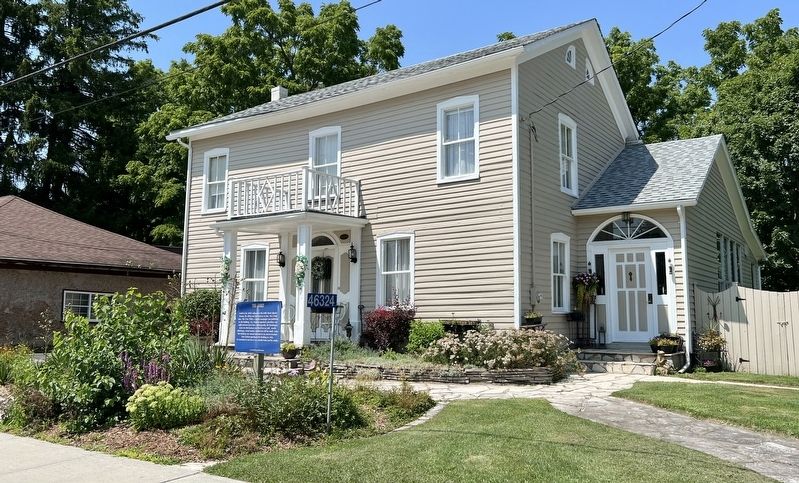
Built in the 1840's adjacent to the Mills Hotel (Sparta House), the Abbey was first used as an inn. For a brief time, The True Teller, a Sparta newspaper was published in this building. R.J. Stratton operated a furniture and coffin business . . . — — Map (db m260357) HM
A modest example of Greek Revival architecture and suited to the plain tastes of a Quaker-influenced community, this house was built in 1855. It is characterized by a symmetrical facade, and a centre doorway with pilasters and a dentiled cornice. . . . — — Map (db m260329) HM
Built by Henry Yarwood and sold to John Eakins.
The years 1840-1880 marked the prime years of the Sparta Settlement.
As the centre of the agricultural community, Sparta had good supplies of water and power supplied by numerous mills on Mill and . . . — — Map (db m260215) HM
This cairn was first erected in 1935 on the farm of Eli Mann by the Boy Scouts of St. Thomas. Eli had hosted all of the scout camps and activities on his farm for many years. In 1935, he died as a result of a goring by his bull and the scouts built . . . — — Map (db m260321) HM
As the War of 1812 began Sir Isaac Brock, Upper Canada's military governor, called all men for the militia to assist with the defense of the colony. Because of their historic Peace Testimony, and the understanding established when they came to . . . — — Map (db m255244) HM
Hiram came to Sparta in 1830 at the age of 19 with $5.00 and a tailor's goose (a 21 lb. iron for ironing woolen garments). He set up as a tailor on this site, building the house in 1842 for himself, his wife Sarah (Mills) and their two sons, Isaac . . . — — Map (db m260314) HM
The Doan family were the first settlers in the Corners (later named Sparta). Jonathan Doan came in 1813 from the Niagara Region and settled just west of the current village. His son Josfa took part in the 1837 Rebellion and fled to the United . . . — — Map (db m260218) HM
In the late 1800s, excessive drinking had become a major concern in the village of Sparta and a Temperance Society was formed with leadership from the Baptist minister, Rev. J.J. Baker, the Methodist minister, Rev.
W.H. Graham and Dr. G.A. Shannon. . . . — — Map (db m260312) HM
This property was originally settled by John Kipp, a Quaker who came up from Pennsylvania after the War of 1812, at the urging of Jonathan Doan. He began this home between 1819 and 1820. Early Quaker Meetings were held here and at Elias Moore's home . . . — — Map (db m260361) HM
This yellow brick building was constructed in 1886, and served as a Methodist Church until
1925 when it became a part of the new United Church of Canada. After substantial fundraising and local participation in its construction, it opened to great . . . — — Map (db m260359) HM
David Mills erected this finely built hotel in the American Colonial style: it had double verandas and classical proportions with a large ballroom on the second floor. It features dentils under the eaves, eave returns, a boomtown, pilastered doorway . . . — — Map (db m260216) HM
This area of Ontario was originally inhabited by the Attawandarons (Neutrals), but they were dispersed by the conflict between the Hurons and the Iroquois two hundred years before Europeans came to the area. In 1813 Jonathan Doan, a Quaker came . . . — — Map (db m255291) HM
This hotel was built in the 1840's by Hitchcock and sold to Isaac Moore who renamed it Elgín House after the governor of the day. Later the Elgin became Ontario House in 1872. This hotel seemed to have the better business than the other hotels in . . . — — Map (db m260358) HM
Here is one of the pioneer necessities of any village- the blacksmith's shop, which was built by a Mr. Keller from England.
A pit was dug in the clay bank, water added, straw scattered on this and oxen tramped down the mixture which was then built . . . — — Map (db m260355) HM