The Carcross and Tagish people gathered at Tagiush and the mouth of the McClintock River to trade and fish and camped by the Natasaheen Ruver when the Woodland Caribou migrated across the river.
The Klondike Gold Rush brought tremendous . . . — — Map (db m248719) HM
The Yukon steamers were all sternwheelers rather than sidewheelers. The paddlewheel at the rear of the boat allowed grounded steamers to wash the sand away from the hull by reversing their engines. Sternwheelers had a narrow beam enabling them to . . . — — Map (db m248668) HM
Near Klondike Highway (Yukon Route 2) north of Tagish Road.
During World War II, Carcross played an important role in Alaska Highway construction. The connection here between the White Pass rail and water transportation systems gave the U.S. Army access to the Yukon’s interior.
By early 1942, Carcross . . . — — Map (db m68899) HM
On Dawson Charlie Street, on the left when traveling north.
The Caribou Hotel is one of the oldest buildings in the Southern Lakes Region and is one of Yukon's longest-operating hotels.
The Yukon Hotel was moved here from Bennett City and named Anderson Hotel, Carcross/Tagish First Nation citizen . . . — — Map (db m248664) HM
Scotia Mac
"Scotia Mac" John McDonald joined the BYN Co. after working on several steamers for numerous organizations starting in 1896, mostly on Kootenay Lake in British Columbia.
In 1902, MacDonald worked on the sternwheeler . . . — — Map (db m248717) HM
The little engine known as the DUCHESS was once part of a matched set. She and her partner, the DUKE, were built in September 1878 for the Dunsmuir and Diggie Company.
For a time the two little locos hauled coal for the Wellington Colliery . . . — — Map (db m248651) HM
The first southern lakes sternwheelers were constructed on the shores of Lake Bennett during the Klondike Goldrush. They carried freight and passengers from Bennett City to Canyon City at the head of Miles Canyon just upstream from present-day . . . — — Map (db m248729) HM
On Dawson Charlie St, on the right when traveling east.
English:
"Skookum" Jim, a Tagish of the Dakhławèdí
clan and the Wolf moiety, found a nugget on
Rabbit (Bonanza) Creek in August 1896 that
began the Klondike Gold Rush and changed
the history of the Yukon. He made . . . — — Map (db m93750) HM
This reproduction lifeboat and three others were built in the mid-1980s as part of the SS Tutshi restoration project. The Tutshi had space for four lifeboats on the boat deck (so-named for the presence of the lifeboats). Each lifeboat . . . — — Map (db m248660) HM
On Dawson Charlie Street, on the left when traveling north.
On December 24th, 1909, fire swept through Carcross and destroyed many of the prominent buildings such as the depot, Caribou Hotel and General Store.
The Caribou had been an established hotel for some time and was once owned by Dawson Charlie, . . . — — Map (db m248652) HM
Welcome to the Tagish Valley Trail. The Carcross/Tagish people have traditions such as the moiety and clan system that have been followed for thousands of years and are still honored today. For centuries they have lived in this region, an area of . . . — — Map (db m248662) HM
The SS Tutshi was built by the British Yukon Navigation Company in 1917 at Carcross and was pulled out of service in 1955. The Yukon Government purchased the SS Tutshi in 1971 and began an ambitious restoration project that was . . . — — Map (db m248655) HM
Tagish Lake contains a number of reefs and sand bars especially at Golden Gate where Taku Arm and Taku Inlet meet.
Tagish and Bennett lakes are prone to fierce winds and in the fall of 1933, a heavy wind blew the Tutshi broadside against . . . — — Map (db m248722) HM
Construction of the WP & YR railway began on May 28, 1898, at Skagway and took 26 months to complete from Tidewater to Alaska. to Whitehorse, Yukon.
The rail line reached Bennett City, on the south end of Lake Bennett, on July 6, 1899. Land was . . . — — Map (db m248653) HM
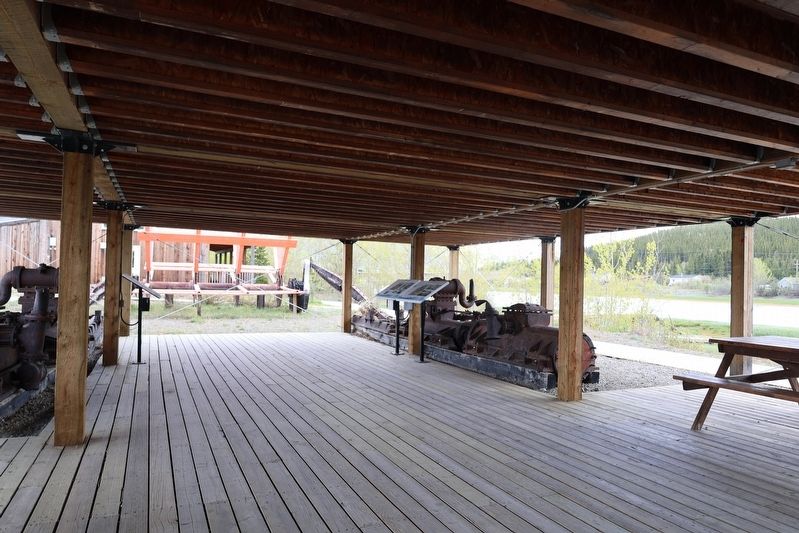
The pieces rescued from the 1990 fire represent the hundreds of meters of steam line and equipment that made the SS Tutshi an efficient and comfortable vessel.
Steam Winch:
A twin-cylinder horizontal steam winch was installed on the SS Tutshi . . . — — Map (db m248720) HM
The Dakl'aweidí and Yanyeidí clans of the Wolf moiety, and the Deisheetaan, Gaanaxteidí, Ishkahíttaan, and Kookhíttaan clans of the Crow moiety welcome you to the Traditional Territory of the Carcross/Tagish First Nation. The Tagish Valley Trail . . . — — Map (db m248659) HM
"To Dad,
Well, here were are, sailing up the Taku Arm, in the wilderness of the Yukon, on the quaintest old stern-wheeler steam-boat you ever saw.
The plumbing is the bowl and pitcher type, but it is all so much fun."
The southern . . . — — Map (db m248654) HM
The first steamboat, tested in 1807, was heralded as "the wonder of the age". The technology was developed and refined until a powerful steam engine, mounted on the light frame construction of a shallow hull, drove a side or stern-wheel vessel. This . . . — — Map (db m248716) HM
Construction of the White Pass & Yukon Railway began on May 27, 1898 at Skagway, Alaska during the height of the great Klondike Gold Rush.
Undaunted by those who said the railway could not be built a small group of devoted White Passers composed . . . — — Map (db m49366) HM
The golden spike was driven to mark the completion of the White Pass & Yukon Route Railway on July 29, 1900. It was the beginning of a fully integrated rail transportation system – which grew to include lakes & river steamboats, stage lines, . . . — — Map (db m72917) HM
The story of the White Pass & Yukon Route railway really begins in April of 1898, with a chance meeting in a Skagway saloon. A group of British financiers named the Close Brothers had acquired the charters that would allow them to build a railway . . . — — Map (db m248650) HM
On Dawson Charlie Street, on the right when traveling north.
White Pass and Yukon Railway
Completed in 1900
A tribute to the American and Canadian engineers who conceived, designed and
constructed the 110 mile narrow gauge railway to develop the
Yukon gold fields. The railway has since . . . — — Map (db m282328) HM
Construction of the WP & YR railway began on May 28, 1898, at Skagway and took 26 months to complete from Tidewater to Alaska. to Whitehorse, Yukon.
The rail line reached Bennett City, on the south end of Lake Bennett, on July 6, 1899. Land was . . . — — Map (db m248728) HM