(side 1)
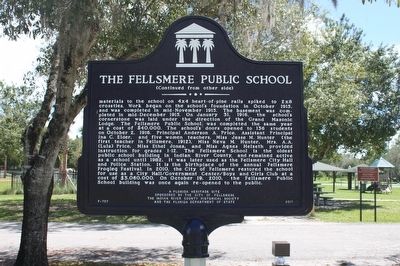
The Fellsmere Public School, the first masonry school building in what is now Indian River County, was constructed during 1915 and 1916 at 22 South Orange Street. The 22,680 square foot, two-story school with a raised basement was . . . — — Map (db m93265) HM
Fellsmere, the northernmost town in St. Lucie County in 1919, had a population of over 800 people. The county built the first public road to cross the St. Johns River marsh in St. Lucie County (now Indian River County). Promoted as the . . . — — Map (db m95495) HM
Treasure Hammock Ranch was established in 1943 by Indian River County pioneer Waldo E. Sexton, who arrived in 1913. The ranch and surrounding lands comprise headwaters of the Sebastian River set in a Chapter 298 Drainage District by the Florida . . . — — Map (db m213227) HM
River travel was vital to the early human activity of Florida and the Indian River area. In the early 1900's, efforts began to dredge the Indian River. By the 1930's, the U.S. Corps of Engineers routinely maintained this channel called the . . . — — Map (db m95033) HM WM
In Memory Of
William Jennings Bryan
The Great Commoner
Who delivered his last public address
from a platform erected upon this spot
at the celebration of the creation of
Indian River County, July 2nd, 1925.
He was the . . . — — Map (db m185871) HM
In the early 20th century, the Indian River was a highway for settlers and tourists. There were few roads, and no bridges from the mainland to the barrier islands in the Indian River County area. In 1923, a road with bridges was opened, crossing the . . . — — Map (db m212943) HM
(side 1)
Fellsmere Union Church, located at 12 North Hickory Street, is the first and oldest church in the City of Fellsmere. The Reverend James A. Liggitt, Pastor of the Presbyterian Church of London, Ohio, and a property owner in . . . — — Map (db m93260) HM
In 1833, August Park was born in Danzig, Germany. After immigrating to the United States, he traveled to New York, and later moved to Fort Pierce, Florida. Park settled in the Sebastian area in 1865, the first permanent resident of European descent. . . . — — Map (db m239205) HM
On February 23, 2005, the five Rotary Clubs of Indian River County joined together to break ground on this Centennial Fountain.
The fountain was built to commemorate Rotary International’s 100th Anniversary and revive the original Rotary . . . — — Map (db m185888) HM
This is the original site of McKee Jungle Gardens, one of Florida’s earliest tourist attractions. McKee Gardens was founded in 1932 by Vero Beach pioneer Waldo Sexton and Cleveland industrialist Arthur G. McKee. They engaged William Lyman . . . — — Map (db m92562) HM
Even before Florida became a state in 1845, the Indian River region was attracting pioneer settlers. These were mostly farmers seeking land to grow winter crops such as beans, cabbage, and tomatoes. They later become famous for growing pineapples . . . — — Map (db m213228) HM
In 1901, William E. Geoffrey, a black man, donated this land for a black school in Gifford. Funded with help from the Julius Rosenwald Foundation, which provided support for hundreds of black schools across Florida and the Southeast, the Gifford . . . — — Map (db m213229) HM
The Merian Fell Library, the oldest library in Indian River County, opened its doors to the public on May 1, 1915 at 63 North Cypress Street, Fellsmere, Florida. Construction of the library was made possible by Marian Fell, daughter of Edward Nelson . . . — — Map (db m93264) HM
The tee-beam bridge at this location carried traffic southbound on US-1 over the Florida East Coast Railway and Old Dixie Highway beginning in 1927. The tee-beam design, constructed from cast-in-place concrete beams and reinforced steel running . . . — — Map (db m95717) HM
In 1893, Henry Flagler's railroad arrived in Sebastian, and reached Ft. Pierce in 1894, bypassing the tiny community of Vero. Flagler renamed his railroad the Florida East Coast Railway (FEC) in 1895. Because of agricultural growth in the area, . . . — — Map (db m112159) HM
Two Dollar Bluff, prominently featured on the U.S. Geodetic Map of 1887, was considered a navigational aid for ships on the Indian River. Located on property owned by settler and citrus grower A.B. Michael, this bluff was an Ais Indian midden and . . . — — Map (db m212947) HM
In 1892, William Edward Geoffrey, an African American man from Darlington, South Carolina, came to work on the Florida East Coast Railroad in Gifford. The town's first school was built in 1898, but only served white children. In 1901, Geoffrey . . . — — Map (db m127810) HM
Frank William Heiser was born in Lafayette, Indiana, in 1892. He was orphaned at age 14 and later dropped out of school. In 1911, Heiser bought a 20-acre farm in Fellsmere and moved to the area in 1912. He married Fellsmere Sales Company secretary . . . — — Map (db m127811) HM
(front)
The pattern of community development which occurred in Vero Beach provides insight into some important aspects of Florida's history. Although the coastal waters in the region attracted fishermen, settlement of this area did not . . . — — Map (db m82788) HM
The Ays Indians lived along the confluence of the St. Sebastian and the Indian River (Rio d'ays) when the Spanish arrived in the 1500s. For hundreds of years after that, settlements in the Indian River area were restricted to the coastal areas where . . . — — Map (db m93109) HM
Dodgertown was the spring training facility of the Brooklyn/Los Angeles Dodgers. Originally part of a World War II Naval Air Station, Dodgertown became the spring training home of the Brooklyn Dodgers in 1948, when local business leader Bud . . . — — Map (db m308784) HM
In the early 1900s, Swedish immigrant and horticulturist Axel Hallstrom sought the warm climate of Florida for his wife's health and moved to this area to from tropical trees and fruits. He first planted pineapples on his new farmstead, in the area . . . — — Map (db m136027) HM
Osceola Park was one of the first residential subdivisions added to the town of Vero Beach and contains the city's largest concentration of early 20th century buildings. In 1915 and 1917, the Indian River Farms Company, who had platted the original . . . — — Map (db m93120) HM
A parade of Model T automobiles crossed the first bridge to span the Indian River on Labor Day 1920. This made Vero the first community with a bridge to Orchid Island. Made of sabal palm pilings and rough-cut planking, it began on the mainland side . . . — — Map (db m136026) HM
Site of the Main Hanger and Control Tower of the Vero Beach Naval Air Station (NAS) that was commissioned on 24 November 1942 to provide Navy and Marine flight training base for over 2700 men 300 WAVES and women Marines. The previously city-owned . . . — — Map (db m288823) HM
The Ais Indian town of Pentoaya is thought to have been located atop the arc-shaped sand bluffs that surround the western edge of what is now Ballard Park. Pentoaya was an important prehistoric Indian settlement on the east coast of Florida, and was . . . — — Map (db m82819) HM
Sanford sits on the southern shore of Lake Monroe in the middle basin of the St. Johns River. The river rises in the marshes of Indian River County and flows slowly north 310 miles to Jacksonville and the Atlantic Ocean. The river spreads out in a . . . — — Map (db m55396) HM
Thin black lines indicate changes in relevance. Between each pair of lines entries are ordered geographically but all have the same relevance.
* Inflectional forms of words are their plurals, singulars, and possessives as well as gramatical tenses and similar variations.