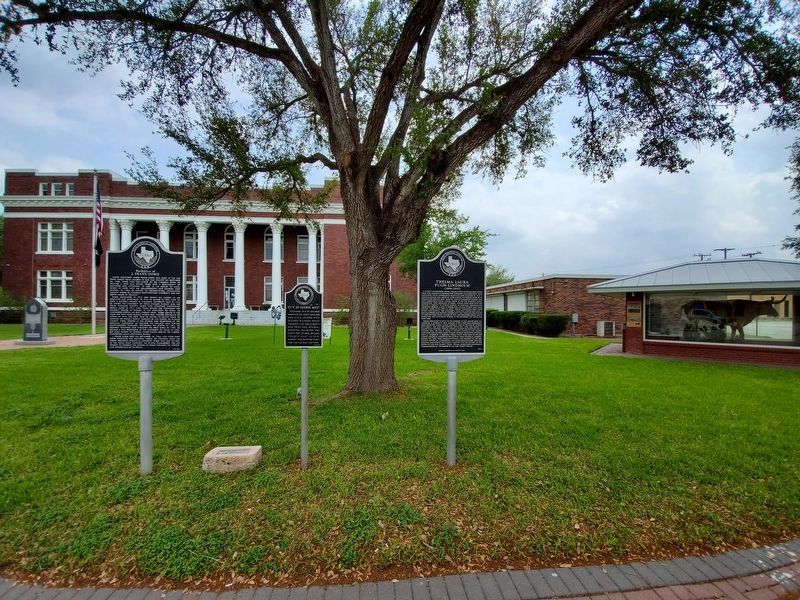
A fourth-generation Texan, Thelma Pugh-Lindholm descended from Irish emigrants Thomas and Margaret (McCann) Pugh, who purchased from empresarios McMullen and McGloin in 1835 a Mexican league and labor of land across the Nueces River from present-day . . . — — Map (db m132235) HM
Created by legislature Feb. 2, 1856, and organized Aug. 4 with Oakville as county seat. Formed from San Patricio and Nueces Counties. Named for its Live Oak trees.
County seat moved, 1919, to George West on railroad. Center for ranching, . . . — — Map (db m131941) HM
Raised by hard-working entrepreneurs, George West became a successful businessman who had a lasting impact on Live Oak County.
Texas or Bust
Seeking opportunity and success in a new land, the entrepreneurial West Family of West Point, . . . — — Map (db m231024) HM
Brought by early settlers and shaped by the wild Texas landscape, the tough longhorn is a Texas original
A True Texan
Spanish explorers introduced cattle to the new world. These long-horned ancestors of Geronimo roamed over the Texas . . . — — Map (db m231022) HM
Noted folklorist James Frank Dobie was born at the old Dobie Ranch near Lagarto in Live Oak County on September 26, 1888. Dobie was the eldest of six children born to Richard J. and Ella (Byler) Dobie and a descendant of ranchers and cattlemen. At . . . — — Map (db m132237) HM
Winters Park, Set Aside to Honor Family of James and Rhoda Creel Beall Winters. Pioneers who led their large family here in 1834 from Tennessee. Two older sons, Wm. Carvin and John Frelan Winters, came to Texas in 1832. On receiving their good . . . — — Map (db m274463) HM
Charles (Charlie) and Emma Tullis, native Live Oak County residents, shared roots preceding the Republic of Texas and Live Oak County. Charles' (b. Oct. 10, 1873) forebears, James and Rhoda Creel Beall Winters and family, walked from Tennessee to . . . — — Map (db m220687) HM
In Live Oak County, two generations of the Chapa family are remembered for their imprint on the land and the people. The family does not appear to have descended from aristocracy, yet those who knew them best bestowed the traditional honorific term . . . — — Map (db m220684) HM
One of George West's favorite lead steers, Geronimo stands today as a symbol of this community's longhorn legacy.
King of the Road
Spanning hundreds of miles over rough terrain, the cattle drives of the mid 19th century required . . . — — Map (db m231020) HM
The Texas Legislature created Live Oak County in 1852 and the first county seat was in Oakville. A native stone and lumber building constructed on the public square and modified through the years served as the county courthouse for more than sixty . . . — — Map (db m220682) HM
The Live Oak County community comes together to preserve the legacy of Geronimo.
Preserving Geronimo's Legacy
In 1927, George West's favorite steer Geronimo was preserved and placed in an all-glass structure on the grounds of the Live . . . — — Map (db m231027) HM
In 1856, Live Oak County organized, first officers elected, at this site. Scene of picnics, horse races, school programs. Recorded Texas Historic Landmark — — Map (db m291003) HM
Late in 1899 James (Jim) Monroe Cunningham moved to Oakville from Devine and bought the Live Oak County Leader. Cunningham soon married Sara Emma (O'Neal) and they began a family. When Oakville was bypassed by the San Antonio Uvalde and Gulf . . . — — Map (db m220622) HM
From the early days of Spanish colonial Texas well into statehood, the only "Highways" in the area were primitive dirt roads. Although many had names, others were simply called "Ox-Cart roads" for the sturdy Mexican carts so frequently seen on them. . . . — — Map (db m220633) HM
Dinero was settled in the year 1838 by farmers and ranchers. The town was first named "Barlow" after the local ferry operator. The townspeople were instrumental in organizing Live Oak County, 1856; they started a school by 1858. By about 1872, . . . — — Map (db m291006) HM
As late as 1920 dilapidated rock walls stood on this site, known as Fort Ramirez. Treasure hunters pulled them down and workmen hauled them to the hollow below. Erected by two brothers named Ramirez, from whom Ramirena Creek derived its name, . . . — — Map (db m286473) HM
By 1912, when George W. West began developing his namesake town in Live Oak County, Oakville Baptist Church, located in the county seat of Oakville, had an active ministry locally and throughout the county. Six other Live Oak County communities . . . — — Map (db m220640) HM
Oakville, seat of Live Oak County from 1856-1919, first called "On the Sulphur," was near a Nueces River crossing called Puente de la Piedra (Rock Crossing). Joseph Bartlett built a stone courthouse and attached log jail in 1857 as a center of . . . — — Map (db m180855) HM
The George West Cemetery was originally part of the George West Ranch. The ranch dates to the 1880s, when George Washington West (1851-1926) and his wife, Kitty Searcy West (1858-1939), purchased 140,000 acres in Live Oak County. On March 4, 1916, . . . — — Map (db m288603) HM
Thin black lines indicate changes in relevance. Between each pair of lines entries are ordered geographically but all have the same relevance.
* Inflectional forms of words are their plurals, singulars, and possessives as well as gramatical tenses and similar variations.