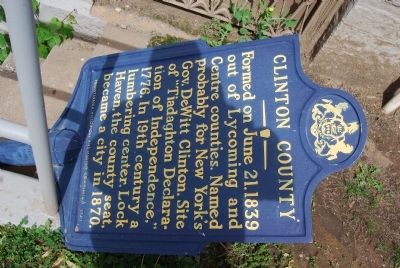
Formed on June 21, 1839 out of Lycoming and Centre counties. Named probably for New York's Gov. DeWitt Clinton. Site of "Tiadaghton Declaration of Independence," 1776. In 19th century a lumbering center. Lock Haven, the county seat, became a city . . . — — Map (db m65547) HM
A journey down the West Branch tells the tale of lumbering in Pennsylvania, from the early lumber mills to today's sustainable forests. As you float downstream you will see the legacy of lumber; the "rafting points" used by river pilots to navigate . . . — — Map (db m87639) HM
A journey down the West Branch tells the tale of lumbering in Pennsylvania, from the early lumber mills to today's sustainable forests. As you float downstream you will see the legacy of lumber; the "rafting points" used by river pilots to . . . — — Map (db m251275) HM
A journey down the West Branch tells the tale of lumbering in Pennsylvania, from the early lumber mills to today's sustainable forests. As you float downstream you will see the legacy of lumber; the "rafting points" used by river pilots to . . . — — Map (db m263023) HM
Welcome to Bellefonte, the county seat of Centre County and one of the "Gateways" into the Lumber Heritage Region of Pennsylvania. The history of lumbering in Centre County can be divided into four phases. The earliest lumbering operations were . . . — — Map (db m134708) HM
1810 Irish immigrant Roland Curtin Sr. and Cumberland
County native Moses Boggs establish Eagle Forge (iron refinery)
near Philip Antes' grist-and-lumber mills 1,000 feet northwest
of this spot, on the south side of Bald Eagle . . . — — Map (db m275201) HM
When pioneers ventured into northwestern
Pennsylvania in the early 1800s, they
encountered a daunting landscape
blanketed by dense, dark, ancient forests
unlike any they had encountered in New
England or eastern Pennsylvania. In . . . — — Map (db m251181) HM
Timbering — Clinton County, at one time of settlement was considered one of the most remote parts of Pennsylvania. It is likely that during this early time most of the area was densely covered with white pine, eastern hemlock, and hardwoods . . . — — Map (db m176028) HM
Timbering — Clinton County, at one time of settlement was considered one of the most remote parts of Pennsylvania. It is likely that during this early time most of the area was densely covered with white pine, eastern hemlock, and hardwoods . . . — — Map (db m282643) HM
Migrated from Switzerland in 1758, locating between Philadelphia and Lancaster…
In 1767, he settled on the farm on which Barner's Church is now located…..
He married the widow of John Bunn. They had two sons. One son, Henry Barner, . . . — — Map (db m253347) HM
The Goshen Road was one of the earliest roads in Clinton County and was traveled by its first settlers. The original road was blazed by wild animals and Native Americans. The first record of its use, however, was in 1808 when its course was mapped . . . — — Map (db m98931) HM
In 1912, there were approximately one million motor vehicles registered in the United States but few good roads. Most of the roads outside of urban areas were dirt that turned to mud when wet. Long-distance travel by car was still very much a . . . — — Map (db m162418) HM
Jonah’s Run Baptist Church.
The comingling of faiths in an area settled predominantly by
Quakers helps explain the origins of Jonah’s Run Baptist Church.
Ministered to by a Baptist preacher, the children and neighbors of
Daniel Collett . . . — — Map (db m141498) HM
Lock Haven...looking to the future, warmly remembering its past!
Nestled between the West Branch of the Susquehanna River and the scenic mountains of Central Pennsylvania, Lock Haven has small town charm and a rich historical architectural . . . — — Map (db m251748) HM
During the American Revolution (1775-83),
what is now Clinton County was the
northern frontier of Northumberland
County. In 1776, William McElhattan,
Robert Love, William Dunn, and many
others answered the call for independence
and reported . . . — — Map (db m275118) HM WM
Thin black lines indicate changes in relevance. Between each pair of lines entries are ordered geographically but all have the same relevance.
* Inflectional forms of words are their plurals, singulars, and possessives as well as gramatical tenses and similar variations.