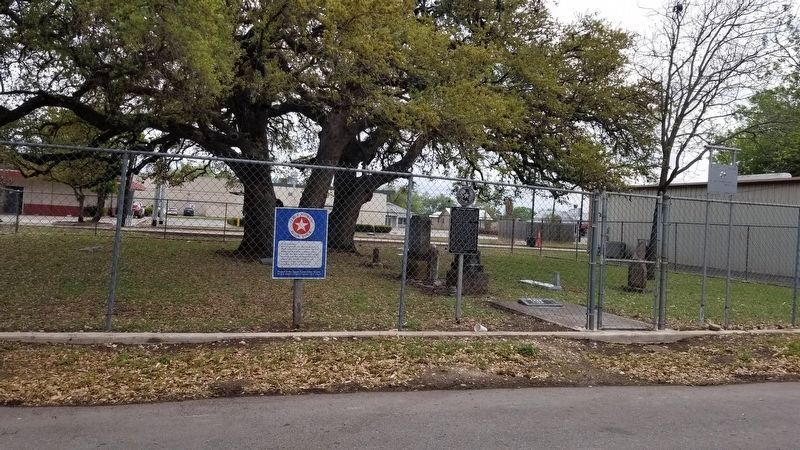
On East Gonzales Street 0.1 miles west of North King Street, on the left when traveling west.
Also known as King Ranger Cemetery, this burial ground is a link to the history of one of Seguin's earliest families. Three brothers, John Rhodes, Henry Basil and William George King were among the city's residents during the days of the Republic . . . — — Map (db m155719) HM
On West Court Street (Alternate U.S. 90) at West Kingsbury Street (U.S. 90), on the right when traveling east on West Court Street.
Formed from
Gonzales and Bexar counties
Created March 30, 1846. Organized July 13,1846
Named for the Guadalupe River
to which this name was given
by Alonso De Leon
in 1689
Seguin, the county seat
named in honor of
Juan Nepomuceno . . . — — Map (db m128120) HM
Near East Walnut Street (County Highway 202) 0.2 miles east of North Highway 123 Byway (State Highway 123).
Born in Kentucky, 1806. Came to Texas in 1835. Joined the Texas Army on its way to San Antonio. One of the storming party who entered Bexar, December 5, 1835. Died in Guadalupe County Texas, 1888 — — Map (db m294452) HM
On Farm to Market Road 539 0.2 miles south of Polly Lane, on the left when traveling north.
Joseph Henry Polley (1795-1869) was born in Whitehall, New York to Jonathan and Rachel Hubbard Polley. He later moved to Missouri, where he was a friend of Moses Austin, with whom he traveled to Texas in 1820. The next year, he returned to Texas . . . — — Map (db m167557) HM
Near 4th Street west of Flint Avenue, on the left when traveling west.
This cabin was built during the Republic of Texas period (1836-1845) and represents the simple architecture of early frontier days. Located in what is now Guadalupe County Texas, it was constructed of winged elm logs chinked with mud from a nearby . . . — — Map (db m135409) HM
On East Walnut Street east of Bypass Texas Highway 123.
Located on the banks of the San Geronimo Creek, this cemetery was originally known as Beard’s Burial Ground when William and Margaret (Bridges) Beard were buried on their family farm in 1846. William Beard first came to Texas as part of the Stephen . . . — — Map (db m294471) HM
On East Donegan Street at South Austin Street (State Highway 123), on the right when traveling west on East Donegan Street.
Eight generations of the ancestors of the Carl Christian Zuehl - Hanna Marie Wreede Zuehl have contributed to the legacy of Texas history since 1846. Leaving their hometown in Tribsees, Stralsund, Prussia with three of their five children, they . . . — — Map (db m170118) HM
On Farm to Market Road 621 west of Staples Drive, on the right when traveling west.
Named for Edward Clark, first Confederate governor of Texas, whose executive order June 8, 1861, created voluntary camps of instruction such as this. Food, camp facilities and guns were voluntary gifts by local people. Farmers, merchants, artisans, . . . — — Map (db m149933) HM
On Navasota Street at East 8th Street, on the right when traveling north on Navasota Street.
Born in Virginia, March 28, 1808 · Died in Guadalupe County, Texas December 21, 1847
Commanded a company of the New Orleans Grey at the capture of Bexar, 1835. Inspector General at San Jacinto. Council House Fight, . . . — — Map (db m289939) HM
Near Landa Park Drive at Monument Drive, on the right when traveling north.
Panel 1
The first German settlements in Texas were Industry in Austin County, founded by Friedrich Ernst in 1831, Biegel in Fayette County, founded by Joseph Biegel in 1832, Cat Spring in Austin County, founded by the von Roeder, Kleberg, . . . — — Map (db m210312) HM
Near Lakeside Pass (County Highway 358) 0.7 miles east of Farm to Market Road 725, on the left when traveling east.
German immigrant August Wilhelm Schumann (1791-1858) arrived in Texas with his family in 1846 and bought a large parcel of land in Guadalupe County. Meeting a wagon train of immigrants from his homeland a few months later, he agreed to sell them . . . — — Map (db m210807) HM
On East Court Street (Alternate U.S. 90) at South Austin Street (State Highway 123), on the right when traveling east on East Court Street.
Cabeza de Vaca traveled the "River of Nuts" which was the Guadalupe. He was the first European to record the existence of pecans. He noted they were good food and recognized alternate bearing. He was held captive for 9 years on the "River of Nuts" . . . — — Map (db m158355) HM
On East Donegan Street near South River Street, on the right when traveling west.
To honor Stephen Fuller Austin, the Father of Texas,
the children of Guadalupe County planned this tree
in the year of his 207th birthday, November 3, 1793.
This Live Oak tree was germinated from the huge Live Oak tree
that stands today . . . — — Map (db m232677) HM
Near East Walnut Street (County Highway 202) 0.2 miles east of North Highway 123 Byway.
Came to Texas in 1830. Participated in the Texans Campaign against Bexar 1835. Wounded in the Battle of San Jacinto, April 21, 1836. Died in Guadalupe County, 1860 — — Map (db m294451) HM
Near Navasota Street at East 8th Street, on the right when traveling north.
Who served under General Jackson in the Creek War, 1813
Soldier in the Army of Texas, 1835
Born in Maury County, Tennessee January 12, 1792
Died in Guadalupe County, Texas February 15, 1871
His wife Kissiah Hines Tom
Born October 15, . . . — — Map (db m44738) HM
On Warncke Road 1.2 miles south of Farm to Market Road 775, on the left when traveling north.
Heinrich Warncke (1839-1908), Elisabeth Eitzmann Warncke (1844-1921) and their two children emigrated from Germany to Ohio in 1868. Within several years their growing family joined other German settlers in New Berlin. Between 1876 and 1882 they . . . — — Map (db m207595) HM
On Cordova Road 0.1 miles west of State Highway 123, on the right when traveling west.
This was the first gasoline operated tractor in Guadalupe County. The model D was the first production tractor to come standard with a starter and lights. It also utilized the Remy Governor Generator system, which used a rheostat linked to the . . . — — Map (db m210909) HM
On East Klein Street 0.1 miles east of South River Street, on the right when traveling east.
This cemetery traces its origin to the Smith family graveyard established by early settlers to this area. Ezekiel (1781-1854) and Susanna (1774-1848) Smith and their four sons migrated to Texas from Virginia. In 1837 Ezekiel was granted land in . . . — — Map (db m158351) HM
On Farm to Market Road 1681 at County Highway 438, on the right when traveling east on Highway 1681.
The community of Nockenut began in 1857, when a number of German and Polish immigrants settled in this area. Originally located in Guadalupe County, it became part of Wilson County after a boundary change in 1869. A post office opened in 1858, and . . . — — Map (db m207564) HM
On South Washington Street at McLain Street, on the left when traveling south on South Washington Street.
Created February 1, 1858 Organized April 23, 1879
Named in honor of Dr. Henry W. Baylor
1818-1854
Indian fighter and Ranger Captain served in the Mexican War.
Seymour, the County Seat — — Map (db m178509) HM
On Farm to Market Road 775 at Farm to Market Road 2538, on the left when traveling south on Highway 775.
The community of New Berlin developed as German settlers came to the area in the 1840s. Businesses, schools and churches were established to serve its residents. In 1898, Luedger Kuehler, H.E. Kalies and Otto J. Muelder entered into a partnership, . . . — — Map (db m207701) HM
A soldier in the Army of Texas in the Mier expedition, 1842 Born in Virginia Died in Seguin, Texas October 28, 1854 Erected by the State of Texas 1936 — — Map (db m269126) HM
On Sweet Home Road (County Highway 409) near Settlers Way (County Highway 411B), on the left when traveling south.
Located in southwest Guadalupe County, the Sweet Home Vocational and Agricultural School served the educational needs of Negro students in Guadalupe County from 1924 until 1962. It was built in part with money from the Rosenwald Fund, a . . . — — Map (db m207573) HM
Thin black lines indicate changes in relevance. Between each pair of lines entries are ordered geographically but all have the same relevance.
* Inflectional forms of words are their plurals, singulars, and possessives as well as gramatical tenses and similar variations.