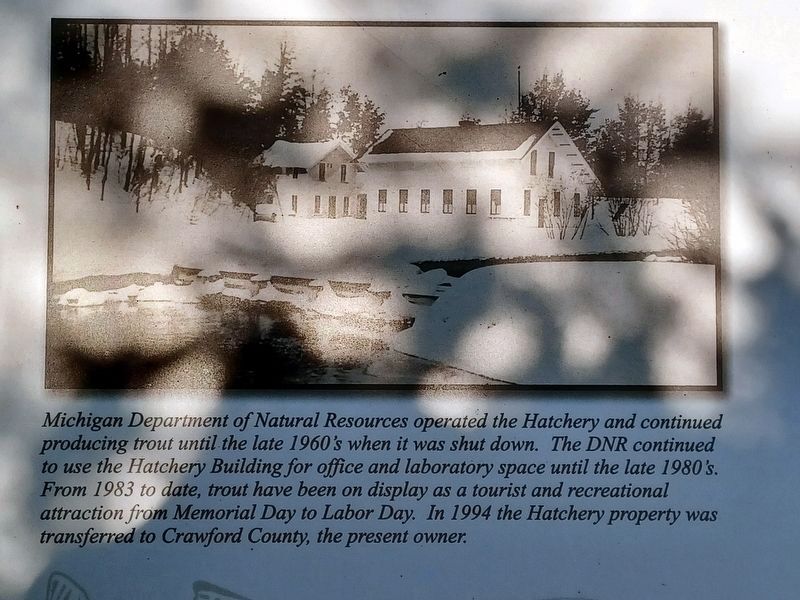
The Grayling Fish Hatchery was established in 1914 by local lumber baron Rasmus Hanson, together with several notable wealthy sportsmen (including Henry and Edsel Ford), as a private fish hatchery.
The native grayling fish were gone from the . . . — — Map (db m230716) HM
The partnership between the City of Grayling and Camp Grayling remains strong after a hundred years. Established on May 2, 1913, under Michigan Public
Act 172, Camp Grayling exists because of the generosity of Rasmus Hanson, a Grayling resident who . . . — — Map (db m213401) HM
A concern over the depletion of Michigan's forest led in 1899 to the creation of a forestry commission. In 1903 the first state forest was set up by the legislature on cut-over, burned-over lands in Roscommon and Crawford counties. The same year . . . — — Map (db m213393) HM
This trout stream was constructed to replace three straight channels, which were edged with broken concrete and rusty steel sheet piling, were silted over time to a shallow depth and were warming the water as they flowed slowly to their outlets . . . — — Map (db m230874) HM
This beautiful trout-like fish, with its sailfish-like dorsal fin, was plentiful in our local rivers in the middle and late 1800s. The grayling were easy to catch, fun to catch and tasted too good.
Wagon loads of grayling were caught and . . . — — Map (db m230790) HM
In 1921, the state passed a bill creating the Michigan Department of Conservation. The bill consolidated management of game, fish, forests and state parks from other agencies to the new department.
During the early years of state forest . . . — — Map (db m251724) HM
Side 1
State forest advocate Charles William Garfield (1848-1934) spent his life studying trees and forests. His father taught him that trees were important because they were "one of God's most attractive creations." As a . . . — — Map (db m250734) HM
After the old growth timber was cut in the 1920s, many jobs at lumber camps and mills disappeared. Some Crawford County residents turned to outdoor recreation to make a living. Locals guided fishing and hunting trips, while resorts and lodges . . . — — Map (db m250724) HM
In 1871, the Jackson, Lansing & Saginaw Railroad (JL&SR) began laying track north from Bay City. One year later, JL&SR built a freight station called Crawford to aid nearby logging businesses that used temporary, narrow-gauge rail lines. In 1873, . . . — — Map (db m278835) HM
In northern Crawford County, where the Kollke and Bradford Creeks converge, the Au Sable River begins its 138-mile journey to Lake Huron. The Anishnaabek called the river Mudaubeebetonagnce, which means "flowing from the interior to the lake." . . . — — Map (db m278833) HM
In 1872, the Jackson, Lansing and Saginaw railroad built "Crawford Station" to serve logging activities. It was located where the Crawford County Historical Museum stands today. In 1874, residents voted to rename their town Grayling in honor of . . . — — Map (db m278832) HM
Camp Grayling is the largest National Guard training facility in the United States.
In 1913, lumber magnate Rasmus Hanson donated over 13,000 acres of cut-over land to the State of Michigan for military training. Originally named the Hanson . . . — — Map (db m251737) HM
For thousands of years, Michigan's forests have provided people with resources to meet their needs.
The Anishinaabek used trees to create tools, canoes and homes. Their deep knowledge of trees included knowing when and how to remove birch . . . — — Map (db m250733) HM
The Great Lakes Region was once covered by glaciers that were more than one mile thick. These heavy ice sheets advanced and retreated over time, exerting forces that sculpted the land below.
Approximately 10,000 years ago, after global . . . — — Map (db m251738) HM
Crawford County's forests are home to a variety of wildlife. The species pictured here are endangered or rare. What do their stories teach us about conservation and the effect of humans on the natural landscape?
Railroads and automobiles . . . — — Map (db m251718) HM
On May 8, 1968, two separate forest fires destroyed more than 6,200 acres of forest in this area. Smoke from both fires would have been visible from here.
The Crawford County Avalanche reported: "The first fire observed by county . . . — — Map (db m278918) HM
Forests contain a variety of plants that people use to meet their basic needs. Throughout history, communities evolved by sharing specific knowledge of both native and introduced plants.
Even today, plants continue to provide food, dyes, . . . — — Map (db m278912) HM
Thin black lines indicate changes in relevance. Between each pair of lines entries are ordered geographically but all have the same relevance.
* Inflectional forms of words are their plurals, singulars, and possessives as well as gramatical tenses and similar variations.