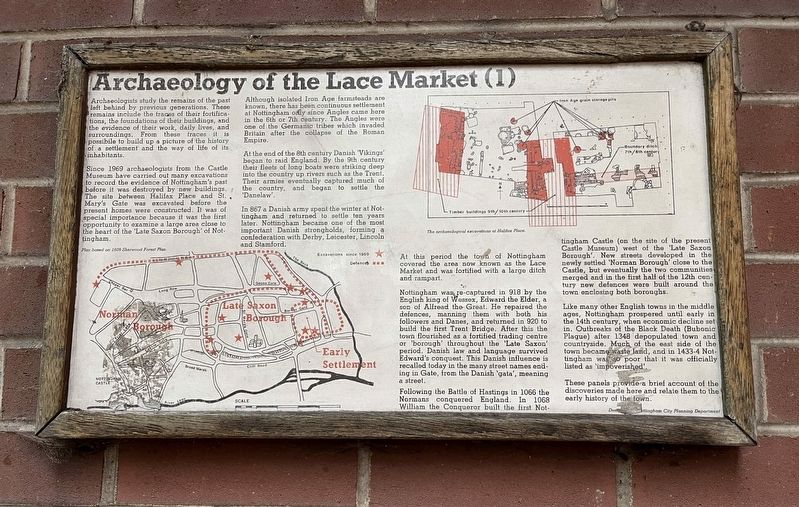
Archaeologists study the remains of the past left behind by previous generations. These remains include the traces of their fortifications, the foundations of their buildings, and the evidence of their work, daily lives, and surroundings. From these . . . — — Map (db m245272) HM
The earliest evidence of human activity found on the site was a number of grain storage pits -- part of an Iron Age farmstead dating to more than 2,000 years ago. This was the second such farm to be found near the city centre, the first being at . . . — — Map (db m245287) HM
Castle Ditch You are overlooking the site of a dry ditch that protected the Castle. This ditch prevented invaders from tunnelling beneath the curtain walls, and was therefore important to the Castle defences. Latrines (outdoor toilets) might . . . — — Map (db m248646) HM
The Council House stands on a site once part of Nottingham's Great Market Place. This was called "the most fairest without exception in all England" by Henry VIII's antiquary John Leland. From medieval times right through to the 1920s a Saturday . . . — — Map (db m246810) HM
Near this site King Charles I raised his royal standard on August 22nd 1642, an act which marked the beginning of the English Civil War.
Presented by the Sealed Knot Society on the 350th anniversary. — — Map (db m248412) HM
Great Hall
The Great Hall was built for King Henry II in 1181-83. Henry had beseiged Nottingham Castle as a young prince when fighting his uncle, King Stephen.
The Great Hall once stood before you. A focal point of formal Castle life, it . . . — — Map (db m248647) HM
The first half of the 19th century saw the decline and destruction of the great mansions in the Lace Market, and the development of the hosiery, cotton and lace trades. It was the lace trade which was to transform the area.
Machines adapting . . . — — Map (db m248257) HM
When Leland, the King's Antiquary, visited Nottingham in the 1530's its population was estimated at 3,000. He found the town well built, with houses of timber and plaster on the hill rising from the Leen to St. Mary's and the Castle partly in . . . — — Map (db m248256) HM
Great Chapel and Great Kitchen
The Middle Bailey was central the functioning of the medieval castle. It was the location of the Great Hall (used for celebrations), the Great Chapel (used for worship), and the Great Kitchen (where feasts . . . — — Map (db m249789) HM
From timber to stone
The medieval Castle was an imposing timber fortress built for William the Conqueror around 1068. It was strategically positioned to maximise the advantages of the natural terrain. Over time, it was rebuilt in stone. The . . . — — Map (db m249791) HM
In front of you is a ruined section of Middle Bailey wall. A bailey is an enclosed area within a castle. Nottingham Castle has 3 baileys: an Outer, Middle and Upper Bailey, all of which, in medieval times, would have been strongly defended. . . . — — Map (db m248411) HM
Outer Bailey
A castle "bailey" is a compound surrounded by walls. A medieval castle could have several and by 1200, Nottingham Castle had three. You are standing in the castle's Outer Bailey. It was well fortified to protect the castle's . . . — — Map (db m249787) HM
Nottingham's famous outlaw is the stuff of legend. An international icon of English folklore for centuries.
But what is the story the hood?
Deep in the heart of Sherwood forest, among the ancient oaks, the King's road between London and . . . — — Map (db m248260) HM
Nottingham is a city of rebellion and has been for centuries. There's something ingrained deep in the civic psyche that makes the city and its inhabitants defiant in the face of oppression. It's impossible to precisely put a finger on where this . . . — — Map (db m248263) HM
Robin was on his way to Fountaindale Abbey when he came across a very fat friar, sitting on the bank of the river eating an enormous lunch.
Robin needed to cross, so he asked the friar if he would give him a piggyback across the deep and . . . — — Map (db m248416) HM
Robin Hood travelled a great distance and saw many battles in his years, and by old age, he certainly wasn't without his ailments. So Little John and Robin traveled to a nunnery in Kirklees for treatment from Robin's cousin, the Prioress. . . . — — Map (db m245262) HM
If you've heard of Robin Hood, chances are you've also heard of his faithful friend, Little John.
The two men - both outlaws living in Sherwood Forest - weren't always friends. They first came face-to-face while crossing a stream bridge by a . . . — — Map (db m253556) HM
This plaque commemorates the 150th anniversary of the formation of the Robin Hood Rifles, Nottingham's original volunteer militia, who first mustered on the East Terrace of the Castle under the command of Major Jonathan White on the 30th May 1859. . . . — — Map (db m248414) HM