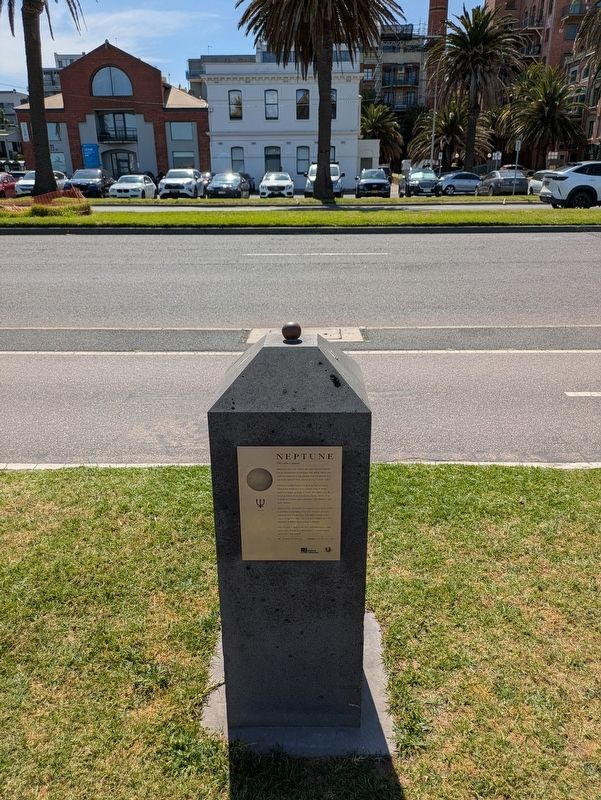
This series is for the set of markers found along the Solar System Trail.
See “Solar System Trail” (https://stkildamelbourne.com.au/wp-content/uploads/2015/11/Solar_System_Self_Guided_Trail_web_friendly.pdf) for more information.
Neptune is the most distant gas giant and like Uranus has an atmosphere of hydrogen with some helium and methane. Neptune is the coldest of all the planets and has more methane than Uranus giving it a bluer colour.
Whirling through Neptune's . . . — — Map (db m315279) HM
Saturn is one of the gas giants of the Solar System and is famous for its magnificent system of rings.
The rings extend more than twice the diameter of Saturn and are made up of billions of icy rocks ranging in size from small grains to . . . — — Map (db m315282) HM
Earth is the third and largest of the rocky planets of the inner solar system.
At its centre, the Earth's core is made up of mostly solid iron, covered by a thick mantle of liquid rock. Over this lies a thin outer crust of rocky silicate . . . — — Map (db m315886) HM
Massive Jupiter contains more than twice the material of all the other planets combined. Like all other gas giants it has no solid surface. Its thick atmosphere, thousands of kilometres deep, consists of hydrogen, some helium, methane and ammonia. . . . — — Map (db m315508) HM
Mars is the last of the four rocky planets of the inner Solar System.
Mars has fired the curiosity and imagination of mankind for thousands of years. It has been thought to be a potential home to alien life and some astronomers even thought it . . . — — Map (db m315885)
Mercury is the innermost of the four rocky planets close to the Sun.
Mercury is a grey barren world in many ways similar to our Moon. Its surface is covered in a thick layer of dust and is heavily scarred with impact craters. Because Mercury . . . — — Map (db m315952) HM
Proxima Centauri is the nearest known star to the Sun, at a distance of 4.2 light years or 40 trillion km. It is a low-mass, faint, red dwarf star and is much smaller and cooler than our Sun. It is also classified as a flare star, meaning that it . . . — — Map (db m315956) HM
The Sun is the star at the centre of our Solar System and incredibly it makes up almost 100% of the Solar System's mass. Due to its great mass, the Sun's gravity dominates the Solar System and holds all of the planets in orbit. The energy it . . . — — Map (db m315954) HM
Venus is the second of the innermost rocky planets and is very similar in size to Earth, It is often called the 'evening' or morning, star as it appears in our sky soon after sunset or just before sunrise.
The planet's dense atmosphere of . . . — — Map (db m315950) HM