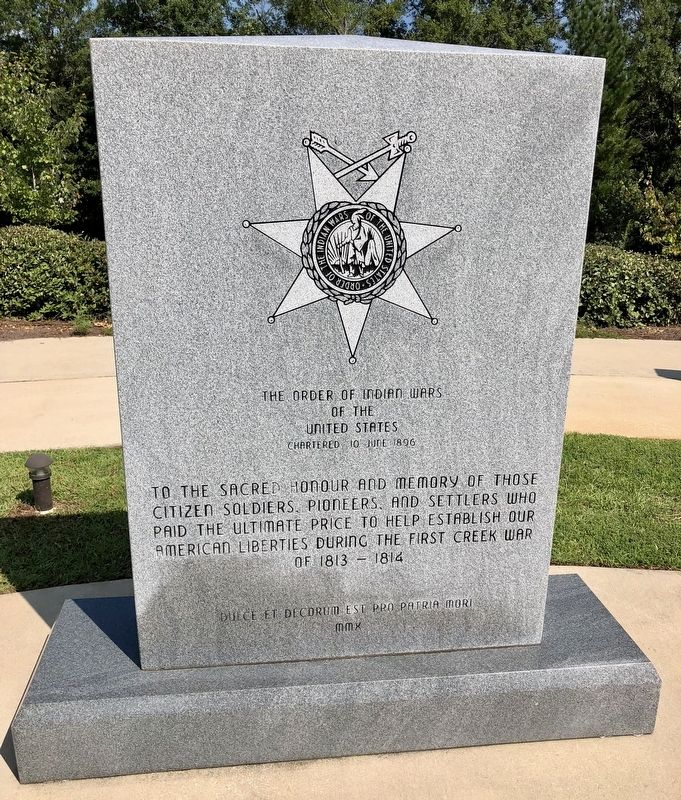
27 July 1813 – Battle of Burnt Corn
30 August 1813 – Fort Mims Massacre
31 August 1813 – Kimbell – James Massacre
2 September 1813 – Attack at Fort Sinquefield
13 September 1813 – Wood's Bluff . . . — — Map (db m122631) HM WM
Born and educated in England, Toulmin became a Unitarian Minister and fled persecution in 1793. In the U.S. he served as President of Transylvania University and Secretary of the State of Kentucky. In 1804 Thomas Jefferson appointed him as the first . . . — — Map (db m100850) HM
This is the site of Francis B. "Frank" Bonifay's law office. Bonifay was the first Probate Judge of Escambia County Alabama 1869 - 1870. Jesse Howard was elected in 1871 and served for a short time but resigned and Bonifay served from 1870 - 1874. . . . — — Map (db m130674) HM
Don't weep for me
O' Land of the free
When it was my time to fall
'Twas for my country's call
'Twas for the land that I loved
That I gave my all
And for the land that I loved,
I did freely give
And in her freedom
And . . . — — Map (db m122607) WM
William Bartram, America’s first native born artist - naturalist, passed through Baldwin County during the Revolutionary era, making the first scientific notations of its flora, fauna and inhabitants. As the appointed botanist of Britain’s King . . . — — Map (db m81855) HM
Ruins of the original Foundation of
Baldwin County's First Courthouse
Authorized 1820 • Constructed circa 1833
Preserved by Historic Blakely State Park 2011-12
With support in part of a Save Amerca's Treasures grant by the National Park . . . — — Map (db m82019) HM
"Alabama's First Farm Winery Since Prohibition"
A 50 acre Muscadine Grape Vineyard was established
at this site in 1972 to produce grapes for Bartels
Winery of Pensacola, Florida. In 1979, legislation
sponsored by Rep. John M. McMillan . . . — — Map (db m122470) HM
Blakeley was once one of the largest cities in Alabama. Envisioned by its founders as a rival to Mobile as a regional trading center, the town thrived briefly before a combination of factors brought about its decline. Today the site of the city is . . . — — Map (db m131864) HM
Incorporated in 1814 by the legislature of the Mississippi Territory, prior to Alabama's statehood, the town of Blakeley was envisioned by the founder Josiah Blakeley as a premier trading canter and a rival to Mobile as a port owing to its deep . . . — — Map (db m280482) HM
In 1799 the first public school in Alabama was built just north of this site at Boatyard Lake in the Tensaw Community. More than 90 small schools dotted Baldwin County in the early twentieth century. This one room school was built in 1920 by African . . . — — Map (db m122669) HM
Morris Slater — better known as Railroad Bill — is considered the most infamous black train robber in American history. A turpentine worker, he had become upset over gun licensing fees and went “postal” — robbing and killing passengers and workers . . . — — Map (db m298888) HM
Side 1
In 1860, the center of commerce in Baldwin County ran along the rivers with the remainder of the county mostly wilderness. In 1861, with secession declared, the Alabama Legislature allocated funds to finish the stalled Mobile . . . — — Map (db m100846) HM
The camellia, often called the Queen of winter flowers, is the state flower of Alabama. Originally from the Orient, the camellia made its way to Europe in the 1600s, then to America and Australia in the 1700s. It now flourishes in the southern . . . — — Map (db m188784) HM
Williams Station, Alabama
1866-1897
Creek Indians lived in these parts some 200 years before trains began stopping here in 1866 to leave supplies for a farmer, William Larkin Williams, who lived nearby. Workers, who came first to build . . . — — Map (db m154553) HM
Lynching in America
Between 1865 and 1950, at least 6,500 African Americans were victims
of lynch mob violence in the United States. After the Civil War, an
ongoing commitment to white supremacy led to organized resistance to
Black . . . — — Map (db m207065) HM
President John F. Kennedy said, " A nation reveals itself not only by the men it produces but also by the men it honors; the men it remembers."
It is our intention to remember and honor these men from Alabama who served their Nation in a time of . . . — — Map (db m85909) HM
The Eastern Shore Trail is a 24-mile pedestrian/bike trail from US Hwy 98 at Gator Alley in Daphne to Weeks Bay on Scenic Hwy 98. Teko Wiseman, founder of the Baldwin County Trailblazers-the organization responsible for the trail's . . . — — Map (db m128881)
This countryside along what is called the “Old Spanish Trail” between Mobile Bay and Pensacola was only sparsely settled in the early 1900’s. In 1909, F. X. Duchesneau and other French Canadians from North Dakota moved here to . . . — — Map (db m285990) HM
Here lived Dr. David Addison Reese, born in Mecklenberg County, N. C., son of a Revolutionary soldier and grandson of a signer of the Mecklenberg Declaration of Independence. When a young man Dr. Reese moved to Monticello and married Mary Gaines . . . — — Map (db m207808) HM
Georgia native O.H. Methvin came to Texas about 1848 with his wife Margaret and his father, Richard R. Methvin. They settled on land in Upshur County which would later become a part of Gregg County. In 1870 Methvin gave 100 acres of land to the . . . — — Map (db m290334) HM
The City of Foley was founded in 1905 by John B. Foley of Chicago. Mr. Foley, who was in the pharmaceutical business, heard about this area from a railroad land agent as they traveled to President William McKinley's funeral in 1901. Mr. Foley . . . — — Map (db m188732) HM
The Village of Montrose. In 1839, Cyrus Sibley of Massachusetts acquired land on the eastern shore of Mobile Bay. Eight years later, a village was formally platted, surveyed, and was called 'Sibley City'. In 1852, it was renamed 'Montrose' as . . . — — Map (db m234963) HM
Stephen J. Boykin was born in an unincorporated area in Wilcox County, Alabama around 1859. He was a self-educated man and worked early in his life as a laborer at a lumber mill. He married Carrie Taylor in 1906 and they raised eight children.
Mr. . . . — — Map (db m234961) HM
In 1841, Raphael Semmes acquired farmland at the head of this bayou. The new homestead was named Prospect Hill. Several of Semmes’ colleagues from the Pensacola Navy Yard obtained nearby property and established “a very nice colony of nautical . . . — — Map (db m71957) HM
This foundation is all that remains of Baldwin County’s first courthouse.
Authorized in 1820 but not constructed until circa 1833, the two-story brick building contained a jail on the bottom floor with office space on the upper floor. . . . — — Map (db m131830) HM
The Baldwin County Historic Development Commission was petitioned on October 15, 2012, for Historic Site Designation, pursuant to the authority conveyed by the Act No. 80-497, as amended by Act No. 89-960, and during their October 21, 2012 meeting, . . . — — Map (db m154449) HM
Front
Lottie has the highest elevation in Baldwin County. A ridge forms a divide where waters to the east flow into Pensacola Bay and waters to the west flow into Mobile Bay. Pine Log Creek begins in Lottie. Pine Log Ditch, used to . . . — — Map (db m122349) HM
The Charles Swift Family
Charles Swift came to Alabama in 1880 and married Susan Roberts in 1885. He developed a successful lumber business, including a sawmill here on the Bon Secour River. The Swifts raised their eleven children in this . . . — — Map (db m122465) HM
The founding fathers of the Fairhope Single Tax Corporation recognized a need and established the Fairhope Colony Cemetery circa 1895. A beautiful site, situated on the corner of Oak Avenue and Section Street in the City of Fairhope, was selected . . . — — Map (db m291860) HM
You are standing in front of the stone remnants of the Matz farmhouse. The land was first homesteaded in 1852. Friedrich describes the initial living quarters as, “An American farmer isn’t set up right away like a German, he simply builds himself . . . — — Map (db m108764) HM
This church and cemetery have been in continuous service by the citizens of this area since the 1840's. Originally named "Methodist Episcopal Church South." Land donated by William L. Howard. Building built by L. E. Edmondson and a Creole helper, . . . — — Map (db m49260) HM
At the end of the Civil War, former slaves John
Lewis (1838-1891) and his wife Nancy Lewis (1841-1910)
enjoyed newly found freedom and moved here to
southwest Baldwin County, Alabama.
The Lewis' lived on unused land and had an . . . — — Map (db m285537) HM
Calhoun-Griffin-Mott House
A beautiful mansion once stood at this riverfront location. This opulent urban home overlooking the Chattahoochee River and adjacent to a busy
manufacturing district was sequentially the residence of three of the . . . — — Map (db m217745) HM
Thin black lines indicate changes in relevance. Between each pair of lines entries are ordered geographically but all have the same relevance.
* Inflectional forms of words are their plurals, singulars, and possessives as well as gramatical tenses and similar variations.