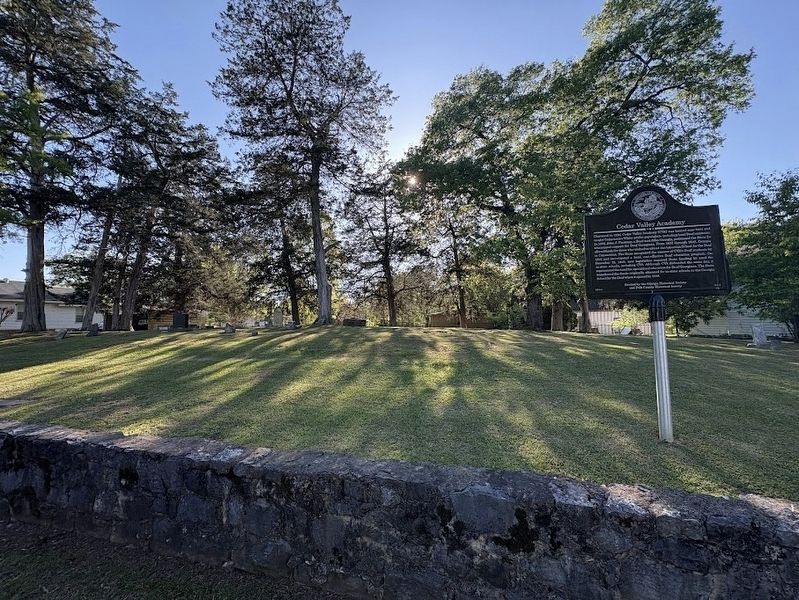
Chartered in 1834, Cedar Valley Academy (CVA) was located near here and taught Cedartown's White settler population, including local Deaf residents. In 1833, John J. Flournoy, a Deaf man from Georgia, petitioned the State for educational support for . . . — — Map (db m270297) HM
Civil War veteran Samuel Fisher Tenney, a Georgia native, graduated from the University of Georgia and from a South Carolina seminary in 1868. He moved to Crockett two years later, following a pastorate in Marshall, Texas. For 54 years Tenney served . . . — — Map (db m219492) HM
North of here on Madden Branch in Polk County, Tennessee, on November 29, 1864, during the American Civil War, six Georgians trying to enlist in the U.S. Army—Thomas Bell, Harvey Brewster, James T. Hughes, James B. Nelson, Elijah Robinson, . . . — — Map (db m47731) HM
Munn Park was established in 1884 as a town square in Lakeland's first subdivision, the original Munn's Subdivision. Later the entire block was dedicated by Abraham Munn as a "Public Square" in perpetuity, to forever remain in public ownership. . . . — — Map (db m53649) HM
The earliest known inhabitants in the Cedartown area were the Cherokee Indians, who had taken over the surrounding territory from the Creek Indians in the 1760's. Cherokee settlements in the area were known as Char'le Town, Cedar Town and Clean . . . — — Map (db m197547) HM
Like most of Appalachian Tennessee, Polk County was a divided land during the Civil War.
Residents formed both Confederate and Federal units. Benton, the county seat, was a regional crossroads, but Ducktown, where the Burra Burra Copper Company . . . — — Map (db m178020) HM
This building, completed in 1869 and renovated in
1981, stands on the site of the first Georgia Railroad
Freight Depot, one of the major railroad structures in
downtown Atlanta during the Civil War. In 1860
Atlanta was Georgia's 4th largest . . . — — Map (db m142540) HM
Cedartown developed from the original town plan that resulted from Asa Prior's division of land that included a courthouse square on the north side of the tract. The lots surrounding the square were planned to be sold as commercial lots. The Rome . . . — — Map (db m197545) HM
Northwest Georgia is blessed with many limestone springs. When Van Wert was founded, hollowed out chestnut and cedar logs were fashioned to bring spring water from nearby hills into the village, making it one of the first communities in Northwest . . . — — Map (db m197537) HM
Tennessee
Polk County
Established 1839; named in honor of
James Knox Polk
Born in North Carolina. 1795. Served,
State House of Representatives: Member
of Congress and Speaker House of
Representatives: Governor of . . . — — Map (db m289217) HM
Settlers from Georgia and the Carolinas began arriving in the Socrum area in the 1840s, before the creation of Polk County in 1861. In August 1851, preaching with baptism was offered at Wm. T. Rushing's homestead at Indian Pond, named for Seminole . . . — — Map (db m104024) HM
The 1870 U. S. Census lists most area settlers as farmers from the upland south. One such family was that of Dr. Alexander Murchiso, who arrived from Polk county, Georgia. Through his efforts the Methodist church organized in Apr. 1871. In the . . . — — Map (db m164263) HM
Main Street Cedartown has always been a top choice for the area's parades, festivals and special events. From the annual fall festival held each October, to Shriner's Parades, Homecoming Parades, and all sorts of political rallies, concerts, and . . . — — Map (db m197583) HM
Side 1
Davenport City Hall was built in 1927 in the Mediterranean Revival style by Streater Brothers Construction Company of Lakeland, Florida at a cost of $15,054.00. The architectural firm, Scroggs & Ewing, of Augusta, Georgia, designed the . . . — — Map (db m268175) HM
The first courthouse in the area was a frame building erected in Van Wert in 1838. When Cedar Town was made the county seat of the newly formed Polk County in 1851, Asa Prior sold land to the new county for a new courthouse for $1,200. The two story . . . — — Map (db m197540) HM
The first bridge crossing the Withlacoochee River at this site was built in the 1850s by slaves belonging to James Lanier. Replaced several times during the following century, the bridge served lumber, turpentine and cattle operations along with . . . — — Map (db m213957) HM
Thin black lines indicate changes in relevance. Between each pair of lines entries are ordered geographically but all have the same relevance.
* Inflectional forms of words are their plurals, singulars, and possessives as well as gramatical tenses and similar variations.