Vermont, Morrisville History & Art Walk Historical Markers
A self-guided walking tour featuring plaques about the people, buildings, Civil War relics and public art in Morrisville’s historic downtown. The route, marked by a green line painted on the sidewalk, is less than a mile.
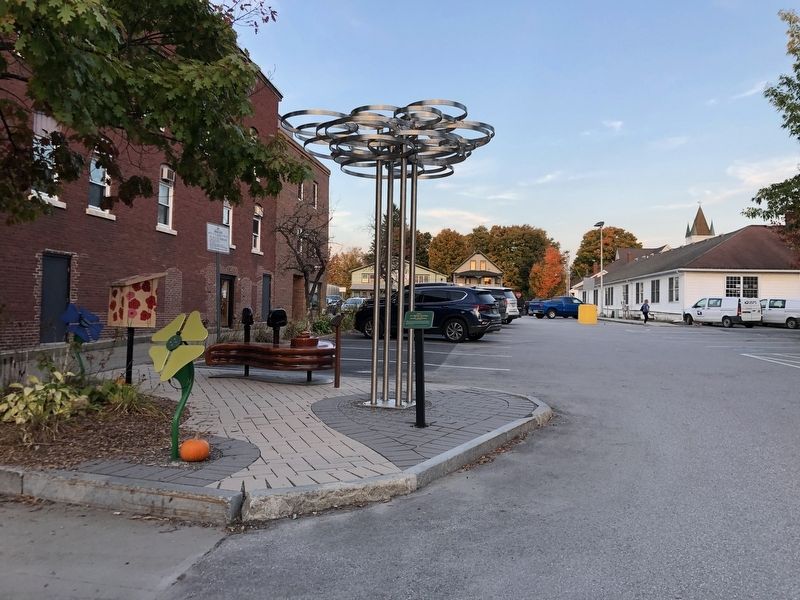
On Portland Street north of Upper Main Street (Vermont Route 12), on the right when traveling north.
from a series of three
Gordon Auchincloss
Stainless steel
Spiral Canopy, one in a series of arboreal-inspired sculptures designed to accentuate important Morrisville institutions, is composed of repeating tiers of stainless steel . . . — — Map (db m261402)
On Portland Street (Old Vermont Route 100) at Bridge Street (Old Route 100), on the right when traveling south on Portland Street.
The Bijou Theatre has operated almost continuously on this site for more than 100 years. The original Bijou, constructed in 1910, was one of the earliest theaters in Vermont to show “talkies”. It was razed in 1937 and this building was . . . — — Map (db m261792) HM
On Lower Main Street (Vermont Route 12) west of Congress Street, on the left when traveling west.
Dewey K. Hickok (1824-1890) of Morrisville was an inventor and a dealer of patent rights. On July 19, 1887, he received a patent for his new invention, a washing machine. Mechanically creative, Hickok also patented a number of other inventions, . . . — — Map (db m261365) HM
On Portland Street (Old Vermont Route 100) north of Brigham Street, on the right when traveling north.
The Elmore Block is a well-preserved, two-story clap-board commercial block with a rectangular false front and Italianate-style bracketed cornice. It also displays an unusual and locally distinctive architectural trait, decorative “ears” where . . . — — Map (db m261774) HM
On Lower Main Street, on the right when traveling east.
The three buildings of the Ferris Block were built circa 1900, each a three-story flat-roofed commercial building. The Ferris building on the far right of the photo was rebuilt in 1949. The upper floors of each building were rental apartments. . . . — — Map (db m261356) HM
On Portland Street at Upper Main Street ( Route 12), on the right when traveling north on Portland Street.
The Fleetwood/Peck Block is a commercial block built in the Greek Revival/Italianate style. Originally constructed as a three-story building, it was known as the Powers and Gleed Block, and later the Fleetwood Block. The Masonic Temple was on . . . — — Map (db m261399) HM
On Upper Main Street (Vermont Route 12) at Pleasant Street, on the right when traveling west on Upper Main Street.
Dr. Horace H. Powers (1807-67) was one of Morristown's original doctors. During the Civil War, he traveled to Virginia to treat wounded Union soldiers. His son H. Henry Powers (1835-1913) became an attorney, served in both the Vermont House and . . . — — Map (db m261397) HM
On Upper Main Street east of Congress Street, on the right when traveling east.
The first building on this site was a church built in 1840. After it was consumed by fire in 1852, a second church was erected in 1865, and it remains largely unchanged to this date. In 1965, with waning church membership, the property was . . . — — Map (db m261370) HM
On Park Street at Richmond Street, on the right when traveling west on Park Street.
Morristown Centennial Library
1912
In 1910, the Town Of Morristown purchased this site, known as the Kelsey property, with the intention of building a library. The building received funding from industrialist Andrew Carnegie on March 18, . . . — — Map (db m261380) HM
On Lower Main Street (Vermont Route 12) east of Portland Street, on the right when traveling west.
The Munson Block is a three-story, flat-roofed, commercial building constructed in 1904 for Harlan P. Munson to house his general store, which also sold feed and hardware in addition to dry goods. Besides the Munson General Store, over the . . . — — Map (db m261754) HM
On Lower Main Street at Brigham Street, on the right when traveling east on Lower Main Street.
In 1816, Jedediah Safford deeded three-quarters of an acre of land on Main Street to David P. Noyes, who built the Village's first general store in 1835. Noyes continued to own and operate the store until 1866, when he sold it to George J. . . . — — Map (db m261759) HM
On Lower Main Street (Vermont Route 100) at A Street, on the right when traveling south on Lower Main Street.
This exceptional brick federal home was built for Jedediah Safford, son of Morrisville's first resident, John Safford. In 1947, the Village of Morrisville, with funding from the Alexander H. Copley Trust, bought the house for use as a community . . . — — Map (db m155274) HM
On Upper Main Street (Vermont Route 12) west of Pleasant Street, on the right when traveling west.
Puffer United Methodist Church's history in Morristown goes back over 200 years. The Society first formed in Morristown Corners and moved to its present site in 1874, when a small chapel was constructed. The chapel was moved to the back of the . . . — — Map (db m261398) HM
On Pleasant Street at Hutchins Street, on the right when traveling north on Pleasant Street.
Before the Civil War, most public education in Vermont was in one-room schools. Any Morristown student wishing to attend high school had to go to Johnson, Bakersfield or a distant boarding school. In 1847, the village of Morrisville purchased a . . . — — Map (db m261794) HM
On Portland Street (Old Vermont Route 100) south of Brigham Street, on the right when traveling south.
The Tegu Theatre opened to great fanfare and operated as a theater from 1937 to 1957. When it closed the building was converted into a grocery store. The building became the town offices via lease in 2005 and it was purchased for the same . . . — — Map (db m261787) HM
On Park Street (Vermont Route 15A) at Upper Main Street ( Route 12/15A), on the right when traveling west on Park Street.
Governor George W. Hendee, the only governor of Vermont from Morrisville, had this house built in 1878. Mr. Hendee went on to represent Vermont in the Unites States House of Representatives from 1873 to 1879.
This house is a 2½-story, . . . — — Map (db m261388) HM
On Upper Main Street (Vermont Route 12) at Park Street ( Route 15A), on the left when traveling east on Upper Main Street.
The Soldier's Monument & War Memorial
In June 1910, the town voted to erect a Soldier's Monument in Academy Park. Made of Barre granite, the base is 10 feet square, 24 feet high and surmounted by a twelve-foot bronze statue of a color . . . — — Map (db m261372) HM
On Lower Main Street (Vermont Route 12) at Portland Street, on the right when traveling west on Lower Main Street.
The Union Savings Bank and Trust Company opened for business in July of 1891. By June 1892, the business had grown into this building at 20 Lower Main Street. Union Bank has expanded over the years into the rebuilt Green Mountain Block on the . . . — — Map (db m261403) HM
On Upper Main Street (Vermont Route 12) west of Park Street ( Route 15A), on the right when traveling west.
The Congregational Church is the oldest church organization in Morristown, dating back to 1807. The building is the most architecturally significant church in Morrisville today. The original construction, a wood frame structure based on the . . . — — Map (db m261396) HM
On Portland Street (Old Vermont Route 100) at Brigham Street, on the right when traveling south on Portland Street.
Dr. George Woodward, a homeopathic physician and surgeon, erected this 2½-story Italianate-style commercial block in 1880. The façade's distinctive form, with its large arched roofline, gives it an unusual character. The upstairs was . . . — — Map (db m261781) HM