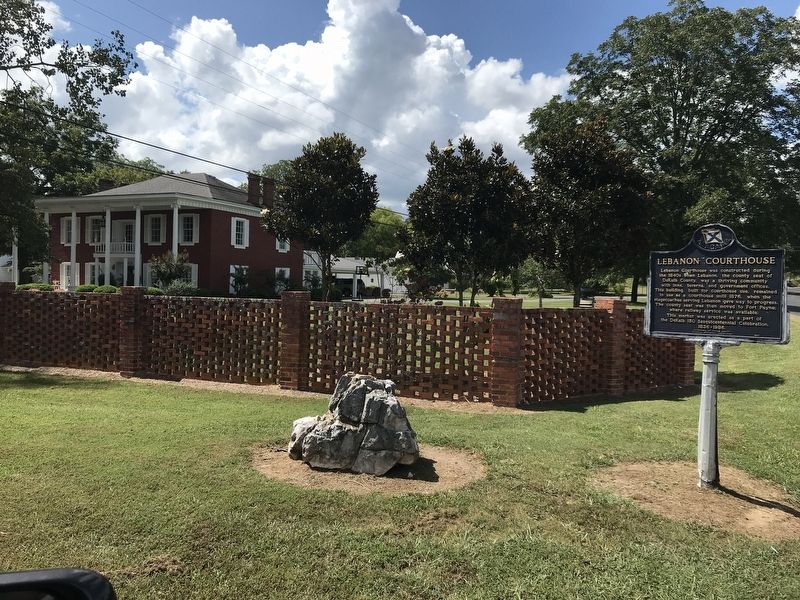
On County Road 52 at County Road 293, on the left when traveling west on County Road 52.
Lebanon Courthouse was constructed during the 1840s when Lebanon, the county seat of
DeKalb County, was a thriving community with inns, taverns, and government offices. This building, built for courthouse use, remained in use as a courthouse until . . . — — Map (db m156255) HM
On Glenn Boulevard SW (Alabama Route 35) at Airport Road West, on the right when traveling west on Glenn Boulevard SW. Reported missing.
The first detachment of 1,103 Cherokees to emigrate under their own officers, prior to leaving for the west held a final council at Rattlesnake Springs (near present-day Charleston, TN) and, by unanimous vote, declared their intentions to . . . — — Map (db m261860) HM
On McCurdy Avenue North (State Highway 75) at Main Street (State Highway 35), on the right when traveling south on McCurdy Avenue North.
Built in 1931 by the McCurdy family, the home's interior was lined completely with cedar wood and the floor made of hand selected quarter-sawed oak. Beveled glass was in the windows and doors. Home to a delicatessen in the 1980s, plans were being . . . — — Map (db m156252) HM
Near Interstate 59 1 mile north of County Road 140, on the right when traveling south.
A Cherokee town founded 1770. Situated on Big Wills Creek, named for a half-breed chief, Red-Headed Will. A place of importance in the Cherokee Territory, it was the home of Sequoyah, inventor of the Cherokee Alphabet; John Ross, the last chief of . . . — — Map (db m213367) HM
On Gault Avenue North (U.S. 11) at 5th Street Northtwest, on the right when traveling west on Gault Avenue North.
Opened Sept. 1890. Built during local boom period. Converted into theatre during era of silent movies. Closed as a theatre in October, 1935. Purchased by Landmarks of DeKalb County, Inc. 1969. Renovated, restored and reopened to public in 1970. The . . . — — Map (db m83686) HM
On Edgewood Avenue SE at Park Place NE, on the right when traveling west on Edgewood Avenue SE.
[Main marker]
SunTrust Bank played a key role in the New South's economic growth in the late nineteenth and twentieth centuries and became the largest bank headquartered in Georgia. In 1891 the Georgia General Assembly chartered the . . . — — Map (db m187137) HM
On Gault Avenue North (U.S. 11) east of 4th Street, on the right when traveling east. Reported missing.
Born in Tennessee, Sequoyah moved to Wills Town (DeKalb County, Alabama) area of the Cherokee Nation in 1818.
Here, in 1821, he invented an 86 symbol alphabet providing the Cherokees with the only written Indian language in the United . . . — — Map (db m261859) HM
On Fulton Industrial Boulevard (Georgia Route 70) at Boat Rock Road SW, on the right when traveling south on Fulton Industrial Boulevard.
Sand Town (Oktahatalofa) and Buzzard Roost (Sulecauga) were two frontier Creek Indian communities here on the Chattahoochee River. The old Sand Town Trail extended westward to the Coosa River in Alabama and eastward into what is now DeKalb County. . . . — — Map (db m14157) HM
On North McDonough Street at West Trinity Place, on the right when traveling south on North McDonough Street.
[First panel]
Illegally sentenced in a DeKalb County court to four months of hard labor on a false traffic charge, Dr. Martin Luther King Jr. put systemic injustice on trial in the court of public opinion.
[Second panel]
How Dr. . . . — — Map (db m197667) HM
Thin black lines indicate changes in relevance. Between each pair of lines entries are ordered geographically but all have the same relevance.
* Inflectional forms of words are their plurals, singulars, and possessives as well as gramatical tenses and similar variations.