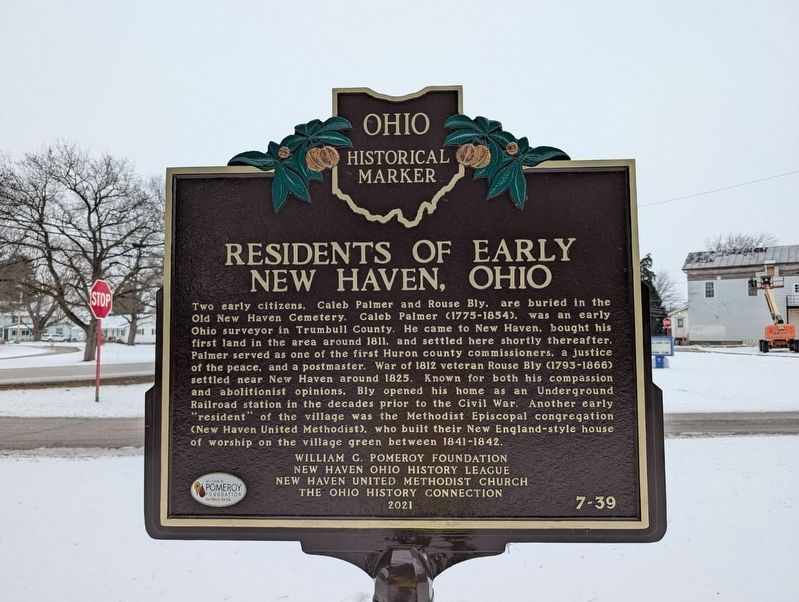
On Prairie Street east of North Street (Ohio Route 61), on the right when traveling east.
Historic New Haven, Ohio. New Haven, Ohio. was the mercantile center of southwest Huron County during the first half of the 19th century. Residents described immense wagons, or "land schooners," lined up for miles on the New Haven-Worthington . . . — — Map (db m309232) HM
On Cleveland Road West at Main Street when traveling east on Cleveland Road West.
The Wright House and the Underground Railroad. In the early 1800s, Jabez Wright, an early Huron County judge, purchased a large tract of lakeside land on the north side of what is now Cleveland Road. There Wright built an eight-room . . . — — Map (db m41809) HM
On East Old Lake Road at Lands End Drive (U.S. 6), on the left when traveling east on East Old Lake Road.
Almon Ruggles, Surveyor of the Firelands. Almon Ruggles (1771-1840) came to Ohio from Connecticut in 1805 and led survey teams that divided the Firelands section of the Connecticut Western Reserve into townships. The Firelands was territory . . . — — Map (db m226455) HM
Madison Gregory was born in Huron County, Ohio in 1848. He married Ester Randall on December 26, 1870 in Kankakee County, Illinois. Three daughters were born to them in Kankakee County-Lillie Gregory Martin, Jennie Gregory, and Ethel Gregory . . . — — Map (db m125356) HM
On West Main Street at South High Street, on the right when traveling east on West Main Street.
School
The citizens of Jeromesville have always taken a great interest in their youth and they have gone to great lengths to provide them with proper training. For many years, the chil- dren of Jeromeville attended school in . . . — — Map (db m298167) HM
On East Main Street at South Railroad Street, on the right when traveling west on East Main Street.
Garrett Augustus Morgan (1877-1963). Garrett Morgan, born in Kentucky, made Cleveland his home in 1895. Famous for his inventions, Morgan blazed a trail for African Americans with practical social activism. In 1908, frustrated by Cleveland's . . . — — Map (db m261844) HM
On River Road 0.3 miles south of East Mason Road, on the left when traveling south.
Camp Avery
1811 One-fourth mile southwest from the site on the brow of the hill overlooking the eastern bank of the Huron River, Gen. Simon Perkins, commanding the Ohio Militia, built the fortifications and block house of Camp Avery for protection . . . — — Map (db m41909) HM
On Park Street east of Ohio Street, on the left when traveling east.
Huron. • Early Indian Village and French trading post, 1749. • First white settlement in Western Reserve — Jean Baptiste Flemmond, 1790. • Surveyed 1806 by Almon Ruggles. • Site of first school in Firelands area 1810 — Alvin Coe and . . . — — Map (db m141647) HM
On East Main Street (U.S. 20) at Northwest Street (Ohio Route 269), on the left when traveling east on East Main Street.
Built in 1846, the Tremont House was opened by Loel and Samuel B. Chandler as a hotel to serve stagecoach traffic on the Maumee Pike (U.S. Route 20). This Bellevue landmark has housed grocery and hardware stores, a pharmacy, and even a cigar . . . — — Map (db m135370) HM
Near Ohio Route 4 0.3 miles south of Route 113, on the right when traveling south.
The Underground Railroad In Lyme Township, Huron County
Historic Lyme Village is helping to preserve some of the local history related to the Underground Railroad. The Seymour House, which is now located in this recreated village, was one . . . — — Map (db m204760) HM
On Settlement Road (County Route 129) 0.1 miles east of Route 61.
The Society of the Precious Blood, established in Italy in 1815, began its American ministry here in Peru in January 1844, led by Swiss missionary Father Francis de Sales Brunner. Continuing the work begun by the Redemptorists at St. Alphonse in . . . — — Map (db m147180) HM
On Main Street at William Street, on the right when traveling east on Main Street.
Among the first residents of Biddulph Township were free blacks from Cincinnati, Ohio who settled in the area in the fall of 1829. They were welcomed after Ontario's Lieutenant-Governor, Mr. John Colborne
stated that Ontarians "do not know men by . . . — — Map (db m274402) HM
On N. Main Street, on the left when traveling south.
Milan
Birthplace of Thomas A. Edison, February 11, 1847.
A Moravian village, Pequotting, 1804–1809.
First permanent white settlers came in 1816.
Milan village platted, 1817; incorporated February 23, 1833.
Ship’s canal to . . . — — Map (db m90656) HM
Sandusky • Early Indian village of Ogontz; also French & British trading post. •
1816 – platted as town of Portland; English version of Indian name, “San Dus Tee,” adopted in 1818. •
First Connecticut settlers arrived in 1817. •
1848 – . . . — — Map (db m262016) HM
On Main Street (Ohio Route 60) north of Ohio Street, on the right when traveling north.
Vermillion. Founded 1808, incorporated 1837.
• Settled by Connecticut “Firelanders.”
• Name derived from red banks along river.
• Old Indian Fort, up river, famous for giving protection to Vermilion Tribe and roving bands. . . . — — Map (db m147774) HM
On Benjamin Franklin Highway (U.S. 224) at Section Line Road (County Route 30), on the right when traveling west on Benjamin Franklin Highway.
The Western Reserve
Southwest Boundary Marker
of the Connecticut Western Reserve
conveyed to the United States, September 11, 1786
erected by
the Early Settlers Association
of the Western Reserve, Cleveland, Ohio
July 3, 1966
Early Settlers . . . — — Map (db m94715) HM
Left plaque
When Benedict Arnold in the late days of the American Revolution ravaged the state of Connecticut he burned the farm houses along his route. In 1792 these farmers were given land grants in the "Firelands,"- Erie and Huron . . . — — Map (db m146192) HM
Between June 9, 1856, and July 6, 1860, ten separate Handcart Companies left Iowa
City, Iowa, or Florence, Nebraska to their land of Zion in the Utah Territory. There were
653 handcarts and 50 wagons.
Nearly 3,000 souls, some with babes in . . . — — Map (db m59369) HM
Thin black lines indicate changes in relevance. Between each pair of lines entries are ordered geographically but all have the same relevance.
* Inflectional forms of words are their plurals, singulars, and possessives as well as gramatical tenses and similar variations.