123 entries match your criteria. Entries 101 through 123 are listed.⊲ Previous 100
Birmingham Civil Rights Heritage Trail Historical Markers
Over 100 markers throughout downtown, are at significant locations along the 1963 Civil Rights march routes. Designed as a self-guided tour, the trail speaks to the valor of both common people and to the spiritual leaders who spearheaded the fight against segregation and other forms of racism.
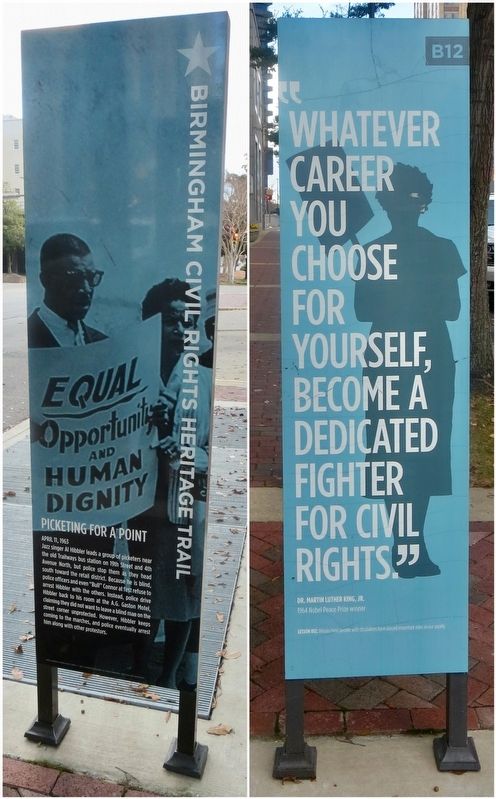
Rev. Shuttlesworth recruited Dr. King and the SCLC to build publicity for
the Birmingham Movement, King invited popular jazz singer Al Hibbler,
one of the first celebrities to take part in the “Project C" marches. King
hoped Hibbler's arrest . . . — — Map (db m187782) HM
Birmingham Blacks had no love for police, who often harassed and brutalized them rather than protect them from bombings and violence.
Some policemen were suspected Ku Klux Klan members or sympathizers.
Public Safety Commissioner Eugene “Bull” . . . — — Map (db m73032) HM
Built 1952, 1501 7th Ave. N.
Poole Funeral Chapel served as a “safe haven” for demonstrators during “Project C's” mass civil rights demonstrations in
April - May 1963. In 1957, its owners, brothers John and Ernest
Poole, came to the rescue . . . — — Map (db m187905) HM
White businessmen failed to integrate their stores and remove "Colored”
signs from water fountains and dressing rooms as promised in 1962. As
a result, Miles College students led by Frank Dukes organized a boycott
against the stores. They . . . — — Map (db m187758) HM
Built 1924 (remodeled for offices in 1995), 413 16th St. N.
Judge Helen Shores Lee bought this one-story building, a
garage from the U.S. Post Office, in 1995 and turned into a law
center to honor her father, pioneer civil rights lawyer . . . — — Map (db m188192) HM
Built 1911, 1530 6th Ave. N.
Sixteenth Street Baptist Church was designed by Wallace
Rayfield, a renowned Black architect. It was among
Birmingham's most prominent African-American churches.
By the time of the 1963 Birmingham Movement, it . . . — — Map (db m187523) HM
Built 1959, 1410 & 1414 6th Ave. N.
Sixth Avenue Zion Hill Baptist Church hosted strategy and mass meetings during the Birmingham Movement. It also served as the departure points for the April 12, 1963, Good Friday march to City Hall, led . . . — — Map (db m244958) HM
Built 1973, 708 15th St. N.
St. John AME Church and Day Care Center are on the site of
the former church that hosted Monday night mass meetings
during the early 1960s. It was also a center where “Project
C" leaders came to strategize about . . . — — Map (db m187892) HM
Built 1904; Renovations 1948-51, 1500 6th Ave. N.
St. Paul United Methodist Church was the site of the first
mass meeting held on Dec. 26, 1956, following the ACMHR's
(Alabama Christian Movement for Human Rights) first
major direct action . . . — — Map (db m187868) HM
Built 1949, 1622 4th Ave. N.
This small, one-story, brick commercial taxi stand building was
constructed after the passage of a 1930 City of Birmingham
ordinance that required separate taxi services for Blacks
and Whites. Rev. George . . . — — Map (db m188185) HM
A key player in the Birmingham civil rights drama was Public Safety
Commissioner Theophilus Eugene Connor. He earned the nickname
"Bull” because of his booming voice as a radio sports announcer. White
voters who supported his politics of racial . . . — — Map (db m187780) HM
After nearly a month, “Project C” seemed on the verge of collapse. The
presence of Dr. King and the SCLC did not rally Black Birmingham behind
the Movement as leaders hoped. The media began to lose interest and
the White community basically . . . — — Map (db m187840) HM
Rev. Bevel and his team worked with popular disc jockeys "Tall Paul”
Dudley White and Shelley “The Playboy" Stewart, whose jive talk on the
radio was actually a secret code that told young foot soldiers when it
was time to "move out.” Despite . . . — — Map (db m187770) HM
Built 1925, 1616-1622 4th Ave. N.
Located in the Historic Fourth Avenue Business District next to
the taxi stand and Colored Masonic Temple, this building
housed one of Birmingham's few hotels for Black travelers. It
also housed restaurants . . . — — Map (db m188186) HM
Dr. Martin Luther King, Jr., hoped to gain more national attention for the
Birmingham campaign by planning marches during Holy Week - on Palm
Sunday, Good Friday and Easter Sunday. But "Bull” Connor created serious problems for King. Connor got a . . . — — Map (db m187834) HM
By the end of April 1963, the national media and local Whites were
losing interest in “Project C.” Fewer Blacks volunteered to be arrested at
downtown stores and lunch counters. So, Rev. James Bevel, a field
Secretary with the SCLC, turned to a . . . — — Map (db m187765) HM
Ministers in 60 Black churches across the city played key roles in the
Birmingham Movement. In the mass meetings, ministers fired up their
working-class members and encouraged commitment to the struggle
against segregation with revival-style . . . — — Map (db m187529) HM
Built in the 1940S, 4th Ave. N. & 19th St. N.
On Mother's Day in 1961, the Freedom Riders, Black and White
members of the Congress for Racial Equality (CORE), arrived at
Birmingham's Trailways bus station. Though integrated . . . — — Map (db m187994) HM
C28 Side
Built 1921, 1800 5th Ave. N.
Lawyers like Arthur Shores and Thurgood Marshall (shown
with Autherine Lucy, the first Black student to integrate the
University of Alabama) filed numerous lawsuits challenging
racial . . . — — Map (db m188003) HM
For seven years before the 1963 Birmingham Campaign, Rev. Shuttlesworth
and other leaders of the ACMHR taught masses of Black citizens how
to take direct but non-violent actions to gain first-class American
citizenship. Inspired by faith, these . . . — — Map (db m187787) HM
April 1916
On April 10, 1916, the U.S. Supreme Court heard a
case from Louisville, Kentucky, where it was illegal
to sell homes to Blacks in areas where Whites lived.
The high court's 1917 decision in Buchanan v. Warley
said Louisville's . . . — — Map (db m189158) HM
1937
Starting in the 1920s, demand for all housing in
Birmingham increased year after year as the
population grew. Residential areas zoned for
"Negroes,” however, remained the same. By the
1940s, surging Black demand and a postwar . . . — — Map (db m189168) HM
1936
Slum clearance became another facial zoning
Weapon. City health officials described. "Negro
quarters” as the unsanitary source of diseases that
threatened community health: Civic leaders used this
reasoning to win millions in federal . . . — — Map (db m189164) HM
123 entries matched your criteria. Entries 101 through 123 are listed above. ⊲ Previous 100