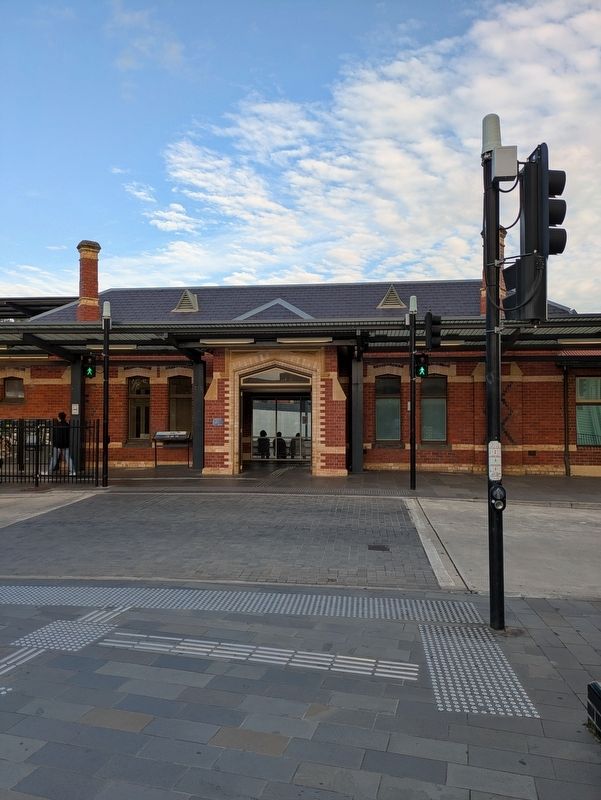
On Railway Place 0.1 kilometers west of Maroondah Highway, on the left when traveling west.
Brick Station Building 1889
The brick station building was constructed in 1889 following the extension of the railway line from Ringwood to Upper Ferntree Gully.
It is a rare example of Tudor style and features a red tack-pointed . . . — — Map (db m297046) HM
On Station Street 0.1 kilometers east of James Street.
Conscription and Honours
Ringwood kept above the Victorian quota of providing 10% of eligible men to serve overseas. Dame Nellie Melba often visited Ringwood to support recruitment and fundraising. Two national conscription referenda were . . . — — Map (db m301808) HM WM
On Maroondah Highway (Victoria Route 34) at Stud Road ( Route 9), on the left when traveling west on Maroondah Highway.
This Q.F. 25 Pounder Field Gun was presented to the City of Ringwood by the Ringwood Sub-Branch of the Returned Services League on Armistice Day 1975.
D.F. Snowball, E.D., Sub-Branch President.
R.J. Martin, J.P., Mayor.
Service: World . . . — — Map (db m297770) WM
On Maroondah Highway (Victoria Route 34) 0.1 kilometers east of Railway Place, on the left when traveling west.
The Railway was a Catalyst for the development of Ringwood
Rural activity, orchards, brick manufacturing and antimony mining underpinned early history in the area of Ringwood and kept the railway busy.
In 1882, the first year of the . . . — — Map (db m297053) HM
On Maroondah Highway (Victoria Route 34) at Stud Road ( Route 9), on the left on Maroondah Highway.
In Memory of those who made the Great Sacrifice
The Great War 1914-1919
Johnston C.H. ∙ McCann H.W. ∙ MacKinlay H.W. ∙ Mitchell L. ∙ Morris J. ∙ Palmer E.R. ∙ Parker J.J. ∙ Pollard L.H. ∙ . . . — — Map (db m298339) WM
On Station Street at Greenwood Avenue, on the left when traveling east on Station Street.
Ringwood Methodist Church memorial windows
Alexander Edgar was a dynamic preacher and persuasive evangelist who headed the establishment of the first Central Methodist Mission. He and his wife Katherine came to Ringwood in 1911.
They . . . — — Map (db m297430) WM
Near Greenwood Avenue 0.1 kilometers north of Caroline Street.
Ringwood Primary School - 1921
The first Ringwood State School No. 2997 was built in 1889 on the corner of Ringwood Street and Maroondah Highway. The original foundation stone is now to the right. The school was transferred to this site in . . . — — Map (db m297431) HM
On Station Street at Kendall Street on Station Street.
This memorial plaque is dedicated to the members past and present of Ringwood RSL Women's Auxiliary whose tireless efforts have materially contributed to the work of Ringwood RSL.
Lest We Forget. — — Map (db m301811) WM
On Maroondah Highway (Victoria Route 34) 0.1 kilometers east of Railway Place, on the left when traveling west.
Ringwood Signal Box
Constructed in 1926 to address the increase in trains arriving and departing the junction station after the electrification of the line.
The Ringwood Signal Box was based on early Victorian railway designs . . . — — Map (db m297051) HM
On Railway Place 0.1 kilometers west of Maroondah Highway, on the left when traveling west.
1882
In 1882 the Melbourne to Hawthorn rail network was extended east to the suburb of Lilydale via Ringwood. The extension was a catalyst for the development of Ringwood and resulted in churches, banks and schools being built to service . . . — — Map (db m297047) HM
On Maroondah Highway (Victoria Route 34) at Warrandyte Road, on the left when traveling west on Maroondah Highway.
Ringwood WWI Memorial Clocktower
The Ringwood Memorial Clocktower was constructed as a lasting memorial to those who served during the First World War.
It was erected as a result of public subscription plus a 500 pound grant from the . . . — — Map (db m297294) WM
On Station Street 0.1 kilometers west of James Street, on the left when traveling west.
Ringwood's WWI Casualties
The Rooney family had four orchards on Mullum Mullum Road, Ringwood. There were five boys and one girl in the family, aged thirteen to twenty-two.
Twenty-year-old Norman enlisted in August 1914. Six days . . . — — Map (db m301807) HM WM
On Maroondah Highway (Victoria Route 34) 0.1 kilometers west of Railway Place, on the left when traveling west.
Ringwood's WWI home front
The Australian Red Cross Society was founded on 13 August, 1914, nine days after the outbreak of WWI. The Ringwood ladies quickly responded and five days later they formed one of the first Australian branches, the . . . — — Map (db m297428) WM
On Station Street at Kendall Street, on the left when traveling west on Station Street.
Ringwood's WWI Honour Boards
Many churches and schools in Ringwood raised money to create honour boards to hang in a prominent position in their buildings.
Honour boards were displayed in the Ringwood Mechanics Hall, St Paul's . . . — — Map (db m301809) HM WM
On Maroondah Highway (Victoria Route 34) 0.1 kilometers west of Railway Place, on the left when traveling west.
Sending off the WWI Troops
The Ringwood community was extremely proud of their volunteers, while understanding the danger and potential loss of life. Large crowds would attend send offs, most times in the Ringwood Mechanics Institute Hall . . . — — Map (db m297429) WM
On Maroondah Highway (Victoria Route 34) at Wantirna Road ( Route 9), on the left when traveling west on Maroondah Highway.
WWI Enlistment
After Federation in 1901, the Commonwealth Military Forces provided the framework for militia regiments such as Brighton Rifles (46th Battalion), 10th Australian Light Horse Regiment, 24th Battalion and 48th Battalion, each . . . — — Map (db m297292) WM
On Maroondah Highway (Victoria Route 34) at Wantirna Road ( Route 9) on Maroondah Highway.
WWI Peace and Celebrations
The Armistice between the Allies and Germany was signed in Paris on 11 November, 1918 and marked the end of WWI.
In Ringwood the celebrations could be best summed up via this report from the Box Hill . . . — — Map (db m297204) HM
On Maroondah Highway (Victoria Route 34) 0.1 kilometers east of Railway Place.
WWI Recruitment
Ringwood recruitment levels were generally not an issue as volunteers were numerous. With a population of approximately 1,000 people, everyone knew each other, so there was little chance of eligible men being overlooked. . . . — — Map (db m297202) WM