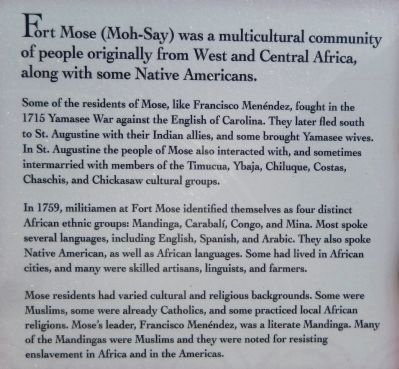
Fort Mose (Moh-Say) was a multicultural community of people originally from West and Central Africa, along with some Native Americans.
Some of the residents of Mose, like Francisco Menéndez, fought in the 1715 Yamasee War against the . . . — — Map (db m289706) HM
Fort Mose (Moh-Say) was a multicultural community of people originally from West and Central Africa, along with some Native Americans.
Some of the residents of Mose, like Francisco Menéndez, fought in the 1715 Yamasee War against the . . . — — Map (db m289706) HM
During the 18th century, thousands of enslaved Africans faced starvation, torture, and even death on their journey to the Americas, a voyage known as the middle passage.
What was the Middle Passage?
The Middle Leg of a 3-part Voyage:
. . . — — Map (db m289711) HM
Once in English Carolina, the enslaved Africans were forced into labor and had no legal standing and few rights.
Africans labored on indigo plantations, and as lumbermen and cattlemen. They produced materials for shipbuilding and cleared . . . — — Map (db m289677) HM
In 1693, Spain’s King Charles II proclaimed that any English slave who reached Spanish Florida would be granted freedom upon converting to Catholicism.
By sea and land, Africans fled to St. Augustine on a dangerous journey with a strong . . . — — Map (db m126966) HM
In 1738, after more than 100 runaways arrived from Carolina, the Spanish governor established Fort Mose.
As Africans continued to flee Carolina, frontier skirmishes between the English, Spanish, and their Native American allies threatened . . . — — Map (db m289675) HM
In 1740, the English attacked St. Augustine, but departed after a bloody battle at Fort Mose.
Georgia Governor James Oglethorpe invaded Florida with a sizable force, including Lower Creeks and Uchise Indian allies. Fort Mose inhabitants . . . — — Map (db m126968) HM
Twelve years after the Bloody Mose battle, Mose residents returned to the frontier and constructed a second fort and community.
Mose's fort, houses, and surrounding fields were destroyed during the siege of St. Augustine. From 1740-1752, . . . — — Map (db m289676) HM
Spain ceded Florida to England in 1763, and Mose residents departed with other colonists for Cuba.
During Fort Mose's final years, life on the frontier grew more difficult. Constant attacks by English and Indian raiding parties drove . . . — — Map (db m289707) HM
All that remains of Fort Mose is underground - on the island before you, and in the surrounding salt marsh.
Working together, archaeologists and historians have pieced together the story of Fort Mose using historic documents, maps, aerial . . . — — Map (db m289671) HM
On the shore of Robinson Creek, ¼ mile east of this marker, was the site of a Spanish mission for Indians left homeless during Queen Anne's War. Since 1688, Negro slaves from the English colonies had found refuge in Spanish St. Augustine. On . . . — — Map (db m126969) HM WM
On the shore of Robinson Creek, ¼ mile east of this marker, was the site of a Spanish mission for Indians left homeless during Queen Anne's War. Since 1688, Negro slaves from the English colonies had found refuge in Spanish St. Augustine. On . . . — — Map (db m126969) HM WM