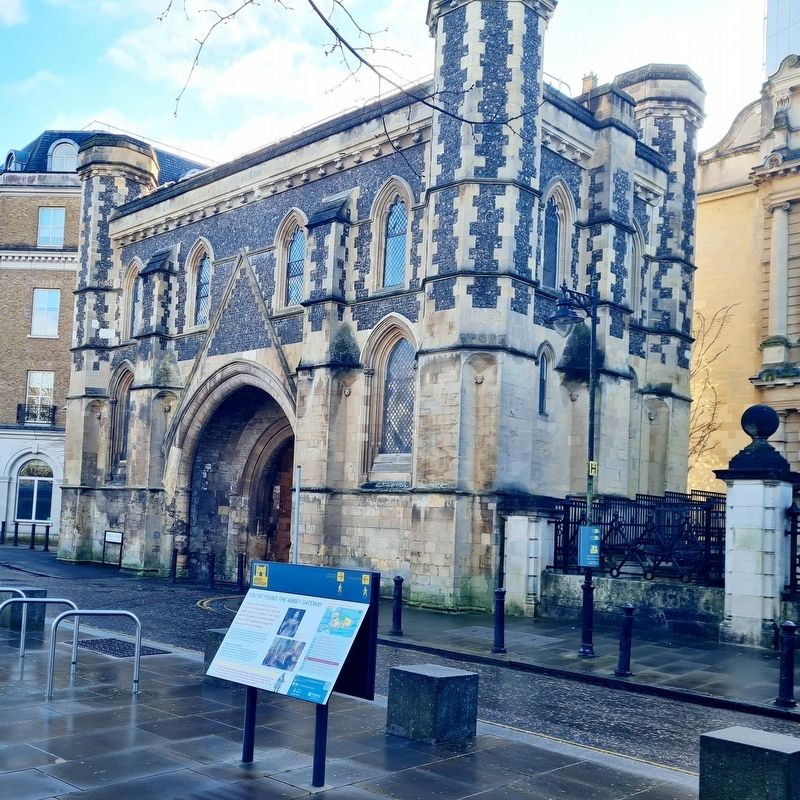
This gateway divided the monks' private living quarters from the more public areas of the abbey. In the 1560s, Queen Elizabeth I turned the abbot's house, which stood just through the gateway, into a royal palace.
After Elizabeth's death, the . . . — — Map (db m241888) HM
You're standing in what used to be the practical, service end of Reading Abbey. In the yard surrounding you was a dormitory where abbey servants or guests slept, the refectory (dining hall) where monks ate their meals, and the abbey kitchen. The . . . — — Map (db m241890) HM
You are now entering Forbury Gardens. In medieval times this was a rough patch of open ground, where horses grazed and pilgrims waited for services at the abbey church. At this time it was known as 'the Forbury'.
The Forbury became a town park . . . — — Map (db m242648) HM
In 1643, during the Civil War, this hill was part of a ring of defences hastily dug out by an army defending Reading from attack. The walls of the abbey were also used as part of the defences.
The attacking army (Parliamentarians) wanted . . . — — Map (db m243511) HM
Today Reading Abbey stands in ruins, but at one time this was one of England's most important religious centres, housed in spectacular and beautiful buildings. Here monks lived a secluded life, following the rules of St Benedict, spending most of . . . — — Map (db m246320) HM
You are now at the heart of the monks' private quarters, at one corner of the cloister. This was a large square courtyard, 44 metres across.
It was surrounded by a covered walkway, bounded by ornately carved stone columns You can see some of . . . — — Map (db m253846) HM
This is the chapter house. Senior monks met here every day to discuss abbey business and order punishments for monks who had broken the abbey rules. Every meeting began with a reading of a chapter from the Bible, so the room became known as the . . . — — Map (db m254053) HM
In front of you and slightly to the right is the base of a massive pillar, or pier, which once towered 6 metres above the floor of the abbey church.
Through the arch supported by this pillar and its neighbour was the presbytery or choir. This . . . — — Map (db m253821) HM
This is the south transept of the abbey church. It feels large but it's just a small part of the overall area of the church.
Monks in business
Running an abbey as big as Reading was expensive and monks could not afford to ignore . . . — — Map (db m253361) HM
Today the ground in front of you drops away. before gradually rising again towards the chapter house wall. The ground was dug out in the 1640s, during the Civil War, and was later landscaped in Victorian times, to create a performance space within . . . — — Map (db m253786) HM
The building opposite was once Reading Abbey's Hospitium (guesthouse). Pilgrims and other visitors to Reading could stay here for two nights, for free, so long as they went to services at the abbey church.
The dormitories were in the building . . . — — Map (db m230554) HM
Who lost his life in a whirlwind at the Great Western Railway Station Reading on the 24th March 1840 Aged 24 Years
Sudden the change, in a moment fell and had not time to bid my friends farewell, Yet hushed be all complaint, 'tis sweet, 'tis . . . — — Map (db m218890) HM
You are standing in the area of the abbey warming room, where a fire was kept alight from All Saints' Day (1 November) to Easter. Monks were allowed to visit for short periods to warm up - there was no other heating at the abbey.
Behind you, in . . . — — Map (db m253851) HM
To the Memory of Laurenthes Braag a Danish Merchant
born in the land of St Croix in the West Indies 21 July 1783 and died as a Prisoner of War on Parole in Reading the 3 of Sept. 1808 in the 26th Year of his Age.
He lived esteemed and beloved by . . . — — Map (db m230484) HM WM
The Glorious Dead
1914 - 1918
1939 - 1945
To the honoured memory of the men of Reading and Berkshire who gave their lives for King and Country during the Great Wars — — Map (db m216275) WM
This has always been the heart of Reading's shopping district. Until the 1860s it was densely packed with rows of half-timbered houses.
Street names like Pig Market. Butter Market, Fisher Row and Butcher Row are clues to what medieval shoppers . . . — — Map (db m254290) HM
Phoebe Cusden MBE (1887 - 1981) lived here from 1927 to 1980 As Mayor of Reading she co-founded the Reading-Dusseldorf Association in 1947
Educationalist - Peace campaigner - Socialist - Feminist - Borough Councillor — — Map (db m216055) HM
In the early years of Quakerism there were many inspirational ministers, including most notably George Fox (1624-1691).
Quakers first arrived in Reading in 1654. They met at the home of Thomas Curtis who ran a woolen draper's shop at a site . . . — — Map (db m230051) HM
Erected and lighted for ever, at the expence of Edward Simeon Esqr. as a mark of affection to his native town.
A.D. 1804.
Lancelot Austwick Esqr. Mayor. — — Map (db m230046) HM
AD 1914 - 1919
In Memory of those who have given their lives for their King and Country
Grant them O Lord eternal rest and let light perpetual shine upon them — — Map (db m230043) WM
This church is called Reading Minster. In the 1550s it was rebuilt, using stones, timber, lead and tiles from Reading Abbey. Henry VIII had closed the abbey in 1539 and building materials from the site were re-used all over Reading.
Tower . . . — — Map (db m253368) HM
This market place was created by the monks of Reading Abbey in the 12th century. They deliberately placed it close to the abbey's main entrance, next to St Laurence's church to your left.
Reading's weekly market was held here for hundreds of . . . — — Map (db m253367) HM
If the abbey church was standing today, you would be on the north side of the nave, looking towards the high altar.
The 'Reading Abbey Stone'
In 1835 excavations in the abbey church uncovered a large stone, brightly painted in red, . . . — — Map (db m253355) HM
To your right the Holy Brook flows into the River Kennet. The stretch of bank where they join was once the abbey's wharf.
Stone to build the abbey was unloaded here, as were important supplies like firewood and wine. All boats heading up to . . . — — Map (db m253372) HM
This enormous sculpture commemorates 328 members of the Royal Berkshire Regiment. They were killed at the Battle of Maiwand in Afghanistan in 1880.
The war was intended to counter Russian influence in Afghanistan by putting a ruler friendly to . . . — — Map (db m253783) HM
The refectory was where monks had all their meals. It was a large, grand space and was also used to host important royal meetings.
The refectory was built at the top of a slope and to be sure that this huge wall stayed upright, there were . . . — — Map (db m253364) HM