Ohio Friends of Freedom Underground Railroad Sites Historical Markers
The Friends of Freedom Society was organized in 1996 to preserve historic locations of the Underground Railroad across Ohio and honor those who participated.
George Gammon (1803? – 1904) and his wife, Sarah Bradley (1808- 1902) built this house c.1850 on land purchased from her parents. The gammon and Bradley families were among the many free black Springfield citizens who actively operated the . . . — — Map (db m157027) HM
Side A Runaway slaves used a web of routes through Crawford County, most going through the city of Bucyrus. Present-day State Route 98 to State Route 4, laid out in 1822 from Norton in northern Delaware County through Bucyrus to Sandusky in . . . — — Map (db m107079) HM
Side A
Called “Station Hope” by many freedom seekers on the
Underground Railroad, St. John’s was one of their final stops.
Though aiding freedom seekers was a crime and often could
not be described in public documents, Sheila T. . . . — — Map (db m140134) HM
Side A
The home of Horatio Cyrus and Martha Cozad Ford
stood near this corner. According to interviews
conducted in the 1890s, it was a stop on the
Underground Railroad. Of New England background,
Horatio brought a set of ideals that made . . . — — Map (db m140135) HM
Delaware County: Anti-Slavery Stronghold
A unique combintation of strong-principled religous communities, free black settlements, and tightly knit extended families fostered a wide-spread attitude of willful defiance that made Delaware one of . . . — — Map (db m12829) HM
Side A No one was more fiercely committed to the Underground Rail Road
than former slaves.They knew first-hand the darkness and despair
of bondage. Such was Abraham Depp (1791- 1858), known as Abram,
born a slave on a tobacco plantation . . . — — Map (db m108067) HM
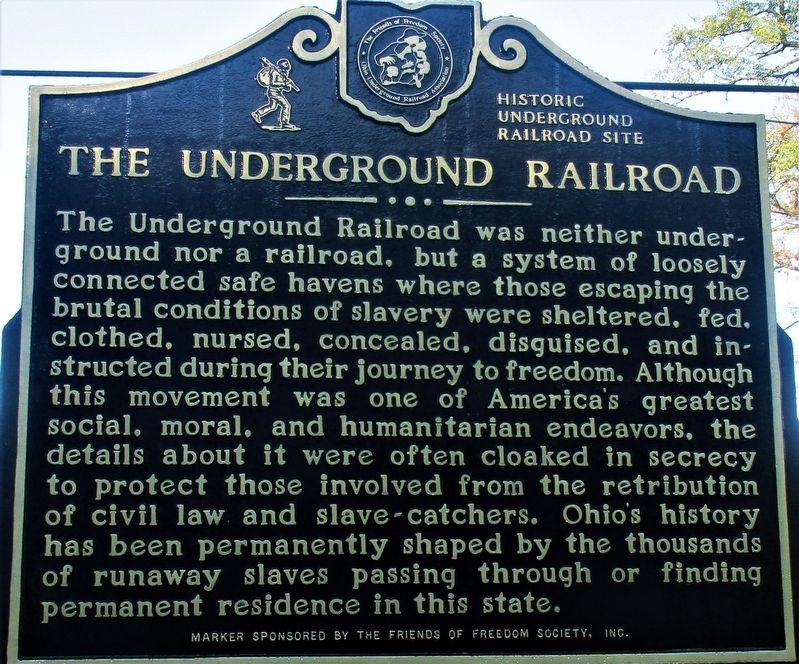
Marker Front: The Underground Railroad was neither underground nor a railroad, but a system of loosely connected safe havens where those escaping the brutal conditions of slavery were sheltered, fed, clothed, nursed, concealed, disguised, and . . . — — Map (db m241233) HM
Side A
Recognized by many as “one of the most active communities in Southwestern Ohio, the Bloomingburg area was a significant link in the Underground Railroad. As many as twelve to sixteen escaped slaves were said to have been passed . . . — — Map (db m121781) HM
When Fernando Cortez and Sophia Stone Kelton built this house in 1852, it was the last residence on East Town Street and was surrounded by pastureland. Ardent abolitionists, the Keltons were members of the local antislavery society. Family . . . — — Map (db m42170) HM
Second Baptist Church - Columbus' Oldest Black Baptist Church, 1836. Second Baptist Church cordially received its independence as a mission church from the First Baptist Church on January 7, 1836. Rev. Ezekiel Fields was chosen as pastor . . . — — Map (db m17174) HM
Alum Creek & The Underground Railroad
The fifty-eight miles of Alum Creek run north to south originating in Morrow County and continues through Delaware County into Franklin County, where it empties into the Big Walnut Creek, draining into . . . — — Map (db m103301) HM
Dr. Wilbur Henry Siebert (1866-1961) organized one of the most extensive historical collections on the Underground Railroad in the United States. Siebert served as a professor of history at the Ohio State University, 1893-1935. His collection on . . . — — Map (db m17416) HM
The Underground Railroad was neither underground nor a
railroad, but a system of loosely connected safe havens
where those escaping the brutal conditions of slavery
were sheltered, fed, clothed, nursed, concealed, disguised,
and instructed . . . — — Map (db m10251) HM
Bishop William Hanby, (1807-1880) courageous and of strong convictions, publicly voiced his scorn at a law that made it a felony to give food to a hungry slave, or shelter to a friendless man. From pulpit, platform, and workbench he condemned the . . . — — Map (db m13118) HM
Side A:
The African Methodist Episcopal Church was organized in 1818 as the Bethel Church. In 1868 its present name, John Gee, was adopted when the church was erected and rededicated at this present site on land donated by Gee. Founders of . . . — — Map (db m30582) HM
The Underground Railroad In Lyme Township, Huron County
Historic Lyme Village is helping to preserve some of the local history related to the Underground Railroad. The Seymour House, which is now located in this recreated village, was one . . . — — Map (db m204760) HM
By 1816, Mount Pleasant had earned a reputation among fugitive slaves as a town where they would be welcomed in their quest for freedom. The Quakers who lived in the village helped Mount Pleasant become a center of antislavery activity. Many . . . — — Map (db m288742) HM
The Fugitive Slave Act of 1850 increased the punishment for
abolitionists and rewards to those whom facilitated their capture
and return to owners.
This led to the routes to the East and West being more difficult to
navigate from Columbus to . . . — — Map (db m140252) HM
A key junction on the Underground Railroad in Oberlin, Ohio connected at least five routes that led from slavery to freedom. No fugitive in Oberlin was ever returned to bondage. Freedom seekers lived openly in the town, and were supported by its . . . — — Map (db m144166) HM
The Underground Railroad
The Underground Railroad was neither underground nor a
railroad, but a system of loosely connected safe havens
where those escaping the brutal conditions of slavery
were sheltered, fed, clothed, nursed, concealed, . . . — — Map (db m92076) HM
The Underground Railroad
The Underground Railroad was neither underground nor a railroad, but a system of loosely connected safe havens where those escaping the brutal conditions of slavery were sheltered, fed, clothed, nursed, concealed, . . . — — Map (db m94909) HM
In the year 1798, several prospectors traveled north from their North Carolina homes in search of new lands for themselves and their friends. Four of these known Quaker prospectors were John Mast, Jr., Martin Davenport and David Hoover from North . . . — — Map (db m19749) HM
History of Alum Creek Friends Settlement. The first settler was Cyrus Benedict, his wife, three children, and Adam Vanduser in 1809. He built a cabin near South Woodbury in 1811. Meetings were held in a house from 1813 – 1815. The first . . . — — Map (db m85263) HM
Nelson T. Gant as one of Zanesville’s most prominent African American citizens. Born into slavery on the Woodburn Estate of John Nixon of Loudoun County, Virginia on May 10, 1821, Nelson was given is freedom by the provisions of his master’s will in . . . — — Map (db m43961) HM
(Front): A tale of two cities. During the time of the Underground Railroad, Zanesville and Putnam were two communities separated by the Muskingum River with two distinct moral views. The people in Zanesville were proslavery, in Putnam . . . — — Map (db m5624) HM
Side 1 Payne Cemetery (1852-1945) is the only remnant of a freed African American community known as Paynes Crossing. Research indicates that the area was involved in the Underground Railroad Movement, and may have been established expressly . . . — — Map (db m86103) HM
The Underground Railroad
The Underground Railroad was neither underground nor a railroad, but a system of loosely connected safe havens where those escaping the brutal conditions of slavery were sheltered, fed, clothed, nursed, concealed, . . . — — Map (db m21994) HM
An Elm Grove abolitionist maintained a lonely Underground Railroad station where he provided safety for escaping enslaved persons. These fugitives were attempting to travel the unfriendly route from Houston Hollow in Scioto County to safe places . . . — — Map (db m59368) HM
The Underground Railroad
The Underground Railroad was neither underground nor a railroad, but a system of loosely connected safe havens where those escaping the brutal conditions of slavery were sheltered, fed, clothed, nursed, concealed, . . . — — Map (db m189183) HM
The town of Franklin Mills, now Kent, was active in the Underground Railroad. Many residents aided fugitive slaves in their flight north toward Canada. In 1825 at their tavern on Mantua Street, Joshua and Rebecca Woodard gave shelter to a group . . . — — Map (db m292789) HM
The Underground Railroad
The Underground Railroad was neither underground nor a railroad, but a system of loosely connected safe havens where those escaping the brutal conditions of slavery were sheltered, fed, clothed, nursed, concealed, . . . — — Map (db m207605) HM
The first known attempt to assist a runaway slave in Ross County
was recorded in 1815, when local residents assisted a slave to
safety in Franklin County. Quakers, the Presbyterians and African
Americans were the principal participants who . . . — — Map (db m146892) HM
[Marker Front]:
Methodism was known in Chillicothe as early as 1796. During the early years, 1803-1821, both African American and white Methodists worshipped together in a small brick church, located on the north side of Second Street . . . — — Map (db m14665) HM
In July 1824, David Nickens assisted by the Rev. Nathan Cory and Rev. William White brought together a group of people in his home for the purpose of organizing a Baptist Church. The new church selected the name of the First Regular African . . . — — Map (db m202515) HM
Many heroic men and women joined forces with others in a vast network that helped fugitive slaves secure freedom. Three groups of people were most active in the Underground Railroad movement in Ross County. They were the Presbyterians, the Quakers . . . — — Map (db m118737) HM
The Underground Railroad
The Underground Railroad was neither underground nor a railroad, but a system of loosely connected safe havens where those escaping the brutal conditions of slavery were sheltered, fed, clothed, nursed, concealed, . . . — — Map (db m189182) HM
The Crossing at Scioto County (front)
The Ohio River was a formidable obstacle for escaping slaves. Many runaways from Kentucky were aided by James Poindexter, an African-American barber and local resident, who picked up fugitives in . . . — — Map (db m59411) HM
The Underground Railroad. The Underground Railroad was neither underground nor a railroad, but a system of loosely connected safe havens where those escaping the brutal conditions of slavery were sheltered, fed, clothed, nursed, concealed, . . . — — Map (db m221322) HM
On this site was the home of Richard Elson, co-founder of the village of Magnolia. As a young man he built flat boats, loaded them with merchandise to sell and traveled down the Ohio and Mississippi Rivers. He did this seven times and walked the . . . — — Map (db m159661) HM
Hudson had a long tradition of being an anti-slavery town. By 1826, records show that the town's founder, David Hudson, was hiding runaway slaves at his home. Early settler Owen Brown and his family helped organize the Underground Railroad in . . . — — Map (db m189296) HM
Leicester King
Born in Connecticut in 1789, Judge Leicester King and his wife Julia Ann Huntington King, moved to Warren in 1817 from Westfield, Massachusetts. He was one of the principle promoters of the Pennsylvania and Ohio Canal, which . . . — — Map (db m65445) HM
A predominantly Quaker community in its early days, Springboro served as a hospitable thoroughfare for many runaway slaves on their way north to freedom. Between 1815 and 1864, Springboro was host to numerous safe-houses and many agents and . . . — — Map (db m227946) HM